Tamil Nadu Assembly Elections 2026: Experiments of a Tamil Nativist
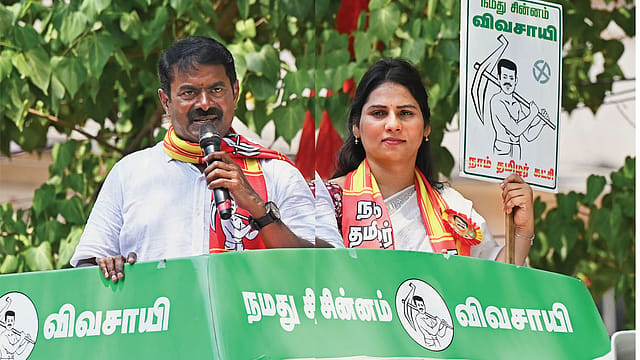
ROSHINI, THE ONLY transwoman contesting the Tamil Nadu Assembly polls, runs a trust that takes care of disadvantaged sections of society, including the elderly abandoned by their families. Born and raised in Tiruchirappalli, she (Roshini identifies as a woman) is now a candidate of Seeman-led Naam Tamilar Katchi (NTK) from Villivakkam near the state capital Chennai. Roshini, 29, says she entered politics because she got attracted to the “ideology” of Seeman, a former filmmaker and actor who boasts of a presence across the state and promises a break from the deeply entrenched Dravidian politics here.
The 59-year-old Seeman is an interesting politician, asserts political commentator and former journalist K Venkataramanan, who has closely watched the actor’s trajectory. A former foreign correspondent in Colombo, Venkataramanan views the claims of Seeman having met the slain LTTE head Velupillai Prabhakaran with scepticism. “He is known to cook up stories, too. He claims once in a while that he had met him,” Venkataramanan says, outlining the factors that make Seeman a colourful figure in the world of Tamil politics dominated for far too long by two Dravidian parties, Dravida Munnetra Kazhagam (DMK) and All India Anna Dravida Munnetra Kazhagam (AIADMK), besides others who tried to ape them in policies and political messaging. Meanwhile, the claims and counterclaims about Seeman having met Prabhakaran in Sri Lanka during the Civil War around 2008 keep surfacing. While Seeman claims that he was served turtle meat by the Tigers in Lanka during his visit, close relatives of the former LTTE chief and others deny any such incident.
Venkataramanan notes that Seeman stands out in Tamil politics because he champions Tamil nationalism and accuses the Dravidian parties of having diluted its purity. “Basically, Dravidian parties find Seeman radicalist and nativist. NTK was born as a reaction to Dravidian politics which has a pan-South Indian perspective,” he avers, emphasising that for Seeman, this is unacceptable because he sees them as entities that are a “fig leaf” intended to promote Telugu, Kannadiga and Malayali interests.
This is primarily because the Justice Party, founded first as the South Indian Liberal Federation in 1916 in Madras, exhibited that kind of pan-South Asian politics because its leaders who championed non-Brahminism included Dr C Natesa Mudaliar, Sir Pitti Theagaraya Chetty and Dr TM Nair. Then when Periyar happened, it continued to retain similar interests. Seeman, who was earlier pro-Dravidian, later turned against the ideals of Periyar and other founders of the movement, suggesting that they were busy upholding ethnic interests of Telugus, Kannadigas and Malayalis. Venkataramanan also highlights that Seeman is not only a purist in that sense, but also against various long-held traits of Dravidian parties: competitive populism and competitive welfarism. NTK is opposed to doling out freebies and against industrial growth of the kind that deprives villagers of their land and allegedly impoverishes them.
In sharp contrast to traditional Dravidian parties, Seeman accommodates Brahmins, LGBTQ people such as Roshini, and has famously fielded candidates in 234 of Tamil Nadu’s constituencies, 117 women and 117 men. He has fielded 10 Muslim candidates although his wish was to name 15, but could not do so for logistical reasons. According to Seeman, Brahmins are natives of Tamil Nadu who have saved the language from perishing, which is why they need to be given political representation, as he has done, in a departure from the state’s Dravidian parties, the bedrock of whose politics was the fight against the Brahminical order.
Seeman holds in high esteem UV Swaminatha Iyer (1855– 1942), whom various language experts and historians laud for digging up and preserving ancient Tamil literature. Iyer had collected thousands of palm-leaf and paper manuscripts and written close to 100 books—which is why the man is often referred to as Tamil Thatha (Tamil grandfather).
Among the six Brahmin candidates handpicked by Seeman— in a state where such acts are rare—is V Anusha from the T Nagar constituency. A Chennai-based lawyer, V Anusha spoke to Open about why she was attracted by the leadership of Seeman and the ideology of NTK. “While Dravidian parties and other parties trying to make an impact here do not field Brahmin candidates, he shows no caste discrimination. When others promise free bus transport to even men besides women, he says nothing will be free. Instead, he says, you pay a little bit and I will offer you air-conditioned buses and help you improve your living standards. He also has great ideas to help revive the state’s rural economy and uplift the urban poor, but not through freebies,” says Anusha, who has represented clients in the Supreme Court and various high courts. She adds that other key takeaways of Seeman’s party are protection of the Tamil language and cultural identity; safeguarding of Tamil Nadu’s land, rivers and natural resources; corruption-free and transparent governance; and priority to local people’s rights and sustainable development.
Now, apart from projecting himself as someone who can offer an alternative to the prominent Dravidian ideology in the state, Seeman takes pride in fielding Dalit candidates from general seats, again not a common practice in the state with the probable exception of when the late Chief Minister J Jayalalithaa did it. His mission, he says, is to replace Dravidian parties in the state, which he alleges are morally bankrupt because of family rule and institutionalised corruption. As regards Tamilaga Vettri Kazhagam (TVK) actor-turned-politician Vijay, Seeman has said in interviews to the local media and others that he sees him offering no alternative to Dravidian politics because he follows leaders of the Dravidian movement such as Periyar.
Over the past 15 years or so, NTK has managed to grow and secure a good percentage of votes unaffiliated to the two major Dravidian parties. For a party that runs vibrant campaigns like the one in Villivakkam and T Nagar, NTK has in the 2024 Lok Sabha polls won about 36 lakh votes in the state, or 8.22 per cent of the total vote share, rising from just less than 4 per cent in 2019. Seeman hopes to spread awareness about greater inclusion in Tamil politics and improve his tally this time around.
Seeman is a breakaway from the usual mould of Tamil politicians because he has different views about Brahmins, freebies and Tamil nativism. He sees Brahmins as early occupants of the Tamil region, thanks to the evidence of Chaturvedi mangalams, Brahmin settlements established by South Indian kings such as the Cholas, Pandyas and Pallavas. In his work Caste, Class, and Power: Changing Patterns of Stratification in a Tanjore Village (1965), André Beteille (1934–2026) had noted, “Villages containing ‘communities of learned Brahmins’ seem to have existed, and to have constituted a distinctive type, from fairly early times. During the Chola period they were referred to as mangalam or chaturvedi mangalam. Later, the term Agraharam came into use to refer to a community of Brahmins.”
Seeman, despite not attracting any electoral breakthrough like the one Telugu Desam Party (TDP) had under NT Rama Rao in the 1980s, has remained in the limelight, attracting controversies and making implosive statements for at least 15 years now, refusing to align with any of the Dravidian parties. In 2013, he had invited then JKLF chief Yasin Malik to a pro-Tamil meeting in Cuddalore, arguing that “JKLF was not a banned organisation and there was nothing wrong in inviting his ‘Kashmiri brother’ to Tamil Nadu.” He was also quoted by the media as stating that “India is one country from Kashmir to Kanyakumari.” For someone who had worked as an assistant director with Bharathiraja and Manivannan, he has had ups and downs in his film career. Seeman, who had campaigned early in his political career for the DMK alliance and Pattali Makkal Katchi (PMK), had spent a brief period in jail over his inflammatory comments against the Sri Lankans. Later, he grew distant from Dravidian politics and embraced Tamil nationalism.
Now, as he campaigns relentlessly across the state, Seeman continues to provoke the Dravidian behemoths and attacks their icons while hoping to trigger a shift in the public mindset.