Stalin’S Hindu Problem
A “JUDGE’S… IMPEACHMENT UNDER arts. 218 and 124(4) can only be ‘on the ground of proved misbehaviour or incapacity’… [T]o invite politicians to use the weapon of impeachment of Judges is hardly desirable or far-sighted. Let us not forget that as many as 198 signatures of M.P.s were procured on a scandalous petition to the Speaker of the Lok Sabha to impeach Justice J.C. Shah, only because he had passed a wholly justified order against a corrupt government servant.”
This was Nani Palkhivala’s commentary on a dismissed civil servant’s petition for impeaching Justice JC Shah in 1970. This maiden petition for impeaching a serving Supreme Court judge was signed by 198 MPs. While the then Lok Sabha speaker disallowed it, Congress dug it out to launch a fresh round of a scurrilous campaign in 1977 when JC Shah was made the chief of a commission set up to inquire into Emergency excesses—the historic Shah Commission. The slander campaign ran in the pages of the notorious Surya magazine helmed by Maneka Gandhi.
Received wisdom tells us that Congress is the progenitor of every vile precedent after Independence—political, constitutional, and everything beyond. Its sustained vandalism of our democratic systems, processes and safeguards has an epic dimension and reminds us of another quote from Nani Palkhivala: “The survival of our democracy and the unity and integrity of the nation depend upon the realisation that constitutional morality is no less essential than constitutional legality. Dharma lives in the hearts of public men; when it dies there, no Constitution, no law, no amendment, can save it.”
Palkhivala’s use of the word ‘Dharma’ is not only significant but perceptive. Dharma as exposited in the Sanatana tradition is the root of universal sustenance, ethics, jurisprudence, order, and morality. It is the temporal application of the invisible cosmic law known as Rta.
In 1970, the whole judicial and legal fraternity stood as one body and successfully defended Justice JC Shah but a precedent had been set: the judiciary was not immune from political encroachment.
Fifty-five years later, the same script is unfolding. This time, its author is Congress’ ally Dravida Munnetra Kazhagam (DMK) and the target is Madras High Court Judge, GR Swaminathan. The motion to impeach him has been signed by 107 MPs hailing from parties fighting for survival but united by the rhetoric of secularism. The fallout of this outrageous move is also a redux of the JC Shah episode. Fifty-six retired judges of various high courts and the Supreme Court have retaliated with a statement condemning it as “a brazen attempt to browbeat judges” which “would cut at the very roots of our democracy and the independence of the judiciary.”

DMK and its opportunistic political buddies were aware that the motion to impeach Justice Swaminathan would fail even on the simplest of grounds: they just do not have the numbers in the Parliament. But the fact that they still went ahead appears strange. Does haste, valour or foolhardiness or all of the above explain the move? DMK’s ire against Justice Swaminathan ostensibly hinges on his order allowing the lighting of the Karthika-Deepam atop the sacred hill of Thiruparankundram, one of six Murugan Kshetras in Tamil Nadu. But when we read the litany of allegations against the judge, it reveals a fuller story.
Among other things, DMK MPs, in a 13-point representation given to the president and the Chief Justice of India (CJI) on August 12, accuse Justice Swaminathan of harbouring “continuous communal bias”, favouring “Brahmin advocates”, upholding “inhuman Hindu rituals”, like the Angapradakshinam, extolling Sanatana Dharma, expressing his reverence for Vedic culture and for the Kanchipuram Shankaracharya.
The judge, in brief, had violated every tenet sanctified in Dravidian mythology. The wording of the impeachment petition is also quite consistent with this tenor. The signatories accuse Justice Swaminathan of not adhering to the “secular functioning of the judiciary”. This is a terminological variation of Indira Gandhi’s diktat of wanting a “committed judiciary” for the proper functioning of democracy.
An old adage says that Indian secularism means branding Hindus as communal. A sense of this history also shows that secularism has caused the maximum number of communal riots in India; secularism brought down the disputed structure in Ayodhya and continues to keep several sacred Hindu spaces on the boil.
The DMK-led impeachment motion against Justice Swaminathan also has a simpler explanation: its desperation to retain power. Tamil Nadu Assembly elections are just months away and DMK’s prospects are anything but bright. Industrial-scale corruption, loot, political criminality, and the narcotics menace have made it perhaps the most hated DMK government since the party came to power almost 60 years ago. It also doesn’t help that both MK Stalin and his son Udhayanidhi have engaged in incessant bashing of Sanatana Dharma, likening it to malaria and dengue, which need to be eliminated.
What makes DMK’s position especially vulnerable is the unprecedented and tangible resurgence of Hindu Dharma in Tamil Nadu. In a way, the Athi-Vardar festival in 2019, which attracted huge crowds and put it on the global map, heralded this resurgence.
K Annamalai’s relentless rallies premised on the passionate Bhakti culture of the Tamil people made painful inroads into the sprawling Dravidian artifice of atheism and Hindu-bashing. While it did not translate into votes, the impact on the ground was real.
Meanwhile, a spate of high court judgments, especially regarding Hindu temples, traditions and rituals has also rattled DMK. A judgment as recently as December 9 orders that the HR&CE department cannot interfere with temple rituals. And then there is the other challenge posed by the political dark horse, actor Vijay.
Singling out Justice Swaminathan for impeachment is also a cheap but outdated imitation of DMK’s ideological ancestor EV Ramasamy Naicker (Periyar), who once accused the whole judiciary that it was unjust because it was filled with Brahmins. This exposes another weakness of DMK, perhaps its worst—the loss of M Karunanidhi. He is the only politician to have successfully straddled every coalition; he could pen hymns to Periyar and write a mellifluous script for a TV series extolling the life of Ramanujacharya. Even the notion of a petition to impeach a sitting judge wouldn’t have occurred in his imagination.
The Stalin-run DMK has essentially scored an own goal. But because it has targeted Justice Swaminathan solely for his order allowing the Karthika-Deepam at Thiruparankundram, we can examine it as such. It is clear that the DMK government’s defiance of his order is to appease and retain its Muslim vote bank. In the bargain, it seems to have antagonised not just the Hindus of Thiruparankundram but earned the wrath of millions of Murugan devotees throughout the state.
TAMIL NADU IS the only state in India to have preserved the Kaumara tradition with such passionate devotion. Kaumara is that which is related to Kumara or Skanda or Subrahmanya or Kartikeya or Shanmukha—or Murugan or Arumugan or Kandan in Tamil. The last time the Kaumara tradition flourished throughout North India was during the Gupta era. With its demise, this tradition almost became extinct in Uttarapatha. Today, North Indian Hindus know Skanda only as Kartik and his worship there is largely perfunctory.
The historical reason for the predominance of Murugan in Tamil Nadu is tied to—among other things—the relationship of the Pallava kings with the Gupta monarchs. Samudragupta defeated the Pallava ruler Vishnugopa but restored his kingdom with full honours. Centuries of cultural and devotional interchange between Uttarapatha and Dakshinapatha enabled the Murugan sect to attain full bloom in the Tamil country, which developed a special reverence for him. In that sense too, Tamil Nadu saved the best elements of the Kaumara Sampradaya (tradition) from receding into oblivion. We only need to visit the Mathura and Ujjayini Museums and look at the exquisite Skanda sculptures belonging to the Gupta era to understand the profound service of the Tamil people in preserving this hallowed tradition.
Such lived historical links also disprove the Dravidian mythology spun around an Aryan versus Dravidian enmity and a separate, ‘pure’ Dravidian nation.
The grandest explosion of piety towards Murugan occurs in the Karthika Masam. Its pan-Tamil Nadu showcase is the barefoot Kavadi Yatra covering the six sacred Skanda Kshetrams—Thiruparankundram, Tiruchendur, Palani, Swamimalai, Tiruttani, and Pazhamudircholai; roughly speaking, from the Kaveri Delta up to the Bay of Bengal. People are transformed into moving shrines carrying the Kavadi or burden on their heads; the profound symbolism of the Kavadi as an act of surrender is indescribable.
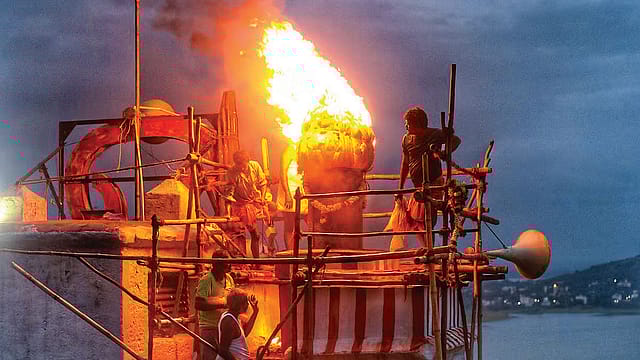
The Karthika Masam festival ends with the lighting of a lamp atop a pillar in various Murugan and Shiva temples; this tradition is of untold antiquity. Thiruparankundram is no exception.
The litigation on which Justice Swaminathan gave his verdict dates back to 1920. By permitting the lighting of the Kartika lamp on the Deepathoon atop the mountain, he has essentially upheld the previous order of the court, including the Privy Council. But his observations related to Muslim encroachments of temple lands in the sacred town seem to have irked DMK more than anything else. This element, too, has a recent context.
The public controversy regarding Waqf that erupted in 2022 began in Tamil Nadu, in the Tiruchendurai village, about 150 kilometres from Thiruparankundram. It spread like wildfire throughout India with shocking revelations—in almost every state, several Waqf bodies claimed entire villages as their private property. Likewise, largescale encroachment of temple lands by various Muslim outfits in Tamil Nadu is a live-wire issue simmering under the surface. Organisations like the Temple Worshippers Society, which are relentlessly battling this menace, have found themselves hounded and have met with little success.
Against this larger backdrop, the issue is not limited just to lighting the lamp atop the Thiruparankundram hill. DMK, caught in the thrall of its Muslim vote bank, seems to perceive that allowing the lamp-lighting would be the first act of a climbdown leading to unpredictable consequences.
ON ANOTHER PLANE, what is playing out at Thiruparankundram is a familiar old script enacted by the purveyors of secularism—of the capture and illegal occupation of sacred Hindu spaces by Islamic conquerors and the efforts of Hindus to liberate them. In each such case, Hindus have found themselves fighting prolonged court battles to merely rescue traditions and spaces that are in reality timeless, whereas dargahs and mazhars routinely sprout up on government land and go unchallenged. One only needs to read Sita Ram Goel’s second volume of Hindu Temples: What Happened to Them to get a comprehensive picture of this secularist perfidy. Unsurprisingly, the secularist camp has been quick to recast Justice Swaminathan’s judgment as the Bharatiya Janata Party’s (BJP) “Ayodhya moment in Tamil Nadu” and variants thereof. Indeed, it is quite incredible that in this litigation, the Tamil Nadu HR&CE department, which is meant to protect Hindu temples, was on the same side as the Managing Trustee of the Sikandar Badushah Dargah built on the Thiruparankundram hill.
Revisionist history tells us that this Sikandar ‘Badushah’ was a Sufi saint. However, the primary annals of Muslim and Hindu histories tell us that he was Sikandar Shah, the last king of the Madurai Sultanate which had ravaged the Meenakshi Temple and transformed the temple town into a wasteland for nearly 70 years. He was killed in a decisive battle at the hands of the Vijayanagara prince Kumara Kampanna who is celebrated in Tamil history as the “liberator of Madurai from the Tulukkans”. (The full story is available in The Madurai Sultanate: A Concise History by Sandeep Balakrishna.)
The aforementioned Dargah is supposed to be the spot where Sikandar Shah was buried. Over time, its vicinity was populated by numerous tombs of fakirs and is now an unambiguous Muslim enclave.
By judging such a complex issue solely on the touchstone of secularism inflicts multiple levels of deception. Justice Swaminathan’s order considers the issue from all these and other perspectives.
With or without the high court’s order, the DMK government should have ideally allowed the Murugan devotees to light the lamp peacefully. But it not only defied the court’s order but deployed strong-arm police tactics to restrain even the Central Industrial Security Force (CISF) personnel mandated by the court to accompany the devotees.
It appears that this was the final straw that led to the demand for Justice Swaminathan’s impeachment. As far as DMK was concerned, all bets were now off. Its anti-Sanatana Dharma rhetoric has now entered sinister territory. It is almost a declaration of war against the judiciary by targeting a specific judge, to make an example of him. Its tenor reminds us of EV Ramasamy Naicker’s chilling call to action in 1973: “Wherever we see a temple, we must go inside and break all the idols inside. Wherever we find a Paapaan [pejorative for Tamil Brahmanas], we must kill and destroy him… If one non-Brahmin Tamil dies while trying to kill one Tamil Brahmin, only three of us will die out of every hundred. Ninety-four per cent of us will still remain but Tamil Brahmins will be eliminated. We will definitely go to this level.”
That the impeachment petition was not only disallowed but met with deserved condemnation is perhaps one of the indicators that our democracy is still healthy and extreme ideologies are shown their rightful place.