Spare the Umpire
Sometimes facts hide in plain sight. Exasperated by Chief Election Commissioner (CEC) TN Seshan, a former cabinet secretary with a sedate record as a career bureaucrat, who had nevertheless discovered the full extent of his powers as CEC, the PV Narasimha Rao government rediscovered a remedy in the Constitution. Article 324(2), enacted in 1950, had always contained a provision for the appointment of election commissioners besides the CEC. The Election Commission of India (ECI) had indeed briefly been a three-member body from October 1989 to January 1990, before reverting to a single-member format, as had been the case for four decades.
Having realised the full extent of the immunity he enjoyed as head of an autonomous constitutional authority, Seshan ignored nudges and hints from the Rao government over the scheduling of by-elections and strictly enforced the model code of conduct (MCC), cracking down on the misuse of official machinery and the flow of unaccounted money during elections. He insisted that ECI’s requirements for the deployment of paramilitary forces for the conduct of elections be met fully. The appointment of senior bureaucrat MS Gill and former Law Secretary GVG Krishnamurthy as election commissioners on October 1, 1993 came as a bolt from the blue for Seshan who, despite his felicity with rules and the law, did not see it coming. He famously went to Tirupati and sat at the feet of Lord Venkateswara seeking a way out of his dilemma, but to no avail. On a more temporal note, his challenge before the Supreme Court failed, and ECI has since been a three-member body with all commissioners having an equal vote.
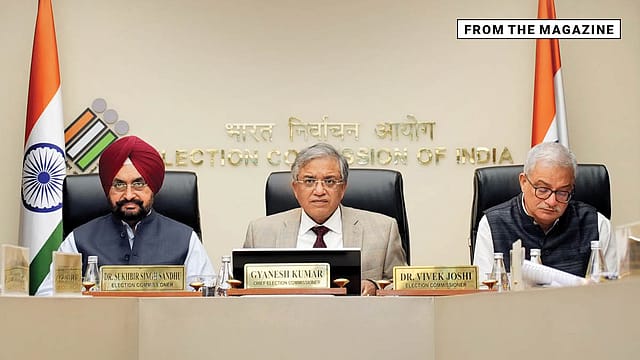
More than three decades later, ECI finds itself in the midst of an unprecedented controversy following reports in the Indian Express that two election commissioners— Sukhbir Singh Sandhu and Vivek Joshi—had, in 14 letters written over 10 months, raised objections to issues relating to the Special Intensive Revision (SIR) of the electoral rolls being carried out by ECI. Sandhu and Joshi are understood to have referred to the centralisation of databases, modifications to Form 6 for enrolling voters and administrative oversight of certain IT-related functions within the commission. They also wrote to the Cabinet secretary about the functioning of a deputy election commissioner (DEC), over what they held to be an arbitrary routing of files. The letters were essentially notes on procedures and processes relating to the execution of the SIR and changes to Form 6, used to enroll new voters or those whose names had been deleted. Although the issues were raised in apparent coordination by Sandhu and Joshi, neither expressed their reservations at formal meetings with the CEC. All decisions and orders regarding the conduct of the SIR were unanimous, according to ECI’s press release. The two dissenting ECs did not formally vote to thwart the CEC on the SIR and its conduct. Yet the controversy over the views they expressed quickly snowballed into a political confrontation between the I.N.D.I.A. bloc and the Modi government, with the Cockroach Janta Party (CJP) also jumping into the fray in the company of Left student groups.

The demand for the resignation of CEC Gyanesh Kumar, raised by Congress and other I.N.D.I.A. bloc members, inevitably reached the Supreme Court, which on October 6 decided to examine the process by which ECI issued orders relating to the SIR. The crucial question was whether Section 18 of the Chief Election Commissioner and Other Election Commissioners (Appointment, Conditions of Service and Term of Office) Act, 2023, which states that the commission’s decisions should be unanimous as far as possible and settled by a majority in other instances, was violated. As counsel for the petitioners argued that the CEC be restrained from taking decisions, the Supreme Court Bench headed by Chief Justice of India (CJI) Surya Kant said the presumption that Gyanesh Kumar had acted unilaterally had not been tested. The court would not proceed on the basis of assumptions, presumptions or claims in media reports.
A thorough examination of ECI’s internal record will likely settle the question at what stage of decision-making Joshi and Sandhu expressed reservations about the oversight, access and implementation of SIR exercises that have been completed for 20 states. It is unlikely to convince naysayers, in keeping with the polarised politics of the day, where several opposition parties—with Congress in the lead—have consistently levelled allegations of bias and prejudice against ECI. It is interesting that until not long ago, all three election commissioners were daubed as villains. Speaking at a rally in Sitamarhi during the campaign for the Bihar election in November 2025, Congress leader Priyanka Gandhi urged the audience to remember the names of Kumar, Sandhu and Joshi, said they would not be able to retire comfortably, and promised to name them at every rally. It was quite extraordinary for a senior politician to name serving election commissioners in such fashion, but the reference escaped adverse comment from the editorial class. Congress leader Rahul Gandhi has made repeated claims after every state election that the party has suffered reverses due to “stolen” votes or suspicious surges in voting in the closing stages of polling. So far, such claims remain unproved, but there is a pattern in making ECI the fall guy for repeated electoral reverses.
Before the SIR exercise, ECI found itself in the crosshairs of allegations that electronic voting machines (EVMs) had been “hacked” and results manipulated. Ahead of the 2019 Lok Sabha polls, senior opposition figures went to court demanding that EVMs be replaced with ballot-paper voting and made this a major argument in their election campaign. In the current face-off over the SIR too, Congress has reiterated the demand for a return to ballot paper, though the reliability of EVMs is not really a point of contention over the revision of electoral rolls. While media reports about the contending views within ECI do not support the conclusion that the SIR has been a flawed exercise, that is precisely the claim the I.N.D.I.A. bloc took to the streets. The demand for the resignation of the CEC is aimed at stalling the SIR process and daubing the electoral rolls in various states as tainted. It was in this context that Rahul Gandhi and other I.N.D.I.A. bloc leaders sought to march towards Nirvachan Sadan, where the EC is headquartered. This time round, Delhi Police did not allow the protesters to proceed and also prevented CJP from occupying Jantar Mantar, as it did in June when it rallied opinion over the leak of question papers for the medical undergraduate entrance examinations. The protests have created logjams in central Delhi as the I.N.D.I.A. bloc and CJP seek to prolong the agitation.
With the charges levelled against Gyanesh Kumar awaiting the apex court’s verdict, a parsing of the notes under scrutiny reveals that they were at times written after ECI’s internal meetings had concluded, and after the Supreme Court’s ruling upholding the revision of the electoral rolls. Further, the notes have been marked to the DEC and not the CEC. There does not appear to be any record of a formal dissent or disagreement, and on some occasions reservations were expressed after the relevant discussion had concluded. The representation to the Cabinet secretary is also puzzling: for one, the top civil servant has no role in the working of ECI and, in terms of protocol, ranks below the election commissioners. The subject of the communication is the commission’s internal reporting arrangements, a matter that hardly falls within the purview of the government.
The representation has brought a senior ECI official, closely associated with the National Informatics Centre and with programmes such as Aarogya Setu, messaging services, single sign-on and the National Knowledge Network, into the political spotlight. A stellar record as an operations person did not protect the officer from partisan commentary, despite no apparent violation of the commission’s internal procedures. Under an order dating back to December 1997 and still in effect, the DEC (Administration) is empowered to decide matters relating to appointments, routine transfers and postings of employees at and above the level of Section Officer (SO), and the transfer and posting of all personal staff of ECs and DECs. Joshi and Sandhu may have had a view on the routing of files or their supervision, but there was no apparent violation of ECI’s procedures and rules.
The controversy over Form 6 bears closer scrutiny too. A case currently being heard by the Bombay High Court pertains to a family that insisted it would be illegal for them to submit Form 6 as they had merely moved from one part of their constituency to another and had not shifted out permanently. The high court’s questions about whether the SIR may end up excluding citizens from voting caught media attention, but the EC counsel pointed out that the petitioners had failed to fill in the enumeration form during the special revision, and this meant their names were deleted from the electoral roll, which, under the SIR, is a de novo exercise. Form 8, seeking corrections to voter entries, cannot be submitted independently when the name of the voter is no longer on the rolls. The EC counsel carefully explained that it was incorrect to claim that submission of Form 6 would amount to a false declaration on the ground that the petitioner was neither a first-time voter nor someone who had shifted to another constituency. The simple point was that once a voter is deleted from the rolls, he is required to fill in Form 6 to be enlisted again. The person concerned applies for inclusion and becomes, in effect, a new voter in a different part of the constituency. A declaration, therefore, about not being on the rolls in any other constituency is correct.
ECI has since announced a revision round in states where the SIR has been completed, even though, barring West Bengal, very few appeals against non-inclusion have been filed. In Bihar, which went to the polls and was seen as a test case for the SIR, 22 lakh of the 65 lakh voters removed from the electoral rolls were dead. There were 33 lakh voters who had permanently shifted. These voters had not been deprived of the franchise, as they could be registered elsewhere; they were simply no longer residents of Bihar. Seven lakh voters were deleted due to duplication, and the high proportion of women in this category was likely because their names appeared on the rolls at both their natal and marital homes. In the end, there were just 5,000-10,000 deletions that did not fall in the category of dead, permanently shifted or duplicate entries. It is, therefore, not much of a surprise that there have been so few appeals. In Bihar’s case, the number was zero. If indeed the SIR removed large numbers of eligible voters from the electoral rolls, affected candidates who lost in Assembly polls in various states would certainly have filed election petitions. The Block Level Agents (BLAs) of parties too would surely have protested against incorrect deletions. Apart from West Bengal, where the previous Trinamool Congress (TMC) government opposed the SIR tooth-and-nail and forced the Supreme Court to appoint judicial officers, the issue has not figured in the minds of most voters or most candidates—irrespective of what party leaders said. In fact, Congress leaders from Kerala felt the SIR had prevented the ruling Communist Party of India (Marxist), or CPM, from manipulating the electoral rolls. Doubts have been raised about the functioning of ECINET and the power of electoral officials, or persons deputed for the SIR exercise, to add and delete entries to the electoral rolls. ECI has said ECINET is a decentralised platform and, as per law, BLOs (often school teachers and Anganwadi workers), AEROs, EROs, DEOs and CEOs can perform their statutory functions on this platform with their Unique ID and password. “Nobody else can perform their statutory function on ECINET including any other officer of ECI. In order to ward off malicious attempts to hack ECINET (which were to the tune of 68 lakh just on counting day of the general elections to the legislative assemblies conducted earlier this year), the cybersecurity of ECINET is provided by ECI,” the commission said.
There is little doubt that the process of adding or rejecting voters requires a higher level of scrutiny within ECI as part of a multi-stage process. The problem lies in picking arguments, or just part of a lengthy communication, to make a partisan point. In the case of the “declaration form” required to be submitted along with Form 6, the commission’s SIR orders plainly state that the power to add the declaration has been upheld by the Supreme Court. The “unanimous approval” of ECI’s SIR orders has been noted on June 24, 2025 (Bihar election), October 27, 2025 (12 states and UTs) and May 14, 2026 (19 states and UTs). The declaration form, in fact, is intended to benefit voters, who then do not need to submit any other document.
ECI is bound to explain its decisions and respond to doubts that relate to the fidelity of the voting process and the electoral rolls. But it can do little if the motives behind repeated attacks are essentially political, where the objective is to reject unfavourable electoral verdicts. There is nothing ECI can do that will convince Congress and its partners that the SIR has been conducted transparently and that a cleaner roll has delivered more reliable verdicts. The SIR is a significant measure in ensuring that the principle of one person, one vote is not impaired by the presence of ineligible entries on the electoral rolls—whether deceased persons, absentee voters, or illegal immigrants who are not citizens of India. A suspect voter list may have worked to the benefit of certain parties but that cannot be a reason for the SIR to be abandoned. Rather than skewing the playing field, the SIR has made the electoral arena more even, requiring all players to abide by the rules. ECI has had its share of controversies, and the current SIR is a precursor to a much bigger test—a likely nationwide delimitation of Lok Sabha constituencies. ECI’s decisions have stood the test of time. The challenge before the three election commissioners is to prevent an incessant, coloured commentary from spooking them out of doing what is right.