Spaced Out Party: Karnataka government has exposed divisions within Congress in dealing with RSS
ON NOVEMBER 16, 2025, 300 uniformed swayamsevaks and a 50-member band walked about 1.25km through Chittapur town in northern Karnataka. Twelve hundred police personnel watched them. Fifty-six cameras were installed along the route and 10 drones flew overhead. The march passed off peacefully. The Rashtriya Swayamsevak Sangh (RSS) had wanted to conduct it on October 19, as one of hundreds of route marches planned across Karnataka for the organisation’s centenary, and preparations in Chittapur were in full swing, with saffron flags and cut-outs lining the main roads. In the early hours of October 18, however, municipal staff took the flags and buntings down, saying they had been put up before permission was granted.
BJP decried the whims of the ‘Republic of Chittapur’. That same day, the state government issued an order requiring private organisations to obtain prior permission for any activity on government property—roads, parks, playgrounds, water bodies, land held by municipal corporations and boards—and provided that a gathering of more than 10 people without said permission would be treated as an unlawful assembly, exposing participants to penal consequences under the Bharatiya Nyaya Sanhita. The order was reportedly prompted by a letter from Priyank Kharge, then the Rural Development and Panchayat Raj and IT/BT minister, to the then Chief Minister Siddaramaiah, seeking a ban on RSS activity in public places and on government premises.
Chittapur is the constituency Kharge represents in the Assembly. On October 19, the tahsildar, Nagayya Hiremath, refused permission for the RSS march. He wrote to the swayamsevak who had applied, explaining that the Bhim Army and the Dalit Panthers had sought to hold roadshows in the town on the same day. He refused the other organisations too. The RSS convener for Kalaburagi, Ashok Patil, went to the Kalaburagi bench of the high court, which told him to apply afresh for November 2. A peace meeting was convened by the district on October 28. On November 12, the tahsildar granted conditional permission and Kharge responded to the development with the post: “An organisation that spent a century defying India’s Independence movement, opposing the Constitution, the National Flag and ignoring the law is now learning to respect and follow it. No one is above the law: not individuals, not institutions and certainly not organisations that think they are bigger than the Constitution.”
Months later, on August 13, the Cabinet cleared the Karnataka Regulation of Use of Government Premises and Public Property Bill, 2026. The Bill proposes a prior-permission regime, requiring individuals and organisations to obtain written permission from the deputy commissioner, the superintendent of police or other authorised officers seven days in advance for processions, meetings, assemblies, celebrations, training programmes and other such activities on government-controlled property. The Bill defines a procession as a gathering of 10 or more people, and covers political, religious and social gatherings as well as route marches. The draft reportedly prescribes up to two years in prison or ₹1 lakh fine for a first offence, rising to three years and ₹2 lakh for a repeat. All offences are cognisable and non-bailable, and a police officer not below the rank of sub-inspector may arrest without a warrant. Marriages, funerals, religious ceremonies and certain educational, recreational and leisure activities are proposed to be exempt. Permission may be refused or be made subject to conditions in the interests of public order, safety, communal harmony, traffic, nuisance and the intended use of the property.

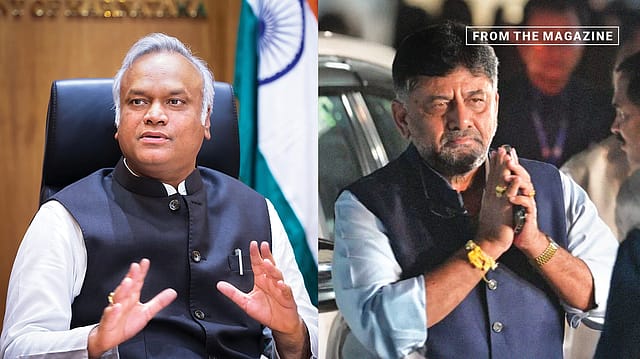
The opposition has framed the new Bill as an extension of Kharge’s personal anti-RSS drive. Kharge has, over the past year, sought to prevent RSS from using public spaces and written an open letter to the organisation questioning its legal status, its office-bearers, its finances, taxation and assets. He has refused to link the Bill to RSS, however, insisting that it is a fair framework for protecting public assets from misuse and for maintaining law and order.
This is the state government’s second attempt at the same regime. On October 16, 2025, the Cabinet discussed a draft titled the Regulation of Use of Government Premises and Properties Bill, 2025, but chose not to proceed, and issued a government order instead. “We did not go for a law as it would have been a long haul,” Kharge said at the time. The October order of the government was, however, challenged at the Dharwad bench of the high court. On October 28, Justice M Nagaprasanna stayed the order, observing prima facie that it infringed on fundamental rights and freedoms. The government appealed the interim order, but a division bench declined to lift the stay.
Several of Kharge’s cabinet colleagues, according to people familiar with the discussions, would prefer the Bill to wait beyond the present session of the Assembly. “It is Home Minister Priyank Kharge’s brainchild. But not everyone is keen on it, partly because the legal team hasn’t resolved all the questions that were raised about the government order from last year,” says a senior Congressman, declining to be named. Others in the state Congress have meanwhile opportunistically hit out at RSS to score brownie points with the high command. Yathindra Siddaramaiah, the former chief minister’s son who holds the urban development portfolio in the DK Shivakumar cabinet, has taken the hottest position available. At a protest outside the Congress office in Mysuru on August 15, held over an alleged purification ritual performed at Haldwani after Mallikarjun Kharge addressed a rally there, he described RSS as a thousand-headed venomous snake carrying the poisons of casteism, communalism and Manuvad. (Yathindra’s father, former Chief Minister Siddaramaiah, while hostile in rhetoric towards RSS, soft-pedalled the issue of banning the organisation in the state when he was in power.) Karnataka Pradesh Congress Committee (KPCC) President BK Hariprasad went one step further, saying that RSS, Jaish-e-Mohammed and the Taliban were indistinguishable and that all three were unregistered in India.
CHIEF MINISTER DK SHIVAKUMAR has kept to procedure. Permission is required for everyone, he has said. The cabinet discussed no particular organisation and informing the police is customary and necessary for security arrangements. Notably, Shivakumar has also refrained from opposing the Sangh on principle. In response to Modi’s praise of RSS in August 2025, Shivakumar only said that the organisation “doesn’t have any history” in comparison to Congress’ legacy. On August 21, prompted by the Leader of the Opposition R Ashoka during a debate on the Chinnaswamy stadium stampede, he sang lines from Namaste Sada Vatsale, the RSS prayer, on the floor of the Assembly. He had, after all, attended the Vittal shakha in Rajajinagar, Bengaluru, as a schoolboy. When Hariprasad demanded an apology from Shivakumar, the latter supplied a conditional one—“If you feel that I have done a mistake, which I have not done, I’m still ready to apologise”—while stating that his loyalty to Congress and to the Gandhi family lay beyond question. However, insiders say that his apparent camaraderie with BJP has angered the high command. At the Viveka SmarakainaugurationinMysuruonAugust1, hetoldPrimeMinister Narendra Modi that the entire state stood with him, and that India had to grow with Karnataka. When Modi took his hand, Shivakumar’s critics read the moment of courtesy as an offer of friendship with the Centre. By August 15, the joke had walked into the Vidhana Soudha, where a section of the audience at the Freedom Habba chanted the prime minister’s name while the chief minister of Karnataka was speaking. Shivakumar told them that even Modi says DK, DK, and the chanting obligingly changed.
“The government is simply trying to distract from issues we are raising, including the condemnable re-induction of B Nagendra, who is accused of misappropriating Valmiki Development Corporation funds, into the cabinet,” says state BJP President BY Vijayendra. “I don’t think this Bill can be brought in without serious objections. Priyank Kharge cannot turn his personal dislike for RSS into a legislation. We will continue to raise questions,” he says. He and Ashoka have dared the government to ban RSS openly.
Rather than banning any outfits, the state government has in fact been working on creating a parallel network of sanghas. The scheme was a Congress manifesto promise commemorating Rahul Gandhi’s Bharat Jodo Yatra, and the cabinet cleared it on June 3, the day Shivakumar was sworn-in as chief minister. On July 13, a cabinet sub-committee headed by Shivakumar issued the operating guidelines for the Bharat Jodo Yuva Sanghas, instructing deputy commissioners and zilla panchayat chief executives to find the sanghas space in schools, colleges, community halls and playgrounds. There are to be 10,000 of them—6,000 at gram panchayat level and 4,000 across urban wards—at an annual outlay of ₹1,010 crore. Each sangha will get ₹10 lakh a year, a trainer on an annual honorarium of ₹24,000, and a 15-member executive elected for two years, with mandatory representation for women and reserved categories. Each will have between 100 and 250 members, aged 16 to 35. District committees sit above them, and above those sits a state monitoring committee chaired by the chief minister. The listed activities are sport and rural tournaments, yoga camps, health and cleanliness drives, cultural programmes, skills training, environmental work and constitutional values. Every sangha is registered under the Karnataka Societies Registration Act, 1960, and its office-bearers are elected. Its money is public money and therefore auditable. Membership is open to any resident of the ward within the age band. While a state-sponsored youth body is not a new idea, the comparison with RSS, which took a century to build a cell in every village and ward, is inevitable. Both are, after all, describing the training of the young in a preferred idea of the country.