Shah Wields the Shield
At a press conference on October 12 amidst I.N.D.I.A. bloc protests demanding the resignation of Chief Election Commissioner (CEC) Gyanesh Kumar, Congress leader Rahul Gandhi responded to a question about the opposition’s future plans, saying there were, in fact, no plans to disclose. His sister Priyanka Gandhi Vadra, Rahul said, spoke to him about the need to plan ahead and he had told her that none was needed. “This is Tandav, Lord Shiva’s dance. There is no planning here,” he said. The suggestion was that the protests had acquired critical mass. Just a couple of days earlier he had posted on X that Gyanesh Kumar would go and so would the government.
Yet, there was a plan, as daily or even weekly protests, while generating media traction, held no promise of a favourable outcome. Referring to a communication from Chief Justice of India (CJI) Surya Kant, the Gandhi scion said the CJI had provided a “path forward” by suggesting the opposition file a petition setting out a case for their grievances against the Election Commission of India (ECI). The next day, on October 13, I.N.D.I.A. bloc leaders marched to the Supreme Court to submit their petition with a crowd estimated to be between 7,000 and 8,000. The deed done, the next show of strength is slated for November 1. The writ petition is likely to be clubbed with ongoing proceedings wherein the apex court has already called for a detailed examination of ECI’s records dealing with decisions regarding the Special Intensive Revision (SIR) of electoral rolls that began late last year.
The problem with working out a ‘plan’ beyond street protests that would be hard to sustain is that Congress had set out goals that are not easy to achieve. The resignation of the CEC is not on the cards, at least until the Supreme Court pronounces on the decisions of ECI. The demand to annul elections since the SIR was rolled out and a return to ballot papers for voting is even more unattainable. In the event, filing a writ and crediting the CJI for pointing to such an option is the best ‘plan’ amid other less attractive options. The writ outlines a fairly modest agenda. It notes that in his reply expressing his inability to meet I.N.D.I.A. bloc leaders, the CJI said some matters highlighting similar issues are to be heard on October 13. “You have my assurance that any such petition shall be heard at the earliest possible opportunity, in accordance with the law,” he wrote.
The political goal of ousting the Modi government over alleged dissonance within ECI and claims that the CEC had functioned in a unilateral manner is tied to Rahul’s repeated assertions—supported in various degrees by I.N.D.I.A. bloc leaders—that the SIR amounts to “vote chori” and the Bharatiya Janata Party (BJP) has won elections in cahoots with ECI. The case that Congress and other opposition parties had their pockets picked lacks substantiation and the government’s response to protests organised by the I.N.D.I.A. bloc and the Cockroach Janta Party (CJP) makes it clear that it will not allow a repeat of July 20 when the New Delhi city centre was taken over by mobs. At the time, widespread anger over the leak of question papers for admission to undergraduate medical courses proved a flash point, acquiring a significantly higher profile after a Ladakh activist began an indefinite fast. The protests culminated in the resignation of Dharmendra Pradhan as education minister. Since then, CJP has sought to keep itself in the spotlight, attempting to draw attention to the government-run schools in states where BJP is in office. The school campaign proved a damp squib with BJP improving its returns in local body elections in Rajasthan—a state CJP focused on. The SIR controversy, following a report in the Indian Express that Election Commissioners Vivek Joshi and Sukhbir Singh Sandhu had differences within ECI, prompted CJP to jump into the fray demanding the CEC’s resignation.
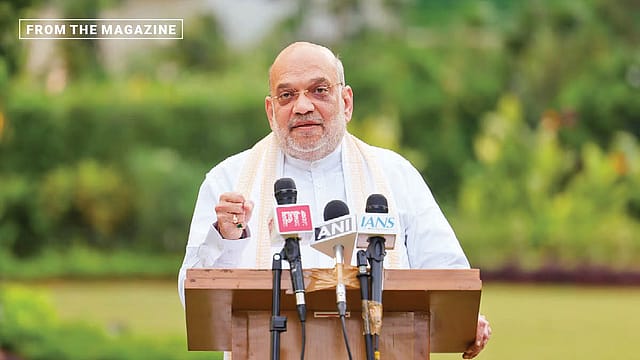
Union Home Minister Amit Shah on October 13 took on Congress, accusing Rahul Gandhi of repeatedly raising the SIR bogey to explain the lack of electoral success and said the real motive was to protect illegal immigrants and ensure they remained on the electoral rolls. Shah did not mince words, accusing Congress of acting on behalf of infiltrators. “By gathering the cadre of 14 parties, walking a kilometre-and-a-half, and collecting a crowd of 8,000 does not make you the voice of the nation,” Shah said, adding a comprehensive defeat awaits the opposition alliance in the 2029 Lok Sabha polls. The counterattack and the framing of the issue as one of the opposition shielding illegal immigrants is significant as it indicates the Modi government has taken note of the sentiments of its backers who want it to push back strongly against Congress and CJP. Congress spokesperson Pawan Khera responded to Shah’s comments, asking if the home minister’s confidence is based on the CEC. The home minister asserted the SIR had nothing to do with Congress’ poor returns. “You [Rahul Gandhi] and not SIR is responsible for Congress’ defeats. Since you emerged as the main leader of Congress and then became its president and leader of opposition, Congress has continuously lost elections. You should introspect,” Shah said.
I.N.D.I.A. bloc leaders might have tacitly acknowledged the limits of their demands with their petition, stopping well short of seeking the dismissal of or even restraints on the CEC’s powers. It does not challenge the validity of the SIR. The plea, littered with drafting errors and even falling short on court fees, questions processes by which the SIR was implemented. The petitioners would be aware that the Supreme Court had, on May 27, 2026, unanimously upheld the Bihar SIR exercise, saying that the revision of rolls is not violative of the Representation of the People Act; nor does it detract from the constitutional requirement for free and fair polls. The petition repeats the charges listed in pleas already before the apex court in referring to “serious allegations” concerning the functioning of ECI during the implementation of the SIR, including alleged exercise of the commission’s “collective powers” by the CEC without concurrence of the other commissioners. The petition claims absence of a recorded decision authorising a nationwide SIR, unlawful modification of Form 6 for new voters, centralised and opaque functioning of the ECINET and ERONET electoral-roll databases and the consequent largescale exclusion of electors without notice or an effective mechanism for restoration.
All these allegations are part of petitions already before the Supreme Court and are the basis of the court’s seeking a detailed response from ECI. It can be presumed that the affidavit filed by the commission will necessarily have the concurrence of Sandhu and Joshi and should establish a verified chain of events or the dissent of the two commissioners. Several of these issues have already been addressed by ECI and further clarified by the apex court. Inconsistencies or omissions in enumeration forms can lead to notices seeking proof by way of documentation and this does not amount to disenfranchisement as loosely claimed by many commentators. Submission of documents has been made even easier with the Supreme Court ordering BLOs to visit homes consequent to notices being issued to voters. The widely circulated claim that 13.3 crore voters have been “deleted” is disingenuous as almost three crore deletions are due to death. Another 9.5 crore are due to voters shifting permanently or being unavailable. This does not mean they cannot be registered afresh at their new places of residence. In Bihar, where 65 lakh voters were deleted, there have been fresh registrations after last year’s Assembly polls. The fact is the number of deleted voters outside the categories of dead, shifted and duplicate entries is very few, only in lakhs.
The political allegations that are part of the campaign against the SIR insinuate that the “logical discrepancies” category tends to accentuate a bias. But the algorithm is the same for all voters and the argument that deletions are higher among Muslims in certain instances refuses to acknowledge illegal immigration from Bangladesh and infiltration of the Rohingya as evidenced by demographic changes not in conformity with fertility rates. Opponents of the SIR and those calling for the exit of Gyanesh Kumar are unable to explain why there is no significant public backlash if indeed millions of eligible voters have been deprived of their franchise. The protests against ECI and Gyanesh Kumar have been most evident in New Delhi and have been sporadic elsewhere. Barring West Bengal, appeals against deletions have been in hundreds in states where the SIR was conducted. Further, BLAs of parties have not filed any significant number of objections as can be expected in case of eligible voters being removed from the electoral rolls.
The SIR has not been an electoral issue for either candidates or voters in states that have gone to polls since the revision of the rolls was ordered by ECI. A thorough vetting of ECI’s decisions by the apex court can be expected to settle doubts about the manner in which the SIR was carried out as also settle questions on the nature of concerns raised by ECs Sandhu and Joshi and clarify if they did sign off on all major decisions taken by the commission since mid-2025. Whether this will close the matter is a moot question. The political dogfight will likely continue just as EVMs are still blamed by opposition parties for electoral losses despite ECI’s impressive record of conducting elections and declaring accurate results that have withstood judicial scrutiny.