Reinventing Kanshi Ram
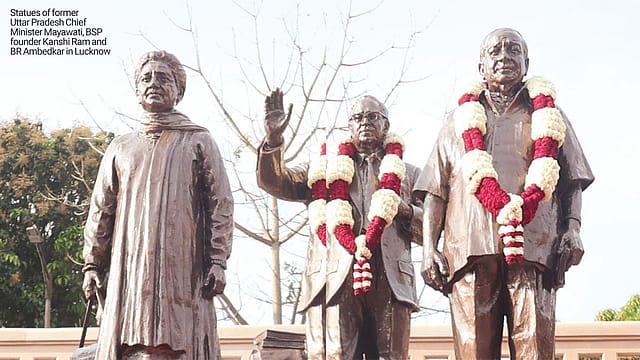
ON MARCH 15, India’s political class performed a familiar ritual of remembrance, except that this time it carried an unmistakable edge of competition. Across party lines, leaders queued up, on social media and at memorials, to pay tribute to Kanshi Ram, the founder of the Bahujan Samaj Party (BSP) and one of the most consequential mobilisers of Dalit political consciousness in post-Independence India. Describing him as a symbol of “empowerment and hope”, Congress leader Rahul Gandhi urged the government to confer the Bharat Ratna on him. Two days earlier at a public meeting in Lucknow, Gandhi also said that had Jawaharlal Nehru been alive, Kanshi Ram would have become a Congress chief minister. Uttar Pradesh Chief Minister Yogi Adityanath, in a message on X, described the BSP founder as a “pioneer of social justice” who “dedicated his entire life to the upliftment of the Dalits, the exploited, and the deprived”, offering his “humble tributes” to the Dalit icon.
Samajwadi Party (SP) chief Akhilesh Yadav called Kanshi Ram a “hero of social change” and highlighted how he “secured a dignified place for the Bahujans within Indian society”, while also reiterating the need to carry forward the struggle for social justice envisioned by him and BR Ambedkar. BSP chief Mayawati paid homage to her mentor but also used the occasion to attack other parties for what she described as selective remembrance. She said that tributes to Kanshi Ram had become an “opportunistic fashion”, accusing parties like SP and Congress of invoking his legacy only for electoral gain. “It is due to Congress’ anti-Dalit mindset and mentality that BSP had to be created in the fit place,” she said.
With crucial state elections on the horizon, not least in Uttar Pradesh, invoking Kanshi Ram has become as much a gesture of reverence as a signal of intent. His project of consolidating Dalit assertion, once seen as disruptive to established political hierarchies, is now claimed by parties that once stood in opposition to it. As a result, in this choreography of commemoration, the line between homage and appropriation keeps on blurring.
The scramble carries an added urgency as every major party begins recalibrating its Dalit outreach. As the Dalit vote remained decisive in a fragmented electoral landscape, Kanshi Ram offered a potent symbol. For decades, he represented a distinct strand of political thought: organisational pragmatism, sharp anti-upper-caste rhetoric, and the creation of BSP, designed to convert the numerical strength of the “Bahujan” into power. Unlike Ambedkar, whose legacy now carries near-universal reverence, Kanshi Ram was once a more polarising and openly confrontational political figure. The “Ambedkarisation” allows parties across the spectrum to appropriate the BSP founder without inheriting the radicalism of his original project. What this produces is a subtle but consequential reframing—Kanshi Ram is no longer invoked primarily as a disruptor of caste hierarchies, but as a precursor to a more consensual, development-inflected politics of inclusion. His sharper edges, like his critique of entrenched social power, his insistence on independent Dalit political assertion, and his scepticism of upper-caste-led parties, are softened or omitted altogether. In their place emerges a curated Kanshi Ram: a social reformer rather than a political insurgent, a figure who can be seamlessly inserted into broader narratives of welfare, governance, and national progress. It is a process not unlike the earlier ‘sanitisation’ of Ambedkar, whose radicalism was gradually subsumed within a consensual national canon.
This transformation also reflects the changing incentives of electoral competition. As Dalit voters become more mobile and less tethered to a single party, their symbolic capital has expanded. Political actors are therefore less interested in replicating Kanshi Ram’s autonomous model of mobilisation, which required long-term cadre-building and ideological discipline, and more in selectively borrowing from it features like the language of dignity, the invocation of representation, and the optics of outreach. The result is a shift from structural challenge to rhetorical accommodation. For example, for BJP, it means including Kanshi Ram in a calendar of Dalit icons. For SP, it entails celebrating March 15 as “Bahujan Divas” in all districts of Uttar Pradesh.
With Dalit vote expected to play a decisive role in the 2027 Uttar Pradesh elections, the question is no longer who follows Kanshi Ram’s politics, but who gets to redefine it. In that contest, memory itself becomes a site of negotiation; it is a negotiation shaped not by fidelity to his methods, but by the strategic needs of the present.
When Kanshi Ram began organising government employees in the 1970s, he was not seeking moral recognition but building the infrastructure of power. Born in 1934 in a Ramdasia Sikh family in Punjab, he worked briefly as a government scientist before turning to activism after encountering the writings of Ambedkar. But while Ambedkar had emphasised social reform and constitutional rights, Kanshi Ram was preoccupied with electoral arithmetic. He founded organisations with names that sounded like molotov cocktails: the All India Backward and Minority Communities Employees Federation (BAMCEF), and later, the Dalit Shoshit Samaj Sangharsh Samiti, or DS-4. Their purpose was clear: mobilise the oppressed majority—Dalits, Other Backward Classes and minorities—against what Kanshi Ram called the domination of the “15 per cent”, shorthand for upper castes. His most famous formulation captured the spirit of the project: “Jiski jitni sankhya bhaari, uski utni hissedari”, or, in other words, representation proportional to population. Democracy, he believed, was fundamentally a numbers game, in which the Bahujan, if it voted in unison, could rule.

In 1984, he founded BSP, the vehicle that would convert this theory into power. The party’s early years were marked by sharp rhetoric and relentless grassroots mobilisation. Kanshi Ram travelled ceaselessly across North India, addressing small gatherings in dusty villages and industrial suburbs. His speeches were unsparing. He mocked Congress for co-opting Dalit leaders and accused upper castes of monopolising the state.
For supporters, he was a revolutionary organiser, while for critics, he remained a divisive populist.
More than four decades ago, when Netrapal Singh Brijwasi first encountered Kanshi Ram in Mathura, the future BSP founder still travelled like an itinerant organiser, hauling exhibition trunks on his head, short of even a few rupees for a rickshaw. The “Ambedkar mela on wheels” he carried across North India was an exercise in political pedagogy in which Kanshi Ram turned icons like Ambedkar, Jyotirao Phule and Periyar into instruments of a new, assertive Dalit consciousness. With organisations like BAMCEF and later through BSP, what followed was a painstaking project of cadre-building, ideological training and electoral consolidation, aimed at transforming the “Bahujan” from a sociological category into a governing majority.
For many who joined him in those years, the movement was as much a lived experience as ideology. Anant Rao Akela, a long-time BSP organiser from western Uttar Pradesh, recalled first hearing Kanshi Ram at an agitation meeting in Bareilly and being immediately drawn in. Like Brijwasi, he would go on to devote decades to the party, rising through its ranks, managing constituencies, and internalising a politics that demanded both discipline and sacrifice. Akela’s turning point had come in his younger days when he was denied the right to recite from the Ramcharitmanas because of his caste. Encounters like these made Kanshi Ram’s message assume a certain urgency: politics was not abstract, but a direct response to lived humiliation.
Kanshi Ram’s politics rested on clear lines of antagonism, between the “Bahujan” and entrenched upper-caste power; it also took roots in the belief that independent political assertion, rather than accommodation, was the route to dignity. Early associates like Brijwasi and Akela were part of this ideology that demanded personal sacrifice and organisational loyalty, where workers moved from rally to rally, often on meagre means, bound by this shared ideological purpose. The slogan was not inclusion, but consolidation for welfare, “Bahujan hitay”. Akela remembered an earlier meeting where a journalist had asked Kanshi Ram why BSP wouldn’t take upper castes into its fold. The Dalit leader replied that such an opening up would halt the process of social change. He said that Brahmins and other castes could join at some point, but they could not anchor the party.
The inflection came under Mayawati after Kanshi Ram’s death in 2006. Her shift to “Sarvajan hitay”, most dramatically embodied in BSP’s 2007 majority, built on Dalit–Brahmin social engineering, was a strategic mastetroke, but also a structural departure. In seeking to expand the party’s social base, she normalised precisely the kind of cross-caste accommodation that Kanshi Ram had treated with caution. Over time, this repositioning did more than reshape BSP’s electoral strategy; it subtly recast the terms on which Kanshi Ram himself could be remembered. Once the party moved away from an explicitly antagonistic “Bahujan” framework, it became easier for other political actors to appropriate its founder without engaging with the harder edges of his politics.
This is precisely the danger that Dalit scholar Anand Teltumbde had flagged years ago: that in blurring the lines between “friends and foes”, BSP risked diluting the very basis of a Dalit political project. In an article in the Economic and Political Weekly, Teltumbde wrote that there is an “intrinsic conceptual error” in assuming BSP as a Dalit party. “How could there be a Dalit struggle without the definition of its friends and foes? By pushing such issues under the carpet, it actually negates the Dalit struggle itself,” he wrote. A movement that does not clearly identify structures of power, he argued, risks collapsing into a generic platform, thereby negating its own transformative potential. As BSP expanded its social coalition, the distinctiveness of Kanshi Ram’s politics began to erode.
For older cadres like Akela, this shift amounted to a dilution. The movement they had joined demanded ideological clarity and organisational discipline; what followed, in their view, was a transition towards electoral flexibility that blurred the distinction between core support and strategic alliances. Yet, from Mayawati’s pepective, these were the compulsions of power in a state as socially fragmented as Uttar Pradesh. The problem, however, is that in broadening BSP’s appeal, she also loosened its monopoly over Kanshi Ram’s legacy.
Attempts to reclaim that sharper legacy from outside BSP have, so far, struggled to scale. Young Dalit leaders such as Chandra Shekhar Azad have sought to revive a more assertive, street-level politics of Dalit assertion, foregrounding dignity and resistance. But these efforts remain fragmented and personality-driven, lacking the organisational depth and nationwide cadre network that Kanshi Ram painstakingly built over decades. The result is a form of symbolic radicalism that generates visibility, but has yet to translate into durable electoral or institutional power.
It is in this context that the “Ambedkarisation” of Kanshi Ram can be seen as a common vocabulary adapted across parties. Where Kanshi Ram once insisted on organisational autonomy and ideological clarity, his contemporary invocations emphasise symbolism, representation and welfare delivery.
This shift reflects a broader transformation in Dalit politics. The rise of a more aspirational, heterogeneous Dalit electorate, shaped by urbanisation, education and welfare expansion, has altered the terms of political engagement. Parties that are invoking Kanshi Ram’s name compete to assemble looser coalitions, combining targeted welfare, symbolic outreach and strategic alliances, whether through attempts at Dalit-Muslim consolidation or broader Hindu social engineering.
The result is a paradox in which one gets the feeling that Kanshi Ram’s politics has never been more widely acknowledged; and, yet, in practice, it is rarely followed in its original form.
With Dalit voters once again central to the electoral calculus ahead of 2027, the contest is no longer over allegiance to Kanshi Ram’s movement, but over the meaning of his legacy itself. In that contest, what is being negotiated is not just memory, but the terms on which Dalit politics will be articulated in the years to come.