Reel Politik
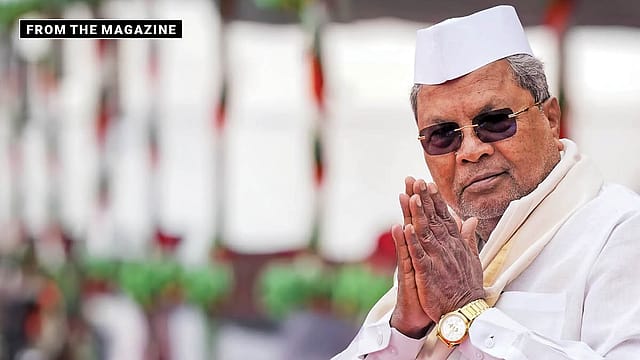
Sometime earlier this year, 22-year-old Ritesh Pandey bought a second-hand phone in Karol Bagh, the electronics bazaar in central Delhi. He never put a SIM card in it, and instead used a Wi-Fi connection on September 27 to allegedly upload a video to a YouTube channel called Karnataka Honeytrap. The footage had been shot with a hidden camera and came to Pandey on a pen drive. A woman whose face is covered answers questions from people off-screen and makes allegations against former Chief Minister Siddaramaiah about an incident around 2011. It has since come to light that the recording was likely made in 2023, and that it presented her as having been a minor at the time of the incident.
Siddaramaiah claimed the video was concocted and called it an attempt to blackmail him. On October 6, he filed a police complaint, asking investigators to identify those behind it. The probe has since opened two trails, one towards the making of the recording and the other towards its circulation. The former begins with the woman in the footage. By October 26, officers of the Central Crime Branch’s (CCB) cyber crime wing had found her in Kerala. According to police sources, she told them that a group approached her in 2023, paid her and told her what to say, and that she had never met Siddaramaiah.
On October 23, Siddaramaiah publicly accused Kripa Alva, a Congress spokesperson from Mangaluru who chaired the state child rights commission from 2015 to 2018, and Rakesh Shetty, managing director of Power TV, of being behind the purported sting that produced the video. Shetty calls himself the “King of Sting”.
Siddaramaiah’s son Yathindra, a minister in the cabinet of DK Shivakumar, alleged that the video appeared to show a female Congress leader seeking a Puttur ticket along with a media organisation head. Alva, who has been questioned by police, has reportedly told the CCB that she did not know the encounter was a sting, and that Shetty spoke to her near a Mangaluru hotel about exposing certain people’s secrets. In his own video posted on October 19, Shetty acknowledged that he made the recording in 2023, called it a “reality check” and said he has the original device. He has been granted interim anticipatory bail. Neither he nor Alva has been charge-sheeted. The Karnataka Pradesh Congress Committee (KPCC) has issued Alva a show cause notice.
The second trail leads to the upload. On October 24, the CCB arrested Pandey in Delhi and brought him to Bengaluru for questioning. He has since been granted conditional bail. Police also picked up two members of the Janata Dal (Secular), or JD(S), social media team. Mohan Gowda, a member of the unit, has been served a notice under Section 94 of the Bharatiya Nagarik Suraksha Sanhita (BNSS) and questioned. A man named Chandan is being sought.
The unresolved link between the two trails holds the key to understanding the whole operation. Who ordered the hit? Who held on to the recording for three years? How did it pass from people alleged to have made it to those who posted it? It is the kind of footage whose usefulness depends on it never quite being seen. By September, that usefulness mostly ran out. Siddaramaiah had resigned in May and announced that he would not contest again. And so the recording, which seems to have passed from one set of hands to another, and possibly from one party to another, was put to another use—one that turned the spotlight on DK Shivakumar. He has been forced to respond to allegations that his government keeps files on its leaders. As for Siddaramaiah—the self-styled heir to D Devaraj Urs, who made minorities, Dalits and the backward castes feel somebody at the top was on their side—the ignominy of being accused of preying on a minor, the kind of person he had won elections claiming to protect, will not wash off easily even if the investigation finds him innocent.
In Karnataka, the hidden camera has become something close to a branch of government. At least 30 politicians have, over the years, obtained court orders to stop sexual material linked to them from circulating. “Why has no one pursued the makers of these videos? Because everybody has used them,” says Dinesh Amin Mattu, a veteran journalist who was also Siddaramaiah’s media adviser. In February 2019, it was JD(S) leader HD Kumaraswamy, then chief minister, who called a press conference to play a recording of Bharatiya Janata Party (BJP) leader BS Yediyurappa allegedly offering a JD(S) MLA’s son money and a ministry to help bring the coalition down. Yediyurappa disputed the tape’s authenticity. In 2020, Rakesh Shetty’s Power TV aired a sting on alleged kickbacks involving Yediyurappa’s son, BY Vijayendra. The broadcast led to police action, and the channel subsequently went off the air. In 2021, a CD forced BJP’s Ramesh Jarkiholi out of the cabinet. Jarkiholi said it was extortion, and police found evidence that the woman and two former employees of a news company had set out to trap him. In 2025, KN Rajanna, then a minister in the Congress government, told the Assembly that he and 48 others had been targets of honey trap attempts.
This time round, it is Kumaraswamy, a Union minister who is allied with BJP, who has been the most tireless prosecutor, holding press conferences, staging a dharna, setting deadlines for investigators and standing up for Siddaramaiah, a man his family spent the better part of three decades trying to keep out of the chief minister’s chair. Kumaraswamy’s allegations have grown with each press conference: that Shivakumar rode the sting into office and is the “master” of such operations; that Siddaramaiah was shown the material in Delhi and eased out; that the investigation is being steered towards JD(S) to bury a recruitment scandal; that the government is smoothing Shetty’s way to bail; that an alleged Rs 600-crore contract has been given to finish off the Deve Gowda family, and that there are 12 more videos Shetty is keeping in reserve.

In the past few months, Kumaraswamy has time and again locked horns with Shivakumar over the Bidadi township, the NICE corridor and the Karnataka Public Service Commission (KPSC) recruitment scam. “He fancies himself to be the Nitish Kumar of Karnataka but BJP still remembers October 2007, when he refused to hand over the chief ministership at the end of his 20 months,” says Mattu. Whether Congress leaders ordered the sting or not, party insiders say, the man who stands to benefit from this episode is Kumaraswamy . Indeed, the trail the police have so far followed from the upload back towards its source runs through members of Kumaraswamy’s own party’s social media unit. He has retorted that police are chasing the messengers to spare the makers. But a recording that embarrasses Shivakumar’s government and settles an old score with Siddaramaiah could hardly have served Kumaraswamy better if he had picked the moment himself. Kumaraswamy gains either way: he weakens his Vokkaliga rival in the chief minister’s chair, makes a play for Kuruba votes drifting from Siddaramaiah, and with BJP all but content to let him lead, makes himself the opposition’s loudest voice and the ally it will have to reckon with when seats are divided in 2028. BJP’s broad charge, meanwhile, is that Congress is eating itself. Jagadish Shettar, a former chief minister who briefly left BJP for Congress in 2023 before returning the next year, says he has no doubt about the sequence of the sting operation. “When Siddaramaiah was not ready to step down, it was because of the sting operation, because of having those CDs, that the high command forced him to step down,” he says. This will definitely impact the image of Congress, which acts holier-than-thou, he adds. Shettar’s colleague, Lahar Singh Siroya, a Rajya Sabha MP, described in a post on X a Congress government “on the verge of collapsing with one powerful faction blackmailing and honey trapping another powerful faction”.
State BJP President BY Vijayendra says that with discontent against Shivakumar growing within Congress, MLAs were beginning to rally behind Siddaramaiah. This “might have tempted some leaders within the party” to attack the former chief minister, he says. Asked why BJP was mostly watching from the sidelines, he concedes that “there is a limitation”, but that they were focused on all the issues facing the state, and not just the honey trap one. “We have demanded a white paper on the state’s finances, for instance, and disbursement of drought relief to farmers,” he says, adding that in just “a few days, senior MLAs will rally behind Siddaramaiah and demand a change”. Vijayendra incidentally shared the stage with Siddaramaiah at a community event on October 28. “He strongly feels there is a big conspiracy, and that his own people are involved,” he says.
The charge that Shivakumar keeps a watchful eye on his colleagues is older than the controversy. He has supplied some of the material for that suspicion himself. In September, during an Assembly debate on drought and Bengaluru’s growth, he remarked that about a dozen MLAs who had come to the city “have two marriages”, adding that he could give a list. At a cabinet meeting on October 6, Shivakumar, who holds the Intelligence portfolio, told his ministers that teams were running private sting operations against them. Later, in an interview, he claimed that he too had been targeted by a man wearing Meta smart glasses. Earlier, in 2021, when Jarkiholi was forced out of the BJP government, he had blamed Shivakumar, then KPCC president, for the release of the tape. In 2024, Shivakumar was accused of orchestrating the circulation of the Prajwal Revanna videos. Revanna, former JD(S) MP, is now serving a life sentence for rape.
Kumaraswamy has openly alleged that Siddaramaiah was called to Delhi on the pretext of cabinet talks but shown the material and pressed to step down. Siddaramaiah’s camp dismisses the claim. An aide privy to the details of the controversy told Open that Siddaramaiah has been set up for the second time, but that this time the entire Karnataka Congress would have to deal with the fallout. “He is not going to make a political comeback and his image is far too clean to be sullied by unsubstantiated allegations, but by exposing Congress’ inner workings, mischief makers have ensured that Shivakumar doesn’t have it easy,” he said.
Kumaraswamy has handled the controversy with a tactical skill his rivals have not matched. He leads 18 MLAs in a House of 224, against Congress’ 136. “A person who commands a small force is above the fold in all newspapers every day,” points out journalist and author Sugata Srinivasaraju. Kumaraswamy’s most effective move has been to express sympathy for his oldest rival. Siddaramaiah rose in the Janata Dal under Deve Gowda’s patronage, broke with the family, was expelled from JD(S) in 2005 and took his AHINDA following to Congress. His supporters hold Kumaraswamy responsible for blocking his path to the chief ministership more than once. Kumaraswamy joined BJP’s march over the MUDA allegations, the first major corruption charge of Siddaramaiah’s career. Now he speaks of a leader who served the state and was humiliated by his own party. This solicitude is both that of an old enemy and of a man whose own family was undone by a pen drive two years ago. Besides, every word of sympathy for Siddaramaiah is an accusation against Shivakumar, and a reminder to Congress that the most persuasive defence of its former chief minister is coming from the outside. Part of what lets Kumaraswamy play prosecutor in a scandal of this kind, Srinivasaraju argues, is that the one episode in his private life that might have been used against him he acknowledged long ago, and on his own terms. “He was bold enough to say, yes, she is my wife, I have a daughter. Not every politician in this country has had that kind of guts,” he says. To a patriarchal electorate, a man who owned his other family and now stands up against the honey trappers looks “very manly” while Congress merely talks about values, Srinivasaraju adds. “The guarantee schemes had sucked up all the money, and the Congress government was not able to deploy anything on the ground. That was sinking them. But now there is both a welfare sink and a moral sink. The whole factional rivalry within Congress has come to the fore again with the sting controversy,” says Srinivasaraju, who foresees a major fallout within the party in the coming months.
At the very least, the episode has diminished a former chief minister, unsettled the sitting one and divided the ruling party. It has also made the leader of the Assembly’s smallest party its loudest voice. Siddaramaiah has been restrained in his response to the controversy. While he has sought a meeting with Rahul Gandhi in the first week of November, people familiar with his thinking say the sting is not the main item on the agenda. He wants the two vacant cabinet berths filled—with a Kuruba and a woman—and a government-party coordination committee formed.
The stakes for Congress extend beyond the state. Karnataka is the party’s largest state government and a source of its resources. Party President Mallikarjun Kharge is from Karnataka. Rahul Gandhi’s case against BJP is a moral one, about fear and its uses in public life. In the one large state that his party governs alone, the opposition’s latest charge is that the ruling party runs on fear of what it knows.