Rahul Gandhi Not On the Same Page
ON FEBRUARY 9 AFTERNOON, Congress leader Rahul Gandhi took a break from his usual sartorial choice of a white T-shirt and dark trousers, and strolled into Lok Sabha in a full-sleeved green pullover and casual cargo cut baggy khaki trousers. He walked to his seat in the front row at the head of the Congress contingent and sought the attention of the chair with party functionary and Alappuzha MP KC Venugopal chipping in at his side. He had been assured that he will be allowed to speak, said Rahul, even as Telugu Desam Party (TDP) MP Krishna Prasad Tenneti, who was in the chair, said he had the name of Congress leader Shashi Tharoor.
As it became evident that Rahul wanted to refer to former Army chief Manoj Mukund Naravane’s book and its account of the 2020 India-China border tensions, Tenneti iterated that Congress itself had submitted Tharoor’s name as the first speaker in the discussion on the Union Budget. “Are you going to speak on the Budget?” he asked and added he had no knowledge of any agreement between the Congress leader and Lok Sabha Speaker Om Birla. Faced with Tenneti’s firm rebuff, Rahul exited the chamber, stopping briefly to have a word with sister Priyanka Vadra on his way out. It was apparent the government would not accept the former Army chief’s memoirs—which it said have not been published and are not available for purchase—being debated and discussed in Parliament.
Matters had come to a head a few days ago on February 3, when Rahul came to Parliament with a purported copy of the book and claimed that contrary to the government’s version, it had indeed been published and predicted Prime Minister Narendra Modi would not come to the House. Proceedings descended into unruly and chaotic scenes as Congress MPs clambered onto the table where Lok Sabha officials are seated and hurled papers at the chair which is at a height. The disorderly conduct resulted in eight MPs, including one from CPM, being suspended for the duration of the Budget session. The belligerent behaviour and the suspensions hung heavy over the House the next day on February 4 when the prime minister was scheduled to reply to the vote of thanks on the president’s address to the two Houses. A routine event took a serious turn when Congress MPs, including some women members, walked towards the prime minister’s seat before he was due to reach the House. The move appeared deliberate as the MPs positioned themselves in a manner that effectively blocked the prime minister’s passage to his seat at the far right of the speaker’s chair.
Keeping in mind the possibility of a confrontation, Modi was advised to skip his speech. Though Congress contested Birla’s assertion that he had feared a sudden and unforeseen development and advised the prime minister to keep away, it was evident that the opposition MPs had crossed well into the seating area of the treasury benches. Any attempt to physically confront the prime minister could well have seen the intervention of Central Industrial Reserve Force personnel deputed as marshals. Bharatiya Janata Party (BJP) managers anticipated that any such showdown would lead to accusations of “heavy-handed” tactics in the House, particularly against women opposition MPs who crossed the well and approached the prime minister’s seat. Modi spoke in Rajya Sabha the next day in a speech just short of 100 minutes.
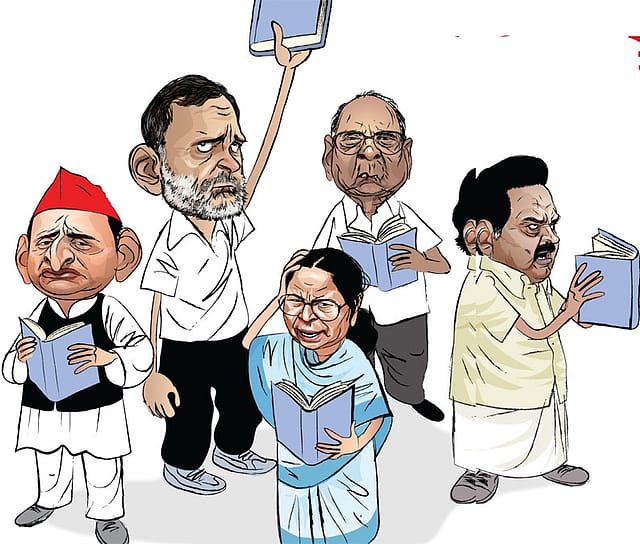
FOR THE LAST several days, Rahul has been reaching Parliament clutching what he said was General Naravane’s book and claimed the general’s account demonstrates that the government did not provide clear guidance to the military during the armed standoff with China. The absence of an authorised version is a hurdle in assessing the claims but the reported instructions of the government seem, on the face of it, clear enough as they authorise the Army to do what is needed. But with a political battle raging, BJP hit back with Godda MP Nishikant Dubey on February 4—the same day when Modi did not speak in Lok Sabha—referring to books that paint Jawaharlal Nehru in poor light to allege Congress leaders failed to protect India’s rights against Chinese aggression. The MP’s intervention saw chits and papers being hurled at the chair. On the next day, Modi responded to the attacks and the Naravane controversy in Rajya Sabha by posing the question—and delivering the answer—as to why the opposition wanted to get rid of him. “On the one hand, I am working to secure the future of India’s youth and on the other, Congress is making plans to dig Modi’s grave [Modi ki kabar khodne ki baat]. People who speak of ‘Mohabbat ki Dukan [shop of love]’ raise slogans of ‘Modi teri kabar khudegi [Modi your grave will be dug]’…is this not an insult to the norms of public life? I have experienced this for long. Since 2002 when I assumed office [in Gujarat], in 2004 when they [UPA] came to power and since 2014, when I came here [to the Central government], over 25 years, there has not been a single session of Parliament when these people have not abused Modi,” the prime minister said.
Modi’s speech that Congress and other I.N.D.I.A. bloc parties were seeking his ouster driven by their hatred of him and anathema for decisions taken in national interest such as repudiation of Article 370 and firm action against Pakistan for terrorism and the counter-narrative on China hit home. While Congress’ aggression severely disrupted Lok Sabha from February 2 to 6, the mood was palpably different the following week when Parliament met on February 9. Though Congress stuck to a combative stance and Rahul continued to brandish the Naravane book, other members of the I.N.D.I.A. alliance were not enthused. They felt the issue had been juiced out and it was time to allow Parliament to function and take up a discussion on the Union Budget. “There is a limit to the utility of disrupting the House and carrying placards and banners inside the chamber,” said a senior opposition leader who pointed out that BJP succeeded in painting Rahul’s actions as “pro-China” while exposing historical chinks in the Congress’ armour over dealing with China. Modi’s credentials, particularly after the Indian military’s success during the May 7-10 Operation Sindoor, were not easy to tarnish. Deliberations among opposition leaders saw them arrive at a consensus on ending the confrontation. At the instance of Congress, it was decided to seek a no-confidence motion against Birla for “not allowing” the leader of opposition to speak but it was also decided that Parliament would thereafter be allowed to function.

Though several I.N.D.I.A. bloc MPs signed the letter regarding Birla, the lack of enthusiasm was evident. For one, the Trinamool Congress did not sign the petition with party leader Abhishek Banerjee saying the matter should be first taken up with the speaker. The reasons for Trinamool not endorsing the plea might well be political as the West Bengal Assembly elections are round the corner. Trinamool leader and Chief Minister Mamata Banerjee has stuck to going it alone and has rejected an alliance with Congress. It is highly unlikely she would sign up to any Congress-led move where Trinamool would play second fiddle. Her experience of dealing with the Congress leadership in the past has left her bitter. While Trinamool’s chief adversary is BJP, animosities with Congress and the Left run deep. The Samajwadi Party shared the lack of interest over prolonging the confrontation even though the party signed the petition against Birla. Of the I.N.D.I.A. bloc constituents, Dravida Munnetra Kazhagam (DMK) is perhaps closest to Congress, but the party seems to feel it has other fish to fry as, like West Bengal, it is girding up for a state election. DMK leaders are keen to make a point in Parliament, particularly on the government’s claims that the trade agreement with the US spells a big relief to sectors such as fisheries, leather and textiles, which are a prominent part of the Tamil Nadu economy.
On February 11, when Rahul spoke on the Budget, he focused on the India-US trade deal. This was possibly because a day earlier, he had persisted with claims that the Naravane book had in fact been printed even though the publisher denied this. The Congress scion insisted on referring to the term “pre-order” as evidence of publication until General Naravane posted a brief post on X endorsing the publisher’s statement. Looking to change tracks, Rahul now targeted the Modi government over the trade deal, saying the prime minister had betrayed the interest of India’s farmers. He alluded to a martial arts chokehold to claim that the prime minister had given in to US pressure. After a somewhat meandering and banal dissertation on geopolitics, the value of Indian data and emerging trends in AI, allegations about India “succumbing” to US diktat on Russian oil purchases, Rahul claimed revelations relating to a case against an Indian industrialist in the US and release of files related to a disgraced American financier was the reason the government allegedly accepted poor terms. It was a typically over-the-top charge that stretched credulity and prevented Congress from making a more effective point. Pointed questions about the future of oil imports from Russia—as outlined by Tharoor a day earlier when the discussion on the Budget began—would have been relevant but the opportunity was lost in the welter of claims and counter-claims.
The over-reliance on a few snatches from a book was problematic not just because it could not be authenticated, but also the events under reference do not lend themselves to simplistic analysis and there is a view that the author may have overemphasised his role in the matter. Though bound by a common objective of taking on BJP which poses a serious political threat to all I.N.D.I.A. bloc constituents, the parties have repeatedly failed to display genuine cohesion. Though Congress is the largest party, it has not been able to engage others in meaningful discussions leading to effective floor strategies. In the current case, too, Rahul sought to up the ante against the government but the expectation that other opposition parties will unreservedly back his solo run was a miscalculation. Around the time Congress MPs were creating a ruckus in Lok Sabha, the party lost the opportunity to elect its mayor in Chandrapur, the only municipality in Maharashtra where it won the most seats. A bitter difference of opinion between the Congress MP and an influential MLA provided BJP an opportunity to wean Shiv Sena (UBT)—despite their rivalry—into an alliance. As a result of Congress’ internal feuding, BJP ensured the election of its candidate as mayor of Chandrapur.
The repeated disruption of Parliament proceedings and unruly behaviour by its MPs is proving to be a case of diminishing returns for Congress. The party has repeated the script in every session of Parliament since the formation of the 18th Lok Sabha and there is no evidence to suggest the tactics have worked. Rather, the party has lost election after election, at both the state and local body level, and is now hoping perceived anti-incumbency in Kerala against the ruling Left-led coalition will break the trend. But going by events over the past 10 days, allies could be turning more and more sceptical about Congress’ ability to lead and deliver.