Punjab: Mann vs the Sacred
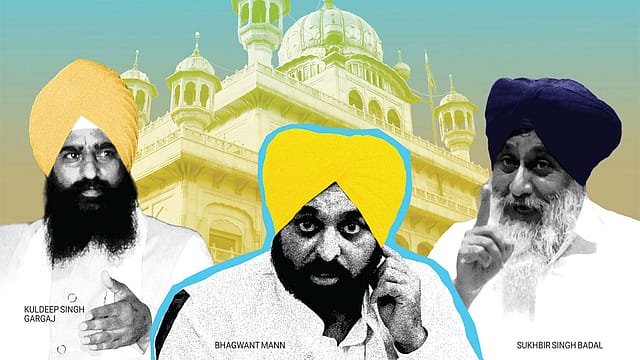
THE RECENT EDICT by Sikh clerics holding Punjab’s Chief Minister Bhagwant Mann guilty of religious misconduct is a dramatic development in the state’s politics even if it was predictable. Within a day of the hukamnama being droned out by Kuldeep Singh Gargaj, the jathedar of the Akal Takht in Amritsar, the chief minister rebutted the charges in their entirety. Mann, in a social media message, said he was surprised that persons holding such high religious authority could indulge in “false propaganda at the behest of their political masters”.
Anyone who follows Punjab’s politics knows what Mann was hinting at. The attack, without naming anyone, was directed at the Shiromani Akali Dal (SAD) and the Shiromani Gurdwara Parbandhak Committee (SGPC), the body tasked with the management of gurdwaras. Technically, SAD and SGPC are distinct organisations but in reality, the two have an umbilical link. SGPC is the centre around which Sikh religious politics is organised through a network of gurdwaras, jathedars and religious congregations. A jathedar is a leader who combines religious and political functions, a feature characteristic of Sikh politics.
Trouble for Mann began many months ago when a video in which he was allegedly seen as disrespecting Sikh gurus began circulating. He was summoned to the Akal Takht, seat of the highest temporal authority in Sikhism. Mann duly presented his case there in January this year. He denied the charges even at that point.
In mid-April, the Punjab Legislative Assembly passed the Jaagat Jot Sri Guru Granth Sahib Satkar (Amendment) Act, 2026. The amendment Act prescribes heavy punishments, both prison terms and fines, for sacrileges against the Guru Granth Sahib, the Sikh holy scripture.
The two events—allegations against Mann, his summoning to the Akal Takht and the passage of the law—are distinct, technically unrelated, events. But in Punjab’s contested politics, it is inevitable that they are likely to be seen together. SAD has been out of power in the state for nearly a decade and has had its own share of controversies over sacrilege, an issue that has haunted it ever since. Now it senses a chance against AAP even if its criticism of Mann is couched purely in terms of religious misconduct. Through SGPC, a body over which it wields influence, SAD hopes to change its political fortunes. Other political parties—Congress and BJP—have also latched on to the issue even if their approach to Punjab’s politics is different.
The nature of SGPC’s political power and its role in Punjab’s politics has changed even if it retains a measure of influence. In the two turbulent decades from 1970 to 1990, the organisation was a major faction in Akali politics. The chief minister, whenever the Akali Dal was in power, the party and SGPC formed three corners of the constellation of power. SGPC had a major role in the factional feuds of that era. Very often, even routine bureaucratic transfers and postings would be decided from Amritsar. This faction-fighting bred Sikh extremism and, ultimately, cost Punjab dearly. Terrorism consumed the state and it has never really recovered after that.
All this was put to an end when Parkash Singh Badal began his tenure in the late 1990s. Faction-fighting was ended. Gurcharan Singh Tohra, the SGPC boss for long and a man who revelled in factional politics, was expelled from SAD and Jagdev Singh Talwandi, who was SGPC chief from 2000 to 2001, had been defanged by then. Later SGPC chiefs were, to put it mildly, more suitable to the changed political environment. That, however, does not mean that SGPC and the assorted jathedars have lost influence in the state’s politics. SAD may have lost political power but there is a very strong constituency for religious politics. As a result, the organisation, its religious leaders and preachers have lost none of their potency for political action. At the same time, the religious constituency has grown in recent years. The two should be seen through the same lens.
This has been noticed by AAP and its leadership. The party faces a tough election next year. Unlike the collapse of all other parties between 2017 and 2022, the playing field has recovered to an extent and Punjab is likely to see a four-cornered context in the Assembly elections next year.
The visible strand of AAP’s strategy rests on two planks: maximising votes it can garner on the basis of promises and delivery and minimising the damage accumulated over the years. Of the various ways in which the state’s electorate can be diced and sliced—by region, gender, occupation and age— AAP has sought to maximise its share of votes. Next month, the Mann government is launching a cash transfer scheme for women that plans to give sums ranging from `1,000 to `1,500 for different categories of women. There is no income bar on potential beneficiaries. The party hopes to sail through the elections based on these and other welfare measures.
The one segment of the electorate where AAP faces headwinds is that of farmers. Farmers have grown restive over the past five years, and agitations are now a part of the state’s political landscape. While the sacrilege law is couched nominally in religious terms, it serves another purpose. It had the potential to transcend political action beyond the usual categories of farmers, women, urban and rural voters, and collect them into one bundle. If that were to happen, at least a part of the negative blowback could be erased. That was the unstated calculation behind the sacrilege law, even if officially such calculations are likely to be denied vehemently.
This is where Mann and his party made an untenable assumption. It was least likely that AAP’s efforts to corner the panthic (religious) vote would go unchallenged at this time. To begin with, they took exception to the proposed law a week before it was introduced in the legislative Assembly in mid-April. This was months after Mann appeared before the Sikh clergy in Amritsar in connection with the alleged video featuring him. Barely two months after the law was enacted came the declaration of religious misconduct against him.
At this stage, all political parties have spoken against Mann. Far from gaining the sympathy of the faithful, Mann and AAP find themselves defending against charges of religious misconduct. This has the risk of derailing a carefully laid strategy of maximising gains and minimising damage. While the “panthic vote” may or may not gravitate to most of these parties, there is now a question mark whether AAP can secure it, unless it takes some decisive action in the matter. It is not clear what such a step could be.
The lesson of the 1980s and 1990s, when Punjab burnt in the fires of terrorism, was simple: never toy with religious politics, or at least its extreme edges. Congress learnt the lesson the hard way after a prime minister and a chief minister of Punjab were assassinated. SAD, too, learnt that it is safer to channel politics along other lines. It took an inexperienced anti-system party to repeat that mistake. Hopefully, the damage will be contained before matters get out of hand.