Power Shift In Patna: Bihar moves on even as Nitish Kumar remains central to the transition
APART FROM A few digs at Bihar Chief Minister Nitish Kumar’s public slip-ups, the Rashtriya Janata Dal (RJD)-led Mahagathbandhan (MGB) treated the Janata Dal (U) leader with prudence if not deference during the November 2025 Assembly election, choosing to instead accuse the Bharatiya Janata Party (BJP) of plotting a “takeover” of the state. The reasons for caution were apparent enough. Despite his decisions to leave the National Democratic Alliance (NDA) only to return after short-lived dalliances with RJD, Kumar continued to be widely respected. Seen as a symbol of empowerment of the socially disadvantaged, there was no significant anti-incumbency against him, a factor that helped NDA record an emphatic victory.
In a state where caste lines are sharply etched, Kumar has his share of detractors. But these are largely sections strongly aligned with RJD irrespective of circumstances. The forward castes who have supported BJP for long may not have always been enamoured of Kumar but found his policies more acceptable than RJD supremo Lalu Prasad’s sectarian politics and derision of upper castes. Unlike many Other Backward Classes (OBC) peers, Kumar has not been tainted by corruption during his almost unbroken stints in office since 2005. Voters credited him with replacing the “jungle raj” associated with RJD with fair policing and for a web of welfare schemes alongside visible improvements in connectivity and infrastructure.
Like Lalu, the JD(U) leader too rose on the tide of Mandal politics and is minutely schooled in Bihar’s political and geographical landscape. While using a chopper for campaigning, Kumar can point out physical landmarks, such as a canal or a building, to help pilots find the landing spot. Largely immune to the culture of aggrandisement and nepotism, Kumar has a wry sense of humour about the expectations of favour seekers and their likely sense of disappointment with him. In a state that has produced many political leaders of standing, he is one of the tallest, having overshadowed Lalu who at one time seemed the unassailable satrap of Bihar. RJD’s inability to get rid of the ‘jungle raj’ tag has as much to do with Kumar’s success in avoiding graft scandals as it has to with the Lalu Prasad clan’s repeated trysts with controversy.
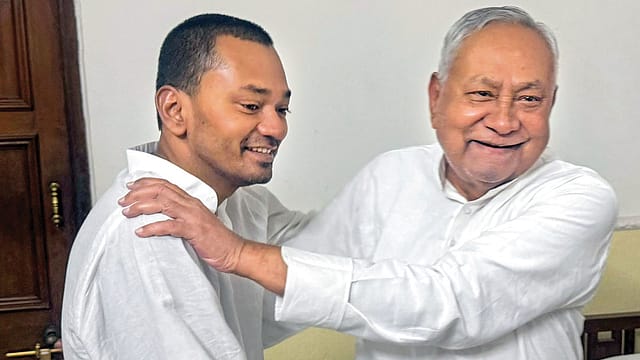
Nitish Kumar’s announcement that he will move to Rajya Sabha was not unexpected as the tasks of governance were proving to be a challenge. Yet his decision is rare as not many politicians are ready to voluntarily step away from office. The decision has been accompanied by the induction of his son Nishant into JD(U) and Kumar’s transition to Parliament is expected to be accompanied by the chief minister’s post passing to BJP. The development has led to RJD leader Tejashwi Yadav accusing BJP of marginalising Kumar and betraying the mandate. Dravida Munnetra Kazhagam (DMK) leader and Tamil Nadu Chief Minister MK Stalin warned BJP would implement the same “model” in the state if given a chance—suggesting that the All India Anna Dravida Munnetra Kazhagam (AIADMK) could be reduced to being a junior partner of the saffron party. So far, the BJP leadership has taken care to ensure Kumar does not feel diminished in any way.
While Kumar may soon be out of the hurly-burly of state politics, his influence on events and decisions will not evaporate overnight. BJP and JD(U) have almost equal numbers in the Assembly and the consultations and backchannels that proved so effective in bringing about Kumar’s Rajya Sabha nomination will continue to work. The BJP nominee will need to gain Kumar’s trust and backing to ensure government decisions are credible. Yet just as Kumar has loomed large over Bihar politics, Prime Minister Narendra Modi has emerged as a major determinant since 2014. BJP and JD(U) need each other to succeed and keep RJD at bay, but Modi has been a key factor for voters who chose NDA. This includes OBCs who might have been more questioning of Kumar’s record in office but who see Modi as a more promising option in terms of future prospects than the rival MGB. BJP’s strong performance in the 2020 state elections was critical to NDA retaining power as JD(U) underperformed. Modi’s rise in national politics has bolstered the BJP-JD(U) alliance and the seamless transfer of votes in last year’s state polls showed that the synergy works and enjoys strong public endorsement.
The power shift, when it happens, will certainly have consequences. Although public infrastructure and delivery of government services have improved immensely, Bihar lags in industry and commerce. Kumar has not been as focused on making Bihar investment-friendly even though the state GDP is better than the national average. With BJP holding the reins, the ‘double engine’ aspect of governance will be much more pronounced. A certain slack in official circles in part due to Kumar’s preoccupations can be expected to be remedied. Sooner or later policies such as prohibition are likely to be reviewed and at least partially relaxed. A well-defined roadmap for Bihar’s industrialisation is an urgent requirement in a state where millions migrate every year in search of livelihoods. The BJP nominee is expected to reflect continuity in OBC leadership in keeping with post-Mandal realities. Caste can be a slippery peel and BJP would not want to give RJD an opportunity to reclaim non-Yadav backwards.
BJP will have a chance to push its cultural agenda and its ‘Hindutva-plus development’ model might be accorded greater salience. Yet the changes may be felt more directly in administration and reduced indulgence of communal mobilisation. The truth is that even with Kumar as chief minister, castes and communities aligned with RJD never viewed NDA in any better light, seeing it as a Hindutva force to be opposed on that count alone apart from other reasons. Bihar will continue to be run by a coalition and it is unlikely to be transformed into a clone of the Yogi Adityanath government in Uttar Pradesh (UP). JD(U) itself will undergo a period of transition as Nishant—no doubt under the guidance of his father and party seniors—will look to step up and take charge. This in itself will be a challenging task as Nishant does not have experience of public life and his expected induction in the state government will be the beginning of a steep learning curve.
Any career, howsoever long and distinguished, begins to dim at some point. Kumar has not been free of idiosyncrasies and personalised agendas and has made opportunistic decisions as well but he now has an opportunity to seal his legacy, something politicians with a long-term view want. He has been the fulcrum of political and social change for two decades and can still be the lodestar for the future of a social and political alliance that has often seemed improbable but defied several predictions of its demise. The glue that held BJP and JD(U) together was not just political power but the ability to find common ground between competing identities and interests.