Poison Politics
The large poster in front of a demolished corner shop says it all: a Sikh with blood flowing from his body and a message in Punjabi, meri maut te na roiyo, meri soch nu bachayo (do not cry over my death, save my thoughts). The man in the poster, Parvinder Singh Jhota, an anti-drugs campaigner in Mansa town of Punjab, was gunned down by a chemist in the city on October 13. The brazen manner of his killing (a chemist selling synthetic drugs shot him in his shop) and the spread of drugs across the state have become a rallying point in Punjab. Two days later, the state shut down, demanding justice for the slain activist.
The killing sent shockwaves across the state. Usually, in Punjab, matters remain localised. But the spread of drugs over the past two decades has reached such a point that a single incident was sufficient to trigger a state-wide reaction. In the days after the bandh on October 15, reports of protests continued to pour in from different parts of Punjab. The anger on the streets of Mansa that day was such that the senior superintendent of police, Vaibhav Chaudhury, had to march across the main thoroughfare to assure people that everything was in order. “Everything is under control. We are trying to ensure that misguided elements are not able to take advantage of the situation,” he told Open. But the anger in Mansa is palpable.
What happened in Mansa was hardly an isolated incident. On October 15, the day of the bandh, Bikramjit Singh—an ordinary individual by all accounts—was killed by a group of drug sellers at Mari Pannuan village in Gurdaspur district. Gurdaspur is across the length of Punjab and that killing too was brazen.
“He (Bikramjit) was out for a walk in the evening. Around the corner of our house two drug sellers live. These people are troublemakers. When Bikramjit protested at what they were doing, they quickly called around two dozen more people and killed him,” Gurnam Singh, Bikramjit’s uncle told Open at Mari Pannuan.
A local doctor, Palwinder Singh Pannu, told Open about the gruesome way Bikramjit was killed. “He was dragged inside the house of these drug sellers. There they used a sickle and pierced his heart. His family members took him to the nearest medical facility in Harchowal village. But by that time, he had died,” Pannu says.
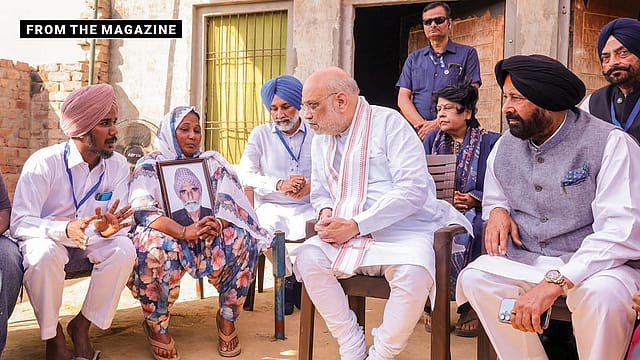
On October 20, Union Home Minister Amit Shah met the families of Jhota and Bikramjit Singh in Mansa and Gurdaspur, respectively. In his comments made in Ludhiana the same day, Shah said “I promise the people of Punjab that by December 31, 2029 we will finish the business of drugs in Punjab. Whoever tries to indulge in this business will be thrown behind bars by the Narendra Modi government.” He appealed to Chief Minister Bhagwant Mann to hand over the cases involving these killings to the Central Bureau of Investigation (CBI) as that was also the demand of the victims’ families. The state government has handed over Jhota’s case to the CBI, and the latter has begun its investigation in Mansa. The other case remains with the state police.
Viewed in isolation, these could be two random incidents in any state. But they are hardly that. Punjab is awash with drugs, and they are being sold openly. At Mansa, the chemist who killed Parvinder Singh, was selling them openly in his shop in the city’s main market. “Please go there and see. There is a police naka (barrier) 20 feet from the shop. Did that deter the shopkeeper? No. Everyone in the town knows who the kingpins are but no one did anything,” Sehajpreet, a childhood friend of Jhota, told Open at the protest site in Mansa on October 16.

The situation in Gurdaspur is different. There the source of drugs is cross-border trafficking from Pakistan through drones. “On an average day we intercept around a dozen drones in the area from Dorangla in the Northern part of the district close to the border, in the area beyond Batala. This is what we manage to intercept. There are drones that evade our nets,” a police officer told Open in Gurdaspur. The extent of the flow is hard to estimate. To give an example highlighting the extent of the problem, the Narcotics Control Bureau (NCB) and the Border Security Force (BSF) arrested a Punjab Police constable, one Karandeep Singh, on October 14, the day the state was in shutdown mode. Singh was detained with 15kg of heroin. He was, in fact, a member of the state police’s anti-drone squad. He is accused of helping smugglers who operate across the India-Pakistan border.
These incidents reflect deterioration in law and order. Even as people in various parts of Punjab were outraged at drug traffickers, those involved in selling drugs continued without any fear.
“Until two or three years ago, we only heard of these cases in cities. But now this poison has spread to villages,” Jagtar Singh, a farmer from Nandgarh village in Mansa district, who had come to the city for the dharna, told Open. “We had voted for them (Aam Aadmi Party or AAP) in the hope that they would make our lives better. Just see what they have given us,” he says while pointing his hand to a portrait of the slain activist.
It is evident that the spread of drugs in Punjab has served as a rallying point for its people in very different locations. What are the chances that the issue will have political consequences? After all, elections are not far-off and are due early in 2027. What does the present climate in Punjab say about politics in the coming months?
A direct answer is hard to discern, given the complexities of electoral politics in any state and political prognostication is hazardous even at the best of times. At the moment, both in Malwa and Majha regions of Punjab, there is simmering anger against the Mann government over the drugs issue. On the Bathinda bypass, from Tapa in Barnala district to the edge of the Delhi-Amritsar-Katra expressway in Sangrur—all in the home territory of Bhagwant Mann—not a single poster, or flex-board depicting the chief minister and AAP stands intact. Most have either been torn down or those that remain intact are not easy to damage. Whether this vandalisation is new, after the recent events, or precede them, cannot be assessed. But it indicates where things stand.
Extrapolating this is risky. The drugs issue has been around for a long time in the state but has never acquired the salience it now seems to have. For example, in the later years of Akali rule (from 2015 to 2017) and even the Congress government that followed (in 2017), identity politics acquired greater weight after repeated incidents of sacrilege involving the Guru Granth Sahib. Even in those years, involving two governments of different political complexion, the SAD from 2012 to 2017 and the Congress from 2017 to 2022, the drugs menace was around but the bigger political issue was incidents of sacrilege involving the Sikh holy book. Drug addiction and the havoc it wrought on Punjab’s society did not move politics, at least not directly.
It appears that matters are changing. The large number of people who assembled in Mansa on October 15 and on the days that followed came from different walks of life: there were farmers from different parts of Mansa district and from elsewhere in Punjab; there were various factions of the Bharti Kisan Union (BKU) from across the state as well as ordinary people. Slogans in favour of Amrik Singh, the leader of the All-India Sikh Students Federation (AISSF) and Jarnail Singh Bhindranwale were also raised from the platform at the dharna in Mansa on October 16, a day after the bandh across Punjab. Singh and Bhindranwale perished at the hands of the Army during Operation Blue Star. The fervour is largely religious and so are the voices even if the campaigner who was killed was working against the menace of drugs. One can dismiss the religious slogans as part of Punjab’s cultural milieu but there are plenty of clues in the anti-drug campaign—in general and not what transpired in Mansa—about Punjab’s politics.
Some 250km to the north of Mansa is the village of Khokhar Faujjian in Gurdaspur district. It is like one of the hundreds of nondescript villages that dot Punjab’s landscape. There is, however, one important distinction. The village boasts a football field turned into a stadium of sorts. The facility is replete with rooms for players and other facilities. There is a viewing stage built atop the facility where viewers and commentators can observe games. The local panchayat has spared no expense to develop the facility, an unusual feature in the increasingly poor state where social and political priorities are quite different from sporting concerns.
On Saturday, October 17, two dozen football teams were competing for the local Shaheed Bhagat Singh Football cup. Teams from as far away as Ambala in Haryana had come to participate in the event. On the stage, along with other local notables was Gurbinder Singh Jolly, a politician whose family had close ties with SAD (Amritsar), Simranjeet Singh Mann’s party, but who is now a member of Akali Dal (Waris Punjab De), the latest political outfit in the state. Its leader, Amritpal Singh, MP from Khadoor Sahib constituency, is under detention in Dibrugarh Jail in Assam. Jolly is now a contender for AD (WPD)’s ticket from the Fatehgarh Churian Assembly constituency in Gurdaspur district.
“The tragedy of Punjab is that people value the dead and not the living,” he told Open in Khokhar Faujian. “The campaigner from Mansa kept rousing people against the (drug) menace but no one listened to him when he was alive. Now everyone says they will follow his path,” Jolly said while keenly observing the ongoing football match.
But aren’t efforts like the one in this village—where sport is one way to keep youngsters away from harm—a way out of Punjab’s morass?
“Look at these children, how well they are playing. We have saved them (from drugs) for now. But once they find out there are no jobs, no work and avenues abroad have closed, they will sink into the same problem,” he said. “Do note that every party in the past has promised to eradicate the trafficking and spread of drugs. But once in power, under each party, the problem has only worsened,” he added.
It is not hard to see why AD(WPD) has a certain appeal in Gurdaspur and other parts of Punjab. In AD(WPD) lies the perfect combination of religious politics and a promise to eradicate drugs, something that many Sikhs find appealing. If the party comes anywhere near power, it will lead to a perfect political storm in Punjab for Amritpal’s party is also the contemporary bearer of Sikh separatism.
As matters stand, however, what AD(WPD) may end up achieving is something different. It is likely to woo voters who belong to extreme Akali factions and a slice of those who want to try “something new”, just as AAP was tried back in 2017. Whether that will lead to a political solution to the drugs menace is a moot question.
“The problem here is that our people don’t like BJP, even if it is one party that can potentially fix Punjab’s law and order as well as the drugs problem,” Palwinder Pannu told Open at Mari Pannuan.
Here is the contradiction that lies at the heart of Punjab’s politics. People want a government that is ‘tough’ and that can restore law and order. But historically, the state votes in a manner that reflects its opposition to anything that strengthens central authority in New Delhi. There are, of course, exceptions to the trend. But the trend is unmistakable: the idea of ‘resistance’, even if irrational, is etched in the minds of Sikhs. Will the spread of drugs change their minds? The coming months will provide an answer to that old puzzle.