MGNREGA: Recasting Welfare
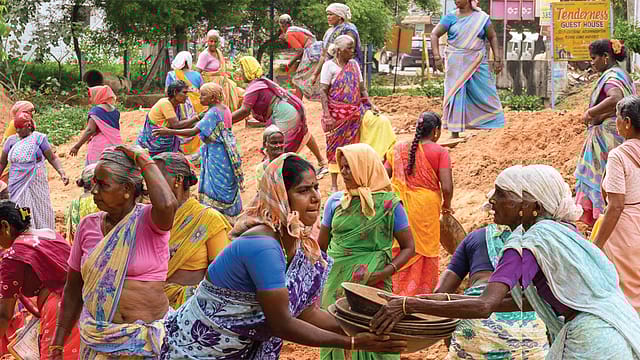
AFTER BECOMING PRIME MINISTER in 2014, Narendra Modi took a good hard look at the Mahatma Gandhi National Rural Employment Guarantee Scheme (MGNREGA) that promised 100 days of employment to eligible beneficiaries and the National Food Security Act (NFSA) that mandated cheap foodgrains to 67 per cent of the population. Modi decided against scrapping or drastically altering either of the schemes. It was perhaps the case that he was chary of attracting the charge of being ‘anti-poor’ and remained mindful of the price the Vajpayee government had paid for the ill-fated ‘India Shining’ campaign that was denounced for being ‘elitist’. India’s growth rate did indeed surge to 8 per cent in the Vajpayee government’s last year in office but failed to impress voters who felt they were in the rain shadow of reforms.
The Congress-led United Progressive Alliance (UPA) that replaced the National Democratic Alliance (NDA) in 2004 opted for rights-based schemes focusing on income and food ‘guarantees’ that helped UPA win two successive terms in office. There was merit in the thinking as the so-called ‘trickle down’ effect of reforms did not work fast enough to change lives at the bottom of the socio-economic pyramid. For many, India Shining seemed a mirage when compared to their own existence. A bottom-up approach that worked as a security net would in fact help build support for reforms, went the reasoning. The schemes framed by the Sonia Gandhi-led National Advisory Council (NAC) also sought to cast her in the role of annadata, or a benevolent patron, in a bid to borrow a page from Indira Gandhi’s populist ‘pro-poor’ playbook that had earned her accolades as ‘Indira Amma’.

The Liberation of Bengal
05 Jun 2026 - Vol 04 | Issue 74
A silent revolution ends the reign of fear
Framed by activists and leftist economists like Aruna Roy and Jean Drèze, the original NREGA was a vast socio-political project with a no-limits budget. The authors of the scheme have consistently opposed every measure to make it more accountable, accusing the Modi government of “exclusion” when Aadhaar-based identification of beneficiaries was introduced. Ahead of the 2019 Lok Sabha election, they paraded hundreds of allegedly excluded people in Delhi in a bid to support the Congress campaign. Aadhaar helped ensure that eligible people received foodgrains while cleaning the Public Distribution System (PDS) of duplications and fraudulent entries. It is
no surprise that the same set of activists and politicised economists are planning to oppose the reworked Act even though their argument that Parliament does not have the right to alter MGNREGA is puzzling given that is how the original law was brought into being.
While MGNREGA and the FSA pumped billions into the rural economy, Modi was not unmindful of the fact that expenditure was often wasteful and poorly accounted. The need to reform MGNREGA was, as a matter of fact, voiced even when UPA was in office. Jairam Ramesh, then minister of rural development and currently communications in-charge of Congress, had in 2012 said that the employment guarantee scheme needed to be about more than digging ditches and rejuvenating ponds. Nationalist Congress Party (NCP) leader Sharad Pawar, who was agriculture minister in the UPA government, had said MGNREGA was creating labour shortages during sowing and harvesting seasons, and suggested the scheme be halted for three months coinciding with farm activity.
As chief minister of Gujarat, Modi had understood that MGNREGA was vulnerable to corruption and leakages and he took steps to make the scheme more effective. A roundabout process of payments was simplified so that beneficiaries received wages on time and geo-tagging was introduced to check whether sanctioned works were actually carried out. The permissible list of activities was expanded and Aadhaar-based transfers checked misuse. In a case in Uttar Pradesh (UP), a set of fingerprints was used to make repeated withdrawals but the electronic trail helped authorities quickly track down the miscreants. The FSA, too, was prone to leakage and making the PDS efficient and accountable was accorded priority even as storage depots were modernised and foodgrain stocks tracked remotely.

Over the years the Modi government regularly underlined its success in making large payments under MGNREGA, and the scheme helped offset the shock of the November 2016 demonetisation and the Covid pandemic in 2020-21. Yet, the budgets were touching astronomical heights. The 2024-25 Union Budget allocated `86,000 crore for MGNREGA and the final expenditure was only a shade less. In 2020-21, the Budget allocation was `61,500 crore and the spending was `1,11,170 crore. While this can be attributed to the impact of economic shutdowns due to Covid that directly impacted livelihoods, the spending in 2022-23 was `90,810 crore against a Budget estimate of `73,000 crore. In 2023-24, the outgo was `89,268 crore against the Budget estimate of `60,000 crore. The question whether the Budget allocations were underestimates needs to be considered, but MGNREGA was a demand-driven scheme with the Centre obligated to meet the bills generated by the states. The open-ended nature of the scheme encouraged states to incur expenditures without much concern about accountability. A scheme conceived as a fallback measure in an emergency like drought or flood—essentially a safety net—had become a means of regular payouts even if it was not quite dole. It became increasingly obvious that something had to give.
The renaming of the Act as Viksit Bharat—Guarantee for Rozgar and Ajeevika Mission (Gramin) was the first part of the shock therapy. The decision to do away with Mahatma Gandhi as the prefix to the Act drew angry remonstrations from Opposition benches when Shivraj Singh Chouhan, agriculture and rural development minister, presented the Bill in Parliament on December 16. The acronym G-RAM-G used to describe the Bill, a deliberate play on words, drew the Opposition’s ire. Leader of the Opposition Rahul Gandhi said the move reflected the Modi government’s hatred for the Mahatma’s ideals. The Bharatiya Janata Party (BJP) said the Bill was a much-needed rationalisation and that the legislation embodies the vision of Ram Rajya and its values espoused by Gandhi. An examination of the Bill reveals that an increase in the number of days of guaranteed employment, from 100 to 125, is accompanied by a well-defined sharing of costs between the Centre and the states. In the case of the Northeast and Himalayan states and Union territories—comprising Uttarakhand, Himachal Pradesh, and Jammu & Kashmir—the fund-sharing pattern is 90:10, but for all other states it is 60:40. Moreover, the Centre is to decide the “state-wise normative allocation” for each financial year based on “objective parameters” to be defined by it. The Centre will set up a national-level steering committee to recommend decisions relating to the allocations and will, significantly enough, review performance of states and recommend “corrective and supportive” measures. Any expenditure in excess of determined allocation is to be borne by the state government. And last, all works under the revised Act will be aggregated into a Viksit Bharat national rural infrastructure stack that will be a comprehensive listing of work aligned with national development priorities.
It is evident that apart from the significant overhaul of policy prescriptions, G-RAM-G is a major political reset to end the ‘open tap’ approach that amounted to splurging money rather than enabling sustainable employment. In seeking to replace the populist welfarist scheme with a more closely defined and fiscally disciplined one, the government has acted more in keeping with the prime minister’s instinctive distaste for wasteful expenditure. The move is evidence that the Modi government is prepared to bite the bullet and run the risk of accusations of being ‘anti-poor’, a label most dispensations are wary of. The conviction stems from a belief in fiscal conservatism and the need to make states participate in shared accountability by having to foot a chunk of the funding. Getting beneficiaries off payouts is notoriously difficult and G-RAM-G is indeed a strong dose. It is prescriptive in its desire to set spending limits for states and sets out the responsibilities of panchayats at district level and the district programme coordinator (an officer such as the district collector) in considerable detail. The panchayats are to register households, receive and process work applications, execute works and maintain records while the programme coordinator is to consolidate and finalise the district aggregate plan. The coordinator will ensure compliance of the Act, accord administrative sanction, oversee management of information, conduct inspections, and redress grievances.
THE POLITICAL RESET is monumental as it draws down and curtails gravy train policies. Modi’s decision to continue with MGNREGA had not been a decision based on political considerations alone as he understood that the rural poor need support. But initiatives like Drone Didis and PM Vishwakarma Scheme that offer equipment, skill upgrades and collateral-free loans are seen to encourage people to earn incomes rather than seek handouts. It is true that the Modi government has claimed credit for spending nearly `7.8 lakh crore under MGNREGA in early 2025, and has also consistently patted itself on the back for providing free foodgrains to 80 crore people under the FSA.
The reform of MGNREGA seeks to balance concerns about reduced spending by increasing the number of days of guaranteed employment and asking states to share the bill. In the case of the FSA, it is quite evident that mandated coverage of 67 per cent of the population raises the strong possibility of the deserving being lumped with the less worthy. It remains to be seen if a rationalisation of the FSA will be attempted in future. It would be consistent with the changes in MGNREGA. The decision, like the one to finally notify the new labour codes, could be the result of the confidence generated by a gratifying electoral victory in Bihar that followed successes in Haryana, Maharashtra, and Delhi. The big win in Bihar validated the government’s development strategies and while Modi has not been constrained by electoral results in the past—rather, he seems to believe defensive tactics do not pay—the current moment might be propitious.
The election victories have wiped out the morale deficit caused by BJP underperforming in the 2024 Lok Sabha polls when it failed to get a majority of its own. But the prime minister has not paused in his third term, campaigning during state polls with undiluted vigour. He remains on message, a careful mix Hindutva, nationalism, economic well-being and welfare measures initiated by the Centre. After tagging Congress and other I.N.D.I.A. parties as “pro-infiltrator”, Modi dwells on India’s success against Pakistan during Operation Sindoor, the improvements in the rating of India’s economy, and the benefits of a “dual engine” government. The wins in state polls have been hard earned and provide an opportunity for moving forward on difficult reforms that have become more urgent in light of global uncertainties and challenges, such as the US tariffs on Indian exports. Seen in this context, the rationalisation of the Goods and Services Tax (GST), operationalisation of labour codes, and pruning MGNREGA are all intended to make the economy more efficient and curb profligacy. The weaponisation of trade and tariffs poses serious long-term challenges even if the immediate difficulties with the US are resolved. It is apparent that tariffs as an issue in US domestic politics will not fade anytime soon even as India’s trade deficits with other nations like China are a cause for worry.
In 2014 the new Modi government was yet to unroll its welfare-development schemes and, therefore, altering the MGNREGA and FSA programmes would have sent a wrong signal and played into the hands of critics warning of a deregulatory blitz, aggressive privatisation, and rollback of government in keeping with the “minimum government, maximum governance” slogan of the BJP campaign. Instead, the role of government in welfare delivery and development infrastructure has only expanded and policy infrastructure has become more detailed and overarching. G-RAM-G redefines government activism by tying it firmly to a rules-based order and economic viability.