Kerala Assembly Elections 2026: The Pinarayi Plebiscite
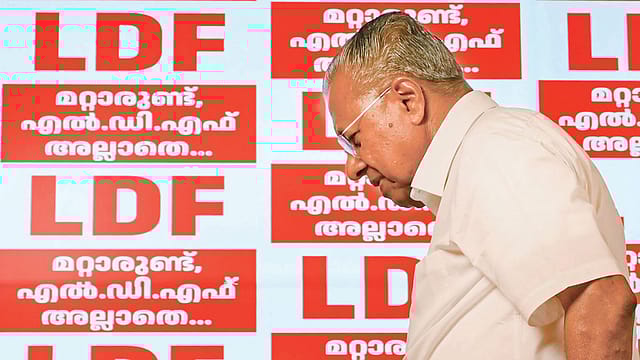
AS KERALA VOTED on April 9 in the state Assembly election, the divide was broadly between those who backed Pinarayi Vijayan and those who did not. The chief minister who completed two full terms in office—a record for Kerala—is simultaneously the most liked and the most vilified political figure in the state. The 80-year-old evokes extreme views: that of ardent admiration and visceral hate. A trip across Kerala speaking to common people reinforces that observation beyond doubt. As the most prominent communist leader in the country, a victory for Vijayan’s coalition, the Communist Party of India (Marxist)-led Left Democratic Front (LDF), will mean triumph for his brand of politics in the last outpost of Marxists in the country. A loss would mean Vijayan will stand to shoulder the blame alone, with the media and his rivals dismissing him as a loser and his comrades as a messiah who couldn’t deliver and turned into a liability. A defeat will be interpreted as a personal defeat for Vijayan who, de facto, presides over the fate of the biggest constituent of the Left in the country.
More than 2,000 hoardings depicting Vijayan have been set up in key locations across the state. While many people across age groups look up to him as the mascot of the state’s development initiatives of the past decade and of continuity, many others look down upon him as the spearhead of a losing alliance, symbolising absolute power and hubris. Most people Open surveyed didn’t voice any specific complaints about his governance, infrastructure push or welfare schemes, but still thought that 10 years was a long time for any party to be in power in Kerala, a state that since the early 1980s has seen incumbent governments thrown out of power every five years, until Vijayan broke the record in 2021 in an emphatic win, securing 99 of 140 seats in the state Assembly.
Five years ago, Vijayan was perceived as the poster boy of a dispensation that led the state through the floods, the Covid-19 outbreak and other odds. Now, it is tough not to realise that, perhaps in a state that prides itself on being fair-minded, a sense of fatigue has set in. “We are a community that doesn’t have tolerance for long rule by anyone. In that sense, 10 years is seen as a long time. But then each constituency is different. It is as if we are having 140 elections in one go,” says a CPM insider, as though consoling himself and hoping for the best.

Vijayan and 11 of his ministerial colleagues were in the fray this time—in total, 56 sitting legislators sought re-election on April 9. This is why some analysts state that what these 56 MLAs did by virtue of being part of the ruling coalition and their familiarity with their constituents may help LDF. On the other hand, several polls suggest an edge for the Congress-led United Democratic Front (UDF) as people seek change.
Surprisingly, the CPM camp and people close to the chief minister are optimistic of a re-election. Even in personal chats, they seem convinced of a victory even though they agree that the LDF tally would drop considerably from last time. CPM has contested from 86 seats, including 75 of its own party candidates and the rest independents backed by them.
What is shocking though is that their projection of a win flies in the face of the character of the CPM cadre which has changed from being absolutely obedient to the party to waiting for an opportunity to strike back at the leadership. In the party stronghold of Kannur, the birthplace of Vijayan, CPM rebels have emerged as challengers in two crucial constituencies of Payyannur and Taliparamba. “Vijayan has been an undisputed leader within CPM in the sense that within party forums very few people question his decisions and choices, especially in the past one decade of him being chief minister,” says a party leader, adding, however, that “the exit of several party leaders, especially G Sudhakaran in Alappuzha, who decided to contest against the party by aligning with UDF, shows that something is brewing within the Stalinist confines of CPM.” True, it is not for the first time that CPM has faced challenges from within, but then the readiness of even senior party members to immediately join hands with political rivals in a swift realignment of forces has left CPM’s top leaders confused.
Vijayan has been a dyed-in-the-wool communist and disciplinarian who attracted fear from within the party even when his political role was confined to Kannur in the early 1980s. Office secretaries in Azhikodan Mandiram, the district headquarters of CPM in Kannur, used to warn student and youth leaders about arriving late from their activities on nights when Vijayan had decided to stay overnight at the office. “Mind you, this was when Vijayan was just a district-level leader,” said one of them. “Leaders far senior to Vijayan were milder, not a fearsome character like him.”
In fact, a delegate at the Visakhapatnam Party Congress of CPM in 2015, its high-level triennial summit, wanted the leadership to incorporate in the political resolution the right to work without fear of party honchos. Under the title ‘Tasks’ in the ‘Draft Political Resolution’, a delegate proposed the insertion of a paragraph to fight authoritarianism within the party, thus putting the spotlight on the tyrannical tactics employed by some Marxist bosses in the party stronghold of Kerala to quell dissent (‘What’s Left, Comrade Yechury?’, Open, May 5, 2015). That the delegate was critical of the Vijayan style of politics was no secret.
Open had pointed out in a recent article that Vijayan thrived without ever diluting his fiery ways within the organisation, although he has switched to not being a prisoner of ideology in governance. When he became an MLA aged 25 in 1970, he was the youngest legislator in that House. Yet, former Legislative Secretary Dr R Prasannan’s memoir described Vijayan as someone breathing fire in his words and eyes. Aggression and ferocity were words used even by his former comrades within the communist party and outside. “He may have mellowed down from what he used to be in the past, but not much,” says a former CPM leader close to Vijayan.
HIS RISE IN CPM, as often noted in Open, was meteoric and against odds. After serving two terms in the Assembly in the 1970s, his former mentor MV Raghavan began to marginalise him, and Vijayan was forced to stay on the fringes from 1980 to 1985. In 1986, Vijayan was back at the helm as Raghavan faced disciplinary action inside the party. From then on, Vijayan has had a rise that had the potential to detach politicians from reality. He rose to become the district secretary of Kannur in 1986; a few years later he was included in the topmost panel of decision makers—the state secretariat. A few ups and downs here and there, he was back in 1996 as the minister of power and of cooperation, two plum portfolios, in the EK Nayanar ministry of 1996. He was only 51. Two years later, he became the state secretary of CPM, a powerful position back then. Since then, notwithstanding the prolonged battle for supremacy with his former mentor VS Achuthanandan, he began to wield more and more power within CPM as the ageing Achuthanandan finally lost out to him. The famed “VS Group” ceased to exist by the time Vijayan relinquished his position as CPM state secretary in 2015 and became the chief minister in 2016. By then, CPM had lost power after 34 years of uninterrupted rule in West Bengal and was two years away from being vanquished in its other stronghold, Tripura.
In 2021, when he was re-elected the chief minister of Kerala, Open had interviewed Jacob Punnoose, former director general of police of Kerala (‘Pinarayi Vijayan: The Invincible’, Open, May 17, 2021). He was all praise for Vijayan, saying, “Under the chief minister’s leadership, the state police could achieve what other states could not in the face of natural calamities.” Similarly, TKA Nair, former principal secretary and later adviser to Prime Minister Manmohan Singh from 2004 to 2014, brought up two examples to highlight Vijayan’s calibre, one in which he had played a role while at the Prime Minister’s Office: the GAIL pipeline. The land acquisition was cumbersome under various chief ministers, but Vijayan made it happen in Kerala despite protests from certain quarters.
Technically, the advantage that Vijayan has this time is that none of his rivals either in Congress or the Bharatiya Janata Party (BJP), which is hoping to make an impact in Kerala’s bipolar politics, are as seasoned and experienced as he is. Congress’ VD Satheesan, the outgoing leader of the opposition, has challengers from within, according to people close to the matter. Although CPM had not declared Vijayan as the party’s chief ministerial candidate, for all practical reasons, he is seen as the chief ministerial face of the party. “For the central leadership of CPM, it is very difficult to rein in Vijayan and suggest another name for chief minister because he is too powerful and resourceful to be forced to take a backseat,” says a senior CPM leadeer. If the party wins, the only disadvantage he has is his age. Vijayan is also a cancer survivor.
But then a victory this time around won’t be easy for a raft of reasons, including alienation among Muslim voters. Again, BJP has penetrated many traditional Left pockets, including in districts such as Kannur and Alappuzha. One can also spot this trend in CPM turfs such as Vadakara, Thalassery, Koothuparamba, and several parts of the northern district of Kozhikode. The Christian community in these parts are now predominantly supportive of BJP, thanks to their growing hostilities with the Muslims. More worrying for CPM, meanwhile, is the growth of BJP in areas dominated by Ezhava and Dheevara communities, who have long been engaged in coir-making and fishing.
When it comes to changing political allegiances in Alappuzha, one of CPM’s strongest bases, it appears that BJP is slowly making inroads into villages in the district. “One example is Karthikappally panchayat. BJP has been working there for many years to build a base and in the recent local body elections, it has gained an upper hand,” says a Kerala researcher who has studied this trend. “If you stroll through the panchayat, you can see what is happening. BJP supporters speak a well-crafted narrative from India’s position during the West Asian crisis (how we are at peace) to issues like Kashmiri Pandits and how we manage to have defence production of our own.” Karthikappally has become important for BJP for several reasons, he goes on. “One key factor is their consistent groundwork. They have built an active team that engages with people, helping with everyday issues, assisting in panchayat matters, and actively participating in local festivals. There are also cultural shifts. The nature of festivals is changing, with new practices coming in, and there is an effort to rewrite stories around historical figures like Velayudha Panicker. These changes subtly introduce an upper-caste narrative in what has traditionally been an Ezhava belt,” the researcher notes, adding that BJP members also raise concerns like youth migration and the presence of migrant labourers (especially Bengali workers). BJP is also targeting the working-class electorate in areas like Thrikkunnapuzha, Arattupuzha, Kumarapuram, and Karuvatta where the Ezhava community is influential, he points out.
Vijayan as chief minister is different from typical communist chief ministers who always had the party lassoing them with vigour. In the past, every communist leader in Kerala had a counterweight within. For instance, MN Govindan Nair was a formidable presence when EMS Namboodiripad made history after the 1957 polls by becoming the first head of an elected communist government in Asia and the third in the world. Even the widely popular Nayanar had Achuthanandan and others watching his every move. Achuthanandan, when he became chief minister in 2006, had to contend with a domineering Vijayan. Vijayan as chief minister, however, has had no such challenger.
In his twilight years, however, Vijayan faces perhaps his most consequential test amidst relentless public scrutiny. If he steers the coalition to victory, he will earn the aura of a leader who restored momentum to the fading fortunes of Indian communism. If he falters, a media ecosystem long hostile to him will swiftly cast him as the man who presided over the slow liquidation of Kerala’s communist movement. May 4, when the election results are declared, will be nothing less than a day of reckoning.