It’s Not Yet Done, Bro
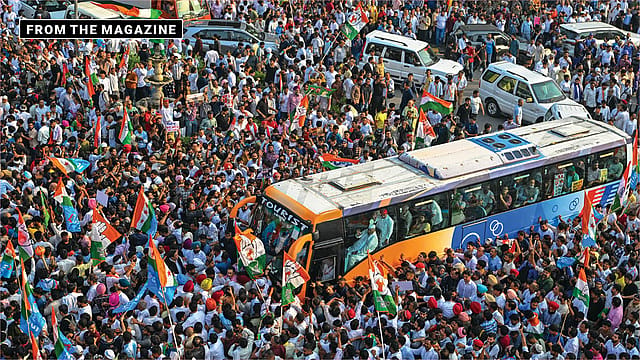
The policemen trying to regulate traffic at the roundabout leading to the Constitution Club are harried. It is half past 12 on October 12, and an opposition march against India’s chief election commissioner is due to begin here shortly. One policeman furiously waves away cars trying to enter the club. The soles of his shoes have collapsed; his face has the look of an aircraft grounded after a bird strike.
At the entrance to the club, the crowd is swelling by the minute. It is difficult to tell who belongs to the media and who is a political worker. Everyone has a mobile phone camera switched on; everyone seems to run a YouTube channel. Many have arrived with inventive posters and slogans, each hoping to make his or her performance count. Young men and women walk up and down the road, speaking into their cameras without pause. Television journalists glance at them while waiting for their own cues; it is difficult to match that energy. The television channels have sent their familiar, supposedly neutral faces. After what happened at Jantar Mantar earlier this year, those who wish to criticise the anti-government protest seem happier doing so from the safety of a studio.
Against this restless activity, a voice issuing warnings from loudspeakers fixed to electric poles has the quality of an apparition. If one ignored the words, the female voice could be making announcements at a railway station. Here, however, she speaks of Sections 163 and 223 of the Bharatiya Nagarik Suraksha Sanhita (BNSS), adding, with bureaucratic vagueness, “as per circumstances”. The voice goes on. People are warned against assembling; journalists are instructed to maintain their distance from protesters.
Across the road, government employees from Shram Shakti Bhawan have come out for lunch. They stand behind the mesh fence, watching. By the time Mamata Banerjee arrives in her car, there is already a sizeable audience on both sides of the road. A little later, Jairam Ramesh walks in. A well-known television journalist from an earlier era arrives with her crew and begins interviewing the first man she encounters carrying a poster.
Soon a bus carrying senior Congress leaders, including Mallikarjun Kharge, pulls up. It resembles one of those tourist buses that take visitors around Delhi to see its historical sites. A few minutes later, a cavalcade of cars carrying Rahul Gandhi and others sweeps into the club. A group of policemen then barricades part of the road leading to the exit.
The plan is to march to the Supreme Court. Outside the club, journalists and other content creators wait. The previous day has been a bad day for the press. Several journalists were detained and roughed up by the police. On this day, it seems that every available force has been brought in. There are personnel from the CRPF, the BSF and the CISF. A group of women police officers passes by—they are so young that they could have been brought straight from a training centre.
Nearby, one journalist asks another, who runs a successful YouTube channel, whether he manages to break even. The two move to a corner to discuss trade secrets.
Soon the procession sets off. There is a large mobilisation of Congress workers, joined by workers from other parties, including the Samajwadi Party and the Indian Union Muslim League. They move along Ferozeshah Road, followed by buses and cars. The leaders are inside the vehicles; the workers walk.
The heat has risen, intensified by the crush of bodies. Shirts are wet, mouths parched. Those who have not brought water begin looking for some. Outside an apartment complex, someone discovers an earthen pitcher filled with drinking water. It empties quickly. People try to move towards the front, but yellow barricades block stretches of the footpath. They walk through the newly planted beds of roadside nurseries, trampling the plants.

Outside the Le Méridien hotel, the crowd encounters its first barricade. It is breached without much difficulty. The barrier seems almost decorative, put there to suggest that the police have prepared for the march. Two journalists remark that the strategy appears to be to let the protesters tire themselves out and then put them on buses.
The procession moves towards Barakhamba Road. A member of civil society says that he has spoken to Yogendra Yadav. Yadav had been expected at a meeting at Himachal Bhawan, but the meeting was cancelled at the last moment and everyone was asked to assemble at the Constitution Club instead.
By now, a large contingent of NSUI workers has joined the march, along with young people from other parties and their student organisations, including AISF and RJD. The RJD contingent has arrived armed with Gen Z slang directed at Gyanesh Kumar. Among the AISF workers is a young man in a black t-shirt and shorts, his face concealed by a Batman mask. The mask will later find its way on to the truck carrying the opposition leaders. It will pass through Rahul Gandhi to Kharge, who will try it on.
By the time the procession reaches the end of the road near Connaught Place, the street has become a mass of people. The bus carrying Congress and other opposition leaders stops. Ahead of it is a decorated truck. It is assumed that Rahul Gandhi will get down and address the crowd from there. The bus waits.
By now, many people who do not appear to belong to any party have joined the procession. A woman stands with the Tricolour raised to her face. She has been standing like this for hours. Young and old people line the road, watching the march go by. Then the bus begins to turn around.
Some people try to contact the leaders inside, but no one seems to answer the phone. There is no clear communication about what is going to happen. Those who have been waiting for Rahul Gandhi to emerge and speak from the decorated truck are disappointed. Some workers lower their flags and begin to leave.
Only later do we learn that Rahul Gandhi has chosen to walk for a while with his sister, Priyanka Gandhi, and Neha Bora, the student leader who has in many ways become the face of the protest. The walk ends somewhere along Bhagwan Das Road. A range of opposition leaders, from the Gandhi siblings to Akhilesh Yadav and representatives of the Left parties, then climb on to the truck. Some workers climb on to buses parked nearby, brought there for the likelihood of detaining them.
There is an overwhelming police presence. Around the truck, the crowd moves in restless circles, like a swarm of ants. Young lawyers from nearby offices have stopped to watch. Residents of the neighbourhood have joined them. They have come to see Rahul Gandhi. They wave at him, trying to catch his attention.
At some point, he tries addressing the crowd, but the sound system is just too weak to amplify his voice over the din. Some try to gesture to him that they cannot hear him, but he doesn’t seem to notice; neither does anyone from his party tell him that.
He walks from the front towards the middle of the truck. From where we stand, we can see Akhilesh Yadav and Tejashwi Yadav laughing at a joke. They lean down to catch television microphones and deliver sound bites. Revanth Reddy stands nearby, all by himself. So does Sukhvinder Singh Sukhu, whom a journalist briefly mistakes for the Congress leader who defeated Smriti Irani in Amethi. The most animated among the leaders is Yogendra Yadav, who is busy working the crowd.
On the road, Mohammed Farooq watches. He has come to the protest from Barakhamba Road. He is about fifty and moved to Delhi from Madhepura, Bihar, about three years ago.
“Abhi bahut thakgaye hain, sach mein badlaav chahiye,” he says. We are tired now; we really need change.
Around the same time, Alka Lamba pushes through the crowd and asks someone to help pull her up on to the truck.
The content creators continue recording. The policemen watch the crowd swell and shift. They look towards the leaders on the truck and wait. The road ahead is blocked by barricades, with a line of women police personnel forming a human barrier in front of them.
The truck eventually turns back.
By now, Neha Bora seems to be the only person on it with any energy left to spare. She waves, flashes victory signs, raises her fist and throws a water bottle down to someone in the crowd. It is time to leave towards the Supreme Court, which we learn later.
The policemen move forward together, blowing their whistles in unison. The sound produces a small atmosphere of coercion. A few protesters are manhandled. Those who have climbed on to the buses are told to get down; some stumble as they descend. Nearby, an ice-cream vendor has done excellent business. His cart is empty. The policemen, too, begin to remove their heavy gear and climb into the buses.
A Congress supporter, Vishal Gupta, standing nearby is pleased with the day’s mobilisation. But he is unsure whether the party can sustain this energy. Bahut jaldi thak jaate hein, he says. They tire out easily. He almost looks up to the sky as if praying for this to not happen.
Congress has been telling the chief election commissioner: It’s done, bro.
But for Rahul Gandhi, the party’s well-wishers might have a different message.
It's not yet done, bro.