‘It’s DONE, BRO!’: BJP Taunts Rahul Gandhi as Stalin Backs Delimitation Bill and JMM Sets Terms
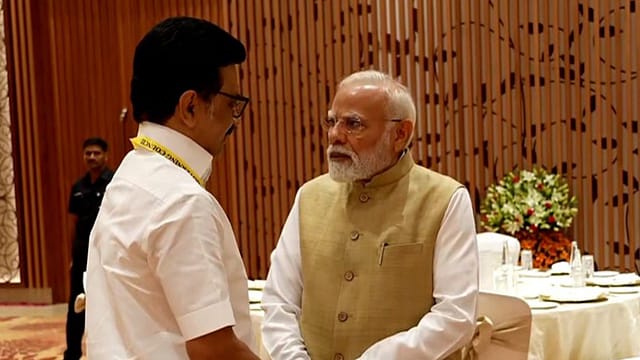
“It’s DONE, BRO!” Karnataka BJP president BY Vijayendra’s message to Rahul Gandhi on Sunday was a dig at the Congress leader’s appeal to “Brother Stalin”. Gandhi had gone to Chennai with other INDIA bloc leaders to persuade DMK president MK Stalin to oppose the Centre’s revised delimitation proposal. Stalin heard them out and stood by his decision to back it.
The parliamentary arithmetic was less settled than Vijayendra’s verdict. The DMK, the YSR Congress Party and the NCP (Sharadchandra Pawar) have indicated support for the revised proposals, bringing the estimated number on the government’s side to around 354 in the Lok Sabha, according to ANI. If all 540 sitting members cast a vote, the two-thirds threshold for the constitutional amendment would be 360.
Hot Pursuit
27 Nov 2026 - Vol 01 | Issue 02
The Shah Doctrine of Internal Security
That leaves Congress with a more immediate question than how to answer Vijayendra. Can it persuade parties that govern alongside it to vote with it? In Tamil Nadu, Stalin says the revision protects gains the DMK secured for the state. In Jharkhand, where Congress shares power with the Jharkhand Mukti Morcha, JMM legislator Basant Soren said his party’s support would depend on what the bill delivers for the state and its people.
Two BJP state chiefs, two messages about Stalin
Vijayendra accused Gandhi of calling Stalin his brother when Congress needed the DMK, then siding with its political rivals to form a government. He said Congress owed much of its own electoral strength in Tamil Nadu to an alliance of two decades and accused it of having betrayed the party whose help it was now seeking.
“The DMK and other parties have finally seen through Congress’ political game,” he wrote on X. Defeating the bill, he argued, could itself cost southern states political representation. He accused Gandhi of putting his own political future ahead of theirs.
Tamil Nadu BJP president Nainar Nagendran chose to address the man who had turned Congress down. Speaking at Tiruchirappalli airport, he thanked Stalin for holding his ground and said he had seen the former chief minister demonstrate his leadership in the Assembly. Nagendran argued that the proposal served Tamil Nadu as well as the country and put the state’s prospective tally at 59 Lok Sabha MPs under his reading of the population formula.
Stalin’s own case rests on Tamil Nadu’s share of an expanded House. The DMK supports the proposed 50 per cent increase in parliamentary seats across states while insisting that Tamil Nadu retain its existing 7.18 per cent share. After meeting Gandhi, Sonia Gandhi, Mallikarjun Kharge and other Opposition leaders, Stalin said defeating the revised bill could leave the state without even the minimum safeguards his party had secured.
In Jharkhand, the argument is over 28, 32 and 42 seats
Congress has made a different appeal to the JMM, which has three Lok Sabha MPs. Its argument concerns the proportion of seats reserved for Adivasis in the Jharkhand Assembly. AICC in-charge for Jharkhand K Raju said that if the Assembly grew by 50 per cent, its 28 reserved seats would have to rise to 42 for Adivasi representation to keep pace. He claimed the proposed framework would yield only 32.
On Raju’s calculation, Adivasi voters could see the number of reserved constituencies rise and still see their share of the Assembly fall. He said the legislative package lacked a corresponding constitutional provision to guarantee a proportionate increase. He also questioned the proposed Delimitation Commission, citing Congress’s concerns about the conduct of the Special Intensive Revision of electoral rolls.
The census figures at issue serve different purposes in the Centre’s proposal. It would retain the 1971 population basis for allocating Lok Sabha seats among states until 2051, while using the 2011 Census to redraw constituency boundaries and determine seats reserved for Scheduled Castes and Scheduled Tribes. The figure of 32 is Raju’s projection of the impact on Jharkhand.
Raju expressed confidence that the JMM would oppose the bill. Basant Soren stopped short of giving Congress that assurance. Chief Minister Hemant Soren had already conveyed the party’s conditions, he told ANI. “If it is fair and in the interest of the public and the state, we are completely in support; if it is anti-people and anti-state, we will strongly and completely oppose it.”
JD(U) puts women’s reservation at the centre of the debate
JD(U) national working president Sanjay Jha challenged Congress on its own record. “Did the Congress not carry out delimitation in the past?” he asked. Jha argued that the most significant consequence of the package would be to give effect to one-third reservation for women in the Lok Sabha and legislative assemblies. Women across the country, he said, would be watching the proceedings.
Congress and other Opposition parties have supported women’s reservation. Their objection is to making its implementation contingent on delimitation and to the population figures the Centre proposes to use. They have called for the exercise to be based on the latest census data. Jha accused Congress of “negative politics”, arguing that resistance to the package would hold up a measure it professes to support.
What comes before the Lok Sabha on Monday
The revised list of business for November 30 says Home Minister Amit Shah and Law Minister Arjun Ram Meghwal will seek leave to introduce three bills: the Constitution (132nd Amendment) Bill, 2026, the Union Territories Laws (Amendment) Second Bill, 2026, and the Delimitation (Second) Bill, 2026.
The package proposes raising the Lok Sabha’s maximum strength to 850, with up to 815 members from states and 35 from Union Territories. It also provides for readjusting Assembly strength, redrawing constituencies and implementing women’s reservation in the Lok Sabha and in state and Union Territory assemblies.
INDIA bloc floor leaders are due to meet at 9.45 am before the sitting. Vijayendra’s taunt captured the outcome of the Chennai visit: Congress asked Stalin to change his mind and he declined. The outcome in Parliament remains open. Monday’s listed business is the introduction of the bills. When the amendment comes to a vote, the number of members who turn up and cast a ballot will determine how far the government’s estimated 354 votes take it.
With inputs from ANI