I.N.D.I.A. Falling: The Unravelling of an Alliance
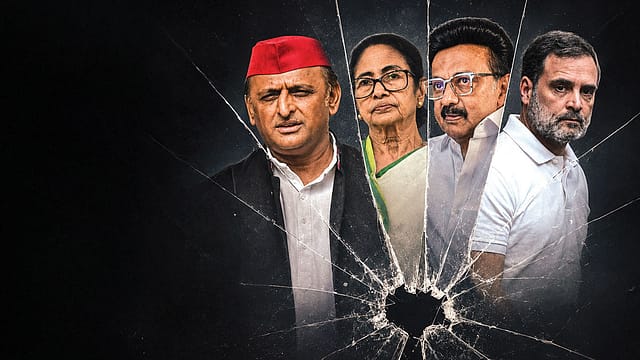
ON JUNE 8, AT THE CONSTITUTION CLUB OF INDIA LOCATED IN THE heart of Lutyens’ Delhi not far from Parliament and the residences of ministers and lawmakers, there was a scent of decay—of morale—among the participants of the I.N.D.I.A. bloc meeting. As it progressed, a sense of urgency that was seen in the past, at least for collective preservation, soon transformed into one of self-preservation by individual parties. What was obvious was that there was everything except cohesion among the so-called allies of Congress, which heads an alliance of sorts meant to be a credible alternative to the ruling Bharatiya Janata Party (BJP)-led coalition at the Centre. It has long been seen by a section of pundits and rivals as a combine that exists more in imagination than reality, bereft of any real mobilising capacity at the grassroots.
The opposition leaders who addressed the media were uncharacteristically taciturn. The reasons were not far to seek. Even as Congress President Mallikarjun Kharge read out a five-point agenda the leaders were aware that a group of Trinamool Congress (TMC) MPs had declared themselves a separate group and had met BJP leader Bhupender Yadav. The split in the Lok Sabha group mirrored the division in TMC’s West Bengal legislative party and veteran leader and Barasat MP Kakoli Ghosh Dastidar announced the rebels would support the National Democratic Alliance (NDA).
Earlier in the day, symptomatic of the crisis facing the opposition grouping, Congress leader Rahul Gandhi picked a quarrel at the meeting with one of the alliance’s most loyal allies—and quite an unlikely foe—D Raja, general secretary of the Communist Party of India (CPI), arguably the constituent most favourably disposed towards the Nehru-Gandhi family. It is said that when the Communist Party of India (Marxist), or CPM, contemplated giving the meet a miss to respect the sentiments of its cadres in Kerala and elsewhere, CPI was determined not to ditch Congress and would make it to the meeting.
Raja merely asked Gandhi Jr why he had accused the Left parties of not being left enough in his recent speeches. Rolling up his imaginary sleeves, the Leader of the Opposition (LoP) in Lok Sabha retorted, “We said that based on facts.” Raja was taken aback and it was left to CPM Rajya Sabha leader John Brittas to step in and ask what exactly he meant by “facts”. Rahul Gandhi went on, with no sense of foreboding about being fact-checked, “You invited Adani to Kerala.” He was referring to the invitation extended to the Adani Group to build and operate the Vizhinjam International Seaport in Thiruvananthapuram.
“No, Mr Rahul Gandhi,” Brittas shot back. “It was your government that invited Adani to Kerala to build the Vizhinjam seaport.” In fact, the record is unambiguous, as Open had reported. It was the Congress-led United Democratic Front (UDF) government (2011-16) of late Kerala Chief Minister and Congress stalwart Oommen Chandy that had awarded the ` 7,525-crore contract to Adani Ports for the construction and operation of the Vizhinjam International Seaport. Chandy himself laid the foundation stone for the flagship transhipment project in December 2015.

At least three leaders present at the meeting told Open that Gandhi’s comments were so preposterous they were almost comical, reflecting what they described as his cavalier approach to the meeting. “It was quintessential Rahul Gandhi—casual, indifferent—and something we have long hoped would change because there is no point in an alliance like this unless we change,” said one of these leaders, who added that he did not wish to attack Gandhi Jr publicly the way the Congress leader often does to fellow I.N.D.I.A. bloc leaders.
The sharp exchange was not the only jarring note at the meet. Samajwadi Party (SP) leader Akhilesh Yadav noted that “recent” developments had put his party under pressure ahead of the Uttar Pradesh (UP) election next year. The suggestion that SP might face the threat of a split or that the odds had now lengthened was not lost on anyone. A leader who attended the meeting wondered if the timing of the meeting had been well considered. If the idea was to express solidarity with TMC leader Mamata Banerjee, the splits in her party were very bad optics.
The meeting, the first held in a long time and after the recent elections in four key states where the anti-BJP combine suffered humiliating defeats in three, saw several participants express frustration at the manner in which Congress had “taken them for a ride”. No doubt, the recent rout was a major political setback for the front and a significant advantage for the BJP-led coalition at the Centre, which has captured more states and expanded its electoral footprint.
While Mamata Banerjee, who attended the meeting along with her nephew Abhishek, was busy airing her grievances about party leaders—especially Lok Sabha members and MLAs—deserting her to join BJP, support NDA at the Centre, or split the party in West Bengal, Congress came under sharp attack from several allies, like SP, Rashtriya Janata Dal (RJD), and others. The criticism ranged across a host of issues, including the manner in which Congress had let down the Dravida Munnetra Kazhagam (DMK) which had categorically stated that it wanted nothing more to do with Congress before skipping the meeting altogether, alongside the Aam Aadmi Party (AAP). Meanwhile, Banerjee said she required help mobilising civil society groups and support from other alliance members to keep her diminishing political entity intact. Those who attended the meeting said Banerjee not only looked crestfallen and anxious but also appeared to be at her wits’ end. A photograph of her hugging Sonia Gandhi spoke volumes and went viral—till recently the TMC leader had steadfastly refused to consider Congress as anything more than a bit player in West Bengal.
“She was in a bad spot, with her own party men deserting her with each passing day,” said one participant. Within days, TMC lawmaker Saayoni Ghosh reportedly quit the party to join rebel MPs, at least 20 of whom have pledged support to BJP. Similarly, Sushmita Dev, another TMC MP, resigned from all party posts before meeting Assam Chief Minister Himanta Biswa Sarma at his Delhi residence. What is unfolding now is not merely a series of defections but a broader unravelling of the party that came to power in West Bengal in 2011, ending 34 uninterrupted years of CPM-led Left rule.
Comments, both on and off the record, from members of the alliance are proof of what is at stake—the alliance itself—with party after party frustrated with Congress, whether they remain formally within the grouping or have already begun drifting away.
DMK LEADERS WHO spoke to Open said the party would continue to work closely with non-Congress I.N.D.I.A. bloc members and cooperate whenever necessary but ruled out participation in any alliance involving Congress, which they accused of betrayal. Speaking to Open, Kanimozhi, DMK leader, MP and daughter of the late M Karunanidhi, said, “What we have said is that we will cooperate with non-BJP parties based on issues.” She, however, declined to comment on whether DMK would cooperate with the five-point action plan announced by Congress chief and I.N.D.I.A. chairman Mallikarjun Kharge after the June 8 meeting. The action plan includes demanding that the Centre convene an all-party meeting on the economy, unemployment, inflation, farmers’ concerns, and other public issues; writing to the Chief Justice of India (CJI) regarding the Special Intensive Revision (SIR) exercise and allegations of electoral irregularities; and working towards the resignation of Union Education Minister Dharmendra Pradhan over the handling of the NEET and CBSE examinations. Kharge also said the parties would meet every two months to devise parliamentary strategy.
Kanimozhi said DMK had decided not to send a representative because “the leadership didn’t want to hurt the sentiments of party workers,” many of whom are opposed to any public display of affinity towards Congress. Before the polls, after several rounds of seat-sharing negotiations, DMK had allotted Congress 28 constituencies, three more than in 2021, besides offering a Rajya Sabha seat. DMK therefore reacted angrily after Congress extended support to Vijay’s Tamilaga Vettri Kazhagam (TVK) without taking DMK leaders into confidence and subsequently secured two ministerial berths and a Rajya Sabha seat from TVK. Vijay’s party has nominated Praveen Chakravarty—whose relations with DMK had already deteriorated long before the formal break—as the Congress candidate for Rajya Sabha from Tamil Nadu.
A senior DMK leader told Open that a section of his colleagues believes that the party, which once had an understanding with BJP during the Vajpayee era, should cultivate better ties with the ruling party at the Centre. However, A Raja, DMK deputy general secretary and MP, told Open: “We will not align with BJP. We are not part of an alliance with Congress, but we are friends with all other secular parties in the I.N.D.I.A. alliance.” There is, however, little doubt that the change of regime in Tamil Nadu has created room for potential realignments. SP, TMC, and DMK were the bedrock of the opposition to the women’s reservation and delimitation Bills. BJP leaders say they will revive the Bills the minute a two-thirds majority is feasible.
While many parties raised issues of alienation and internal dysfunction within the fragile alliance, particularly the treatment meted out to DMK, they also highlighted problems they themselves had faced at the hands of Congress. Akhilesh Yadav, who was invited to speak first at the meeting by Kharge, remarked that Congress has yet to realise that leadership within an alliance at the state level naturally rests with the dominant regional player. In UP, he said, that party is SP. He regretted that such an understanding still eludes Congress and argued this failure prevents the alliance from capitalising on what he described as growing public disenchantment with BJP over inflation, hardship, poor service delivery, and other pressing concerns. “When a UP Congress leader is asked whether SP and Congress are in alliance nationally, he says no. That is the state of affairs in Uttar Pradesh,” he told the meeting, stressing that the front needed to examine why several leaders, including Nitish Kumar, had left it. He, like many other leaders, such as Supriya Sule of the Nationalist Congress Party (Sharad Pawar) and Mamata Banerjee, expressed concerns about DMK’s exit from the grouping.
For his part, RJD leader Tejashwi Yadav also used the occasion to air grievances against Congress at a time when the alliance ostensibly needed to present a united front against BJP. RJD had earlier blamed Congress for the disastrous performance of their alliance in Bihar, where Congress won only six of the 61 seats it contested. Yadav reportedly reiterated his dissatisfaction, particularly over the manner in which Congress handled the 2026 Rajya Sabha elections in Bihar, where NDA swept all five seats after three Congress MLAs abstained from voting. Tejashwi is also said to have remarked in exasperation that the Bihar Congress was compromised and effectively serving BJP interests.
Many participants attacked Congress for what they described as duplicity and one-upmanship. Both Tejashwi and Akhilesh backed CPM when Brittas criticised Rahul Gandhi and Kharge for what he called behaviour unbecoming of I.N.D.I.A. leaders, particularly their attacks on former Kerala Chief Minister Pinarayi Vijayan during the recent campaign. “From Kashmir to Kanyakumari, the nature of Central agencies is the same,” Akhilesh Yadav warned the meeting.
Ahead of the meeting, following DMK’s decision to stay away and the Jharkhand Mukti Morcha’s (JMM) sharp attack on unilateral decisions being taken for the upcoming Rajya Sabha elections in Jharkhand without consulting Chief Minister Hemant Soren, CPM General Secretary MA Baby had written to Kharge seeking clarity on what he described to Open as vitriolic comments directed at the Left and CPM leaders in the run-up to the Assembly polls in Kerala. In his strongly worded letter, Baby wrote: “I would like to cite a recent political development during the Assembly elections. There was a systematic campaign by the Congress leadership during the Kerala Assembly elections that the CPM and the BJP had struck a deal… Further, it was alleged that the CPM’s senior leader, Member of the Polit Bureau [sic] and then Chief Minister, Comrade Pinarayi Vijayan, had also struck a deal with (Prime Minister Narendra) Modi. The question was posed: ‘Otherwise, why is it that he has not been interrogated or arrested by the Enforcement Directorate?’” The letter added: “These were not stray remarks made in the heat of an election campaign, but the centrepiece of your political campaign. Every national leader—Shri Rahul Gandhi, Shrimati Priyanka Gandhi and yourself—made such allegations repeatedly.”
Speaking to Open after the meeting, which he did not attend, Baby said the political situation in the country was grim and that efforts to preserve the alliance needed to be strengthened. He emphasised: “All the constituents of this alliance will have to display remarkable political skills in evolving a mechanism to strengthen the India bloc and expand it as a counterweight and credible alternative to the alliance led by the BJP, which is controlled by the fascistic RSS.” He noted that apart from the recently concluded elections, which have helped BJP expand its control over more states than before, the party also continues to hold power at the Centre. “Of the total 140-plus crore Indians, 112 crore people live in states ruled by the BJP and its allies. Therefore, it is unfortunate that the LoP and senior leaders of the Congress are not rising to the occasion to challenge the supremacy of the BJP-led alliance. They are missing the big picture, which is why I had to send a letter to Kharge ji.”
MUCH TO THE anguish of this Congress-led front, over the past 12 years, BJP has made considerable electoral gains, although there have been ups and downs along the way. In early 2014, BJP ruled seven states. Today, it governs 20 states and two of the three Union territories with legislative Assemblies. The Narendra Modi-led alliance has consolidated its hold over the Hindi heartland while making significant gains in the east and other parts of the country, making it the strongest political coalition since Congress under Indira Gandhi. On June 10, Modi surpassed Jawaharlal Nehru’s record to become the longest-serving elected prime minister since the first General Election. (Nehru had also served as premier from 1947 to 1952 but not as an elected head of government.)
In comparison, Congress and several regional parties are finding themselves shrinking politically. The Left, which was in power in three states until 2011 and wielded tremendous influence in the early 2000s, was reduced to one state by 2018 and, in 2026, was ousted from its last remaining bastion, Kerala. Various regional parties, including those in UP and Bihar where BJP is in power, not to mention Telangana and Tamil Nadu, are being buffeted by the political storm sweeping across the country. In West Bengal, BJP made dramatic gains, cruising to power for the first time. In Tamil Nadu, there is an expectation in some quarters that the era of Dravidian dominance may be drawing to a close, particularly after Vijay’s victory. In Maharashtra, BJP remains the largest political party following the 2024 elections, while the Shiv Sena (Uddhav Thackeray) faction—part of the pro-Congress alliance—has become a marginal player in state politics alongside the Sharad Pawar faction of NCP, Congress and others. By contrast, the Shiv Sena faction aligned with BJP is an influential force. Fear has also been a factor in drawing more established parties to join BJP. It is not unusual in India for opposition leaders under the shadow of corruption charges to switch allegiance to the ruling party at the Centre.
Posters targeting Rahul Gandhi, interestingly, surfaced ahead of the I.N.D.I.A. bloc meeting, featuring remarks previously made by Sharad Pawar, Mamata Banerjee, Arvind Kejriwal and Udhayanidhi Stalin. Even if the handiwork of mischief-makers, they are evidence of the frictions that have long existed between Congress under Rahul Gandhi and other non-BJP parties.
But the resentments and frustrations have now reached epic proportions, even as RJD leader and Rajya Sabha MP Manoj Kumar Jha cautions that the anti-BJP camp must begin from where it stands. The anomalies have to be corrected, he says, adding that giving up is not an option. “We need to work on the amalgamation of class and social identities to take on the might of BJP,” Jha states, adding that whether the alliance at hand is good or bad, it is the only one available.
Both Saira Shah Halim of CPM and former Lucknow University academic Sudhir Panwar of SP argue that I.N.D.I.A. is meant to be a loose entity with concomitant complexities arising from diverse political viewpoints. “Regarding this, Congress is the most confused among all parties because they have stopped addressing the economic concerns of the urban poor, leaving that large base to BJP. Again a front like this will not be a monolithic front,” he tells Open.
Meanwhile, in West Bengal, I.N.D.I.A. is expected to face daunting challenges with Leader of the Opposition and rebel TMC leader Ritabrata Banerjee telling Open that he is getting more support from within his party and that more lawmakers are going to leave the so-called official TMC. Somehow, it is in “the unravelling” of TMC that Halim finds hope of a resurgence of CPM in the state. Whatever that is, the prevailing political mood, whether driven by religious polarisation or other trends, appears increasingly accommodating of BJP. Even sections of the electorate that were once sceptical of the party now seem willing to regard it as an acceptable political option.
Many of these opposition parties privately concede that they attended the June 8 meeting largely to avoid sending the wrong signals to their traditional vote base and to affirm that they remain politically relevant and still in the reckoning. With the BJP-led alliance’s overall tally in Lok Sabha expected to rise further, the priority in the opposition camp therefore appears to be self-preservation for individual parties rather than expecting a reluctant leader—whose party is in power in only four states and is a shadow of the behemoth it once was—to suddenly emerge as a rainmaker for anti-BJP forces.