I.N.D.I.A. Bloc Parties: Allies in Anxiety
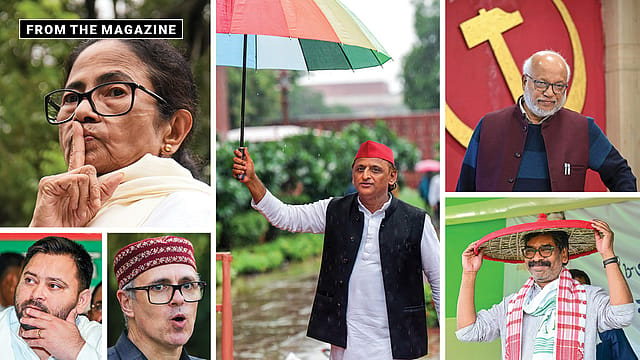
IN KERALA, WHERE Congress’ main rival is the Communist Party of India (Marxist), or CPM, evening TV debates, referred to as anthi charchchakal with a tinge of revulsion and humour in equal measure, often end up being a war of words that even descend into personal attacks between the representatives of these two parties. Although they both argue that their main opponent nationally is the Bharatiya Janata Party (BJP), the loud pronouncements of hate between them make people wonder how true such assertions are.
The decision by a member of the Nehru-Gandhi family to fight their own I.N.D.I.A. bloc allies in the 2024 Lok Sabha polls, typically a race between the BJP-led alliance and the entire non-BJP opposition in most states, was bound to leave a bad taste in Kerala. The communist parties saw it as an encroachment on their turf, claiming that Congress was keener on reining in its own partners in the I.N.D.I.A. bloc than its real enemy BJP. For Congress, it was, of course, a desperate move to save the Gandhis the dishonour of losing their membership in Parliament. Rahul Gandhi fought the elections from Wayanad in Kerala in the 2019 elections—before the bloc was conceived— and won while he lost the family pocket borough of Amethi to Smriti Irani by a margin of more than 55,000 votes. In 2024, he contested again from Wayanad and managed to win from Rae Bareli in Uttar Pradesh, following which Congress fielded Priyanka Gandhi from Wayanad after he vacated that seat in a bypoll. Left leaders in the state contend that when the first family of Congress contests from a seat in Kerala, essentially, they convey the message that the “centre of gravity” of Congress has shifted to the state. This, the Left fears, diminishes their poll prospects in the General Election.
THE LEADERSHIP OF Rahul Gandhi and his style of functioning have upset not merely the Marxists of Kerala. Everyone knows what had happened in Tamil Nadu where Congress made much headway thanks to its alliance with the Dravida Munnetra Kazhagam (DMK). After a hard bargain in seat allocation by Congress to which DMK relented in the state polls held this year, Congress showed no hesitation in immediately aligning with Vijay’s Tamilaga Vettri Kazhagam (TVK) after his landslide victory. This was done without taking DMK leaders into confidence and Congress subsequently secured two ministerial berths and a Rajya Sabha seat from TVK. The outcome was DMK’s exit from I.N.D.I.A., accusing Congress of betrayal. Before the polls, DMK had allotted Congress 28 seats, three more than in 2021, besides offering a Rajya Sabha seat.
Elsewhere in the country, in Uttar Pradesh (UP), the most populous state where alliance is crucial for the opposition to give even a semblance of competition to BJP at the Centre, the dominant regional entity, the Samajwadi Party (SP), has had a series of trouble with Congress during seat-sharing talks. Very recently, an SP MLA and a Congress MP had a public spat in Saharanpur, in western UP, over an issue that could have been discussed in private. It brought to the fore the inimical nature of the relationship between the two parties locally. Congress MP Imran Masood and SP legislator Ashu Malik clashed at a public meeting, much to the embarrassment of other leaders present and the entire non-BJP opposition that wants to look cohesive ahead of the UP Assembly election next year.
It is in the nature of the alliance, cobbled together on the sole premise of taking on the might of BJP, to have huge divergence. For instance, regional parties such as DMK in Tamil Nadu, the Rashtriya Janata Dal (RJD) in Bihar, SP in UP, and even the beleaguered Trinamool Congress (TMC) of West Bengal (which is hurtling from crisis to crisis after losing the state polls this year, primarily because of a mass exodus of leaders to BJP and other parties) see their own states as their primary political territory. Congress, by contrast, wants to revive itself across the country. Their interests inevitably collide. But the question that parties in the I.N.D.I.A. bloc ask is this: Congress is organisationally weak to win seats in states without the help of regional bigwigs and yet, why should Rahul Gandhi and his team demand a large number of constituencies to contest from? Clearly, seat-sharing is the biggest flashpoint between Congress and its regional partners who have built their own voter bases. Regional parties also have a long memory, which is also a cause of distrust: Congress governments at the Centre have traditionally tried to weaken or displace them. Which means that although the fundamental problem is not necessarily ideological (because most I.N.D.I.A. parties agree on opposing BJP), regional powers do not want Congress to weaken them in their strongholds. On the other hand, Congress is often accused by smaller allies of being treated as junior partners rather than equals because it demands a greater share of seats, ministries and political space.
This contradiction explains the friction.
The frustration that allies feel about Congress is not without reason. Many I.N.D.I.A. leaders that Open spoke to confide that Congress typically fails to deliver after securing more seats prior to the polls. “This is not confined to any one state. This is felt across states, from Bihar to Uttar Pradesh and beyond,” says a leader of a North Indian ally. For instance, following the 2025 Assembly polls, where the Mahagathbandhan of RJD and Congress faced a major defeat and the ruling National Democratic Alliance (NDA) swept the polls, RJD immediately, and not without reason, attacked Congress for being a weak link that dragged down the alliance.
The slugfest did not end there. Ahead of the Bankipur bypoll to the Assembly, which Prashant Kishor eventually won, Congress had hit out at RJD, accusing Tejashwi Yadav, son of RJD chief Lalu Prasad, of striking a deal with BJP for a lacklustre campaign. RJD leaders contend that it was a cheap shot by a local Congress leader to run down an ally.
This is not a practice restricted to local leadership. Open had reported that at the June 8 I.N.D.I.A. bloc meeting held at Delhi’s Constitution Club, following the resounding setback to the alliance in Tamil Nadu and West Bengal, Rahul Gandhi himself had picked a quarrel with one of the alliance’s most loyal allies, the Communist Party of India (CPI).
When CPI leader D Raja asked why Gandhi had accused the Left parties of not being left enough in his recent speeches, the Leader of the Opposition (LoP) in Lok Sabha retorted, “We said that based on facts.” He went on to add, “You invited Adani to Kerala.” He was referring to the invitation extended to the Adani Group to build and operate the Vizhinjam International Seaport in Thiruvananthapuram. “No, Mr Rahul Gandhi,” shot back CPM leader John Brittas, “It was your government that invited Adani to Kerala to build the Vizhinjam seaport.”
True, it was the Congress-led United Democratic Front (UDF) government (2011-16) of late Kerala Chief Minister and Congress stalwart Oommen Chandy that had awarded the `7,525-crore contract to Adani Ports for the construction and operation of the seaport (‘I.N.D.I.A. Falling’, Open, June 22, 2026).
Ahead of the June 8 meeting, the Jharkhand Mukti Morcha (JMM) had launched an attack on what it described as unilateral decisions taken by Congress in Jharkhand without consulting Chief Minister Hemant Soren; CPM General Secretary MA Baby had written to the Congress president seeking clarity on what he described to Open as vitriolic comments directed at the Left and CPM leaders in the run-up to the Assembly polls in Kerala.
Now, several national allies of Congress also fear a split in their ranks, similar to what happened to TMC, if they are seen as weak and cannot take on BJP on their own on their respective turfs—which is why they see ceding ground to Congress as a suicidal move.
Meanwhile, the two-month-long Jantar Mantar protests by the Cockroach Janta Party (CJP) and leftist student organisations have brought cheer to the opposition because its primary demand was met by the government: the resignation of Union Education Minister Dharmendra Pradhan. The protests over the NEET question paper leak and a raft of irregularities, including in the On-Screen Marking (OSM) system used by the Central Board of Secondary Education (CBSE), and other technical glitches, were met with force by police and paramilitary. On July 20, police used tear gas to disperse students and lathi-charged them. Worse, the young protesters seized the social-media narrative, a domain where pro-government voices once held a decisive edge. Suddenly, the fear and foreboding in Delhi was replaced by defiance that made the government look vulnerable.
Congress naturally expects Rahul Gandhi and the party’s national leadership to have a central role in an opposition coalition, but the party is a pale shadow of what it was. Therefore, it needs to make its alliance more formidable. Manoj Kumar Jha, veteran lawmaker and RJD leader, doesn’t entirely put the blame on Congress or insist on the party taking the lead in mending the alliance. Instead, he says, “I hold a slightly different opinion [than expecting Congress alone to work on making the alliance a cohesive entity]. Each political formation within the I.N.D.I.A. bloc should look at their responsibility in a much more efficient manner compared with what they are doing now. Congress would look for a better footprint. So will its allies in different states. So it will have to be a meticulous balancing act either in the state or Lok Sabha elections. Each and every outfit in the alliance should learn to respect each other, not simply at meetings but also after the meetings. If there are issues of divergence, they should not be swept under the carpet. Most importantly, the I.N.D.I.A. bloc should go for agitational politics and aggressively convey to people what they will do once they come to power.”
While a section of alliance leaders say that Rahul Gandhi has gained in stature lately thanks to his efforts to strike a chord with women and Gen Z, several others are wary of his unpredictable ways that they say “somewhat” resemble US President Donald Trump’s temperament—of shifting goalposts and projecting himself as the winner, whether he wins or not. The problem a few politicians in the I.N.D.I.A. bloc find is that Gandhi behaves as someone who does not owe anyone anything and also as an outsider to the compulsions of mainstream politics. “He seems to have a tendency not only to show that he challenges authority but also to challenge an ally, especially when the ally becomes inconvenient. He is guided by his own temperament and convictions,” says a leader from the Left. “Someone who would ignore established conventions and disrupt the system may be admired, but, in reality, for allies he is a difficult person.”
It is an argument not widely off the mark because those who project themselves as rebels, once they acquire more power, can become intolerant of not only rebellion but even minor dissent.
Again, compared with June—when allies were vocally critical of Rahul Gandhi’s priorities regarding them—they are, as of now, placing more emphasis on working towards establishing a viable popular front against BJP. Yet, a Left party member says, “Rahul Gandhi seems preoccupied with momentary slogans, working more like a bleeding-heart activist than a politician who needs to meticulously plan an electoral strategy to combat the phenomenal electoral machinery that BJP and its allies run. Talking about smashing Brahminical patriarchy may be appealing, but it is far tougher to bring various groupings together to fight and win an election. It requires long-term planning.”
“We are hoping against hope that opportunity strikes and luck favours us,” says another I.N.D.I.A. bloc politician.
And who doesn’t know that, in politics, luck matters as much as strategy?