Follow The Rules. Or Else...
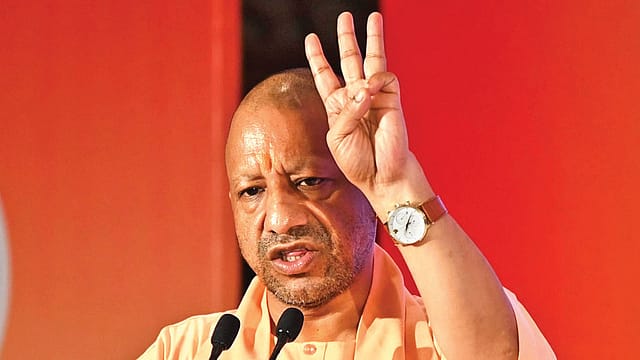
SOON AFTER BAREILLY-BASED Ittehad-e-Millat Council president Maulana Tauqeer Raza was arrested for violence in the city sparked by ‘I love Mohammad’ protests, Uttar Pradesh (UP) Chief Minister Yogi Adityanath spelt out his response with characteristic lack of ambiguity. “You would have seen what happened at Bareilly. The Maulana forgot who is running the government. Sometimes bad habits are hard to give up. Uske liye unki denting-painting karni padti hai kaide se (Bad habits need to be cured by proper denting-painting). I have made it clear that there should be neither a roadblock nor curfew. But if it happens, we will teach a lesson that the future generations (of rioters) will not forget,” he said.
The chief minister’s comments came a day after violence broke out on Friday September 26 after Maulana Raza called for a demonstration in support of the ‘I love Mohammad’ campaign. He reportedly called off the protest at the last hour due to lack of police permission but by then protesters had gathered near his residence. As police dispersed the crowd, some people indulged in stone-pelting and vehicles were vandalised leading to a lathi charge. Senior police officers said efforts were made to end the protests peacefully when a group suddenly emerged and initiated the violence. Later reports said outsiders were involved in the violence.
Maulana Raza, no stranger to controversy, named by the district administration as the main conspirator behind the violence, was sent to judicial custody shortly after his arrest. But the story had begun earlier on September 4 in Kanpur when police received information that the preparations at Jaffar Wali Gali in Sayyed Nagar included an illuminated board with the words ‘I love Mohammad’ which was, according to the FIR filed a few days later, “deliberate attempt to start a new tradition” by the organisers. This was opposed by local residents leading to a flaring of communal passions. The efforts of the police led to the banner being moved to another location and the vacation of the spot by both sides. But the next day when the procession went through the Hindu basti in Rawatpur village, some participants used poles to remove Hindu religious posters. Even as the intervention of the police saw the procession move on, one person identified as a local “kabadi (scrap dealer)” hoisted a banner, leading to communal clashes and tensions. “[I]t is clear that on the day of the incident some Muslim youths acted to deliberately spoil the communal atmosphere to create lawlessness and communal discord,” states the FIR filed by the police.
After the September 5 clashes, Deputy Commissioner Dinesh Triparthi, in a statement to the media, said, “A traditional procession was to proceed in Rawatpur area but there was a deviation and a tent was set up… Later, with the concurrence of both sides the tent and banner were moved to the traditional place… There is no FIR for putting up the banner ‘I love Mohammad’ but it is for deviating from route and tearing down banners. No rumours should be spread on this account.” The police’s emphasis on the fact that the ‘I love Mohammad’ banners were not the reason for action or for the filing of FIRs was lost as an online campaign soon gathered momentum and protesters, worked up over the alleged denigration of the Prophet, poured out in several towns resulting in clashes and communal tension. Days after the incident, similar protests were reported in Ahilyanagar, formerly Ahmednagar, and several people were arrested following a protest hours after a social media post of a roadside “rangoli” stating “I Love Mohammad” went viral on September 28 night. The quick action by the local police appears to have prevented the protests spreading in the wake of the provocative post.
The violence spluttered on in UP as the festival season began with the Navratras and the police had sufficient reasons to see a pattern. Adityanath said troublemakers seemed to become active when Hindu festivals were round the corner. “There are people who don’t like peace and welfare. Whenever there is a Hindu festival, they become agitated and to cool them off, we have to take recourse to denting, painting,” he told a public meeting in Shravasti, reiterating his message and emphasising that issues of faith cannot be raked up to instigate violence against citizens, businesses and the police.
Five days after the violence in Kanpur and following a review of CCTV footage and videos, an FIR was lodged against 24 individuals of whom nine were identified. The named included the organisers of the Barawafat procession. The sections invoked relate to promotion of enmity between different groups and deliberate and malicious acts to outrage religious feelings. “It is crucial to understand that the FIR was not filed for putting up the ‘I love Mohammad’ banners. It was filed because, during the Barawafar procession, member of one community tore down the other parties’ banner and started a new tradition by placing banners at a new location without prior permission,” Triparthi said.

The manner of the violence, including the online mobilisation and deliberate deviation from an agreed route, is part of a well-practised toolkit. The intent is to provoke and the seemingly innocent banners were integral to a plan to whip up sentiments. The damage to property as well as injuries and deaths due to violence do not impact the planners and plotters who are either out of sight or make sure they are not present when clashes break out. The protests were spreading and it was after exemplary action against Maulana Raza that the situation became calmer.
IN A SIGNIFICANT decision, the police in Ayodhya banned the burning of a massive 240-foot high effigy of Ravana as part of Dussehra celebrations. The decision was based on directions issued by Adityanath that no departure from tradition will be permitted with respect to religious festivals and celebrations. This meant the massive effigies of Ravana, Meghnad and Kumbhakarna were seen to pose a safety risk given their size and the firecrackers packed into them and lack of official permits. Allowing the burning of the gigantic effigies would also be seen as an act of indulgence to one community and a deviation from the chief minister’s orders not to allow any “new” tradition.
The tough approach is seen as a hallmark of the administration and Adityanath’s warnings to troublemakers not to disrupt Hindu festivals is not bereft of political signalling as the chief minister reminds people of the slack governance and appeasement that he said marked the Samajwadi Party’s (SP) tenure in office.
Adityanath’s differentiation of his government as one that acts against miscreants as compared to past administrations is based on his criticism that SP leaders spent their time promoting dynastic rule and corruption and is an essential part of the Bharatiya Janata Party’s (BJP) electoral campaign. The BJP government will seek a third term in office in early 2027 and while elections are not imminent, the battle has been joined since SP chief Akhilesh Yadav won the top honours in the 2024 Lok Sabha polls. Yadav’s PDA (Pichada- Dalit-Alpashankhak) strategy looks to revive Backward-Muslim-centric caste calculations, backed by some shrewd candidate selection, and it poses a serious challenge to BJP which must counter incumbency and preserve its support among the non-Yadav Other Backward Classes (OBCs). The decline of the Bahujan Samaj Party (BSP) and a possibility that Dalits may consider SP an option, along with a drift of important OBC castes, can tilt the balance towards SP. A strong response to law and order challenges and the demonstration of the political will to act against Islamist threats lies at the core of the chief minister’s claim to have curbed communal violence and accelerated economic growth. A Comptroller and Auditor General (CAG) report for 2022-23 revealed that UP leads 16 states that had a revenue surplus at Please provide the text you would like to have paraphrased, and I will assist you accordingly.37,000 crore. Adityanath has said the situation has further improved in the past two years.
In November 2013, Maulana Raza had declared a “reward” of ₹5 lakh for Bangladeshi litterateur Taslima Nasreen’s head for alleged remarks defamatory to Islam. He claimed the then United Progressive Alliance (UPA) government’s failure to ban the entry of Nasreen into India had hurt the sentiments of Muslims. The Maulana’s career indicates he has time and again attempted to gain public notoriety by taking up issues related to religious sensitivities. Raza has tried to carve out a political profile, associating with SP as well as BSP, but with limited success. His outfit managed to win one seat in the 2012 UP Assembly election and he was appointed to the state handloom commission. SP’s bid to co-opt the Maulana did not last long as he resigned, alleging the Akhilesh Yadav ministry had failed to contain the 2013 Muzaffarnagar riots. An FIR was lodged earlier in 2010 for an attempt to provoke mobs, again on the occasion of a Milad-un-Nabi or Barawafat procession. The Maulana possibly saw an opportunity in agitating sentiments over the ‘I love Mohammad’ protests and while he certainly succeeded in mobilising a mob, he might have to cool his heels behind bars. The Yogi Adityanath government has moved swiftly to make an example of him and in the process refurbish its reputation as being effective on law and order and unaffected by vote-bank considerations.