Devendra Fadnavis: Maximum Leader
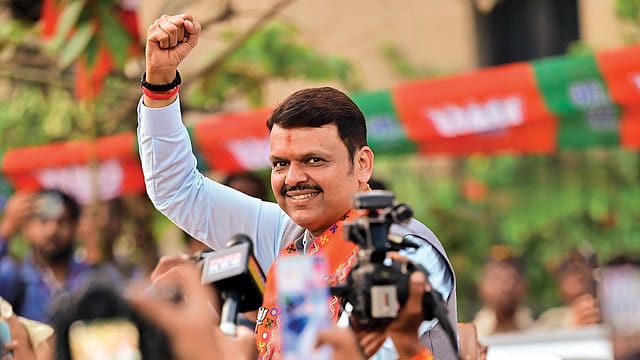
ON TUESDAY MORNING, JANUARY 20, THE LOBBY of the Taj Lands End, the five-star hotel that stands at a picturesque spot overlooking the Arabian Sea in Mumbai’s Bandra area, began filling with a group that stood out from the usual brood of tourists and visitors trying to beat the hotel’s check-out time. These were the 29 corporators (and their attendants) from the Shiv Sena that Eknath Shinde had moved to the hotel less than 24 hours after the Brihanmumbai Municipal Corporation (BMC) results confirmed their victories.
They were there ostensibly for an orientation programme. But the alacrity with which it was conducted, bringing to mind memories of Shinde in 2022 herding his flock of MLAs that had broken away from the undivided Sena through hotels in Gujarat and Assam before appearing at Raj Bhavan to be sworn in as chief minister, meant that everybody knew what was really unfolding. Shinde was foiling any attempt at poaching and also executing a pressure tactic on ally Bharatiya Janata Party (BJP) to get his pound of flesh.
In the lobby, the corporators moved with their suitcases and hugged one another. Some sat in groups for photographs to be taken. They had been camped there for over three days, and a visible relief now seemed to be running across their faces. In previous instances, such as in 2022, most of the individuals involved were male. This time, of the 29 corporators from the Sena, 17 are women, and many of them were reportedly missing their families.
On January 20, the names of the elected candidates were published in the Official Gazette, thereby officially recognising them as councillors, and in Delhi, according to reports, Shinde was meeting senior BJP leaders.

Travel Issue 2026
15 May 2026 - Vol 04 | Issue 71
The Cultural Traveller
“We are going,” one of the corporators, Trushna Vishwasrao, told a reporter at the hotel lobby. “Our seminar got over yesterday. We are now going back home.”
The results of the elections to the various municipal councils, including BMC in Mumbai, are important. By single-handedly winning, or being in a position to win with its allies, 25 out of the 29 municipal councils, the results cement the position of BJP as the preeminent party in the state, ruling not just the Centre and Maharashtra but now also the urban bodies that govern the state’s key cities. But the results are also important in what it says about the opposition. The Uddhav Thackeray led-Shiv Sena (UBT), which was routed in the state Assembly elections earlier, has now lost BMC, a corporation that was central to its politics and one that it had controlled unbroken for about three decades. Uddhav’s much-talked up reunion with his once embittered cousin Raj Thackeray did not work, and the cousins’ highly charged campaign around Marathi identity wasn’t enough either. Deputy Chief Minister Ajit Pawar’s strategic manoeuvre of trying to assert his independence from BJP by allying with his uncle Sharad Pawar and challenging BJP in Pune and Pimpri Chinchwad also failed, revealing Pawar Jr as the weakest link in the ruling alliance. Congress might be in a position to control a handful of the municipal corporations, but its retreat from important cities that it once controlled, such as Mumbai, with just 24 seats this time, now seems complete.
“The thing is people can see the difference. When Uddhav Thackeray was in power [in the state], all infrastructure projects came to a standstill and there was rampant corruption. But when the Mahayuti government came to power, whether it was the Coastal Road, the Metro work, other infrastructure projects, cluster redevelopment, or the many schemes, everything was expedited and it is all there for the people to see,” Krishna Hegde, former MLA and spokesperson of the Shiv Sena, says, as a way to explain why the Mahayuti’s thrust on development and big-ticket infrastructure projects helped it win. To him, the Thackeray cousins built a campaign on Marathi identity that was very divisive and promoted alienation, and voters saw through it. “They [the undivided Sena under Uddhav Thackeray] have controlled BMC for 25 years. And everybody can see the issues that people have faced because of this, whether it is potholes on our roads, garbage disposal, or water management.”
The control of BMC was essential to the original Sena. Its wide purse, with a budget larger than many small states in the country, enabled the party to create a patronage network that sustained cadre loyalty, funded street-level mobilisation, and propelled its expansion beyond Mumbai. Irrespective of how it performed at the state level, the Sena usually did well in BMC elections, and it had been controlling the body uninterrupted from 1997 until 2022, when the next elections were postponed.
One chief reason for this popularity in the city, apart from its charismatic founder and its politics around the Marathi Manoos, was its large network of shakhas spread out across the city that provided services and facilities the government often failed to dispense. The split in the party impacted Thackeray’s control over this network of shakhas. Besides, the aspirations of 2026 are vastly different from what they were 25 years ago.
The aggressive stance on Marathi identity by the Thackeray cousins, and the trotting out of old anti-migrant statements, might also have cost the two. Marathi speakers have been moving out of the city over the decades (and especially into satellite areas under the Mumbai Metropolitan Region where Shinde has built a large base) and today it is estimated that the number of Marathi speakers in the city comprise somewhere around 30 to 36 per cent of the population, a significant decrease from the past. The two may have consolidated the Marathi vote to an extent, although Shinde did serve as a challenge here, but they probably antagonised many others.
While the opposition does emerge from this election seemingly in disarray, it will perhaps be foolhardy to write off the Shiv Sena (UBT) in Mumbai. Despite a large share of its earlier corporators crossing over to Shinde’s party, it still emerged as the second-largest party with 65 corporators, won most of the wards in the Marathi belt of central Mumbai, and emerged victorious in several of the contests where it was pitted directly against Shinde’s party. “The loss of BMC is a big blow, but it will be wrong to read this election purely as one where Uddhav’s Sena was routed,” says Surendra Jondhale, a political commentator and professor of political science at the University of Mumbai. “There is a silver lining in their loss. They won quite a number of seats. And Shinde, despite having a majority of the past corporators from the [undivided] Sena, could only win 29.”
BJP may have emerged head and shoulders above the rest, but the final arithmetic is such that it cannot get to the majority mark by itself, making Shinde’s 29 corporators essential. According to reports, Shinde wants the post of mayor for his party, even if for half the term, and control of BMC’s all-important Standing Committee. His party members are said to be holding discussions in Delhi (Shinde himself was in the capital), even as they wait for Devendra Fadnavis to return from Davos.
The competition isn’t limited to just Mumbai. In Kalyan- Dombivli and Ulhasnagar, two urban centres that lie to the east of Thane and are part of MMR, the two parties, after reaching similar numbers in those corporations, are currently in the midst of snatching the mayor’s post from one another.

In Ambernath, again part of MMR, whose municipal council had elections in an earlier phase in December, after BJP got Congress corporators to switch over to gain control over the council, the Sena overnight got four corporators from BJP’s ally Nationalist Congress Party (NCP) to switch over to its side. This contest in Ambernath, which is being seen as a proxy battle between senior leaders of the two parties (both Shinde and Maharashtra BJP chief Ravindra Chavan come from Thane district), went all the way to the High Court of Bombay recently, which has now directed the collector to have a relook.
Elections to municipal corporations in Maharashtra attract a lot of interest mainly because these are a weathervane of voter sentiment in the state. But what that hides is the limited role that local elected bodies have. In BMC, for instance, the big standoff is now said to be over the mayor, with Shinde and Shiv Sena pushing for their candidate. The mayor, however, has almost no power. The important committees made up of elected corporators are the Standing Committee and Improvement Committee, but they cannot institute policy or initiate projects. Their role is essentially to pass proposals that the commissioner forwards to them. The commissioner is an appointee of the state government, and even if the committees stonewall his proposals, the government has the power to still get them through.
After the election, the Observer Research Foundation published an article titled ‘Municipal Elections in Maharashtra and the Myth of Urban Autonomy’ where it was stated, “It could be argued that with a popularly elected body in place, some less significant local policies may be decided at the local level. Citizens may raise grievances through their elected representatives, and corporators may be useful in expediting service delivery. However, for everything with far-reaching implications for urban planning, municipal functions, finance, and functionaries, the overall authority of the state in municipal affairs remains largely unrestricted. Consequently, the attention devoted to municipal elections is often disproportionate. The popular municipal body remains peripheral. It is the state that is the primary authority.”
Also, the state government was running the corporation anyway without an elected body. It had no additional layer to get through for doing its work. It is a bit of a misnomer that having a BJP-run BMC council will hasten the big infrastructure projects. Where it really helps is in the small-ticket local projects. Because even though corporators have no power, what they do have is connect with the people and they bring those grievances back to the government.
Of all the key individuals who entered the municipal polls, it is Fadnavis who finds himself in the most enviable position. He controls the state government, most of the corporations, and because of the resounding performance, the leverage of his allies over him, like Shinde and Pawar, is almost negligible now. In addition, with BJP at the Centre, there are no funding obstacles for the mega infrastructure projects. If you divided the city’s infrastructure projects as top-down and bottom-up, over the last four years when BMC was administration-led, the focus was on the former—coastal road, Metro network, sewage treatment plants, sea link bridges, etc. With a local body, there will be more pressure to look at local bottom-up projects, like potholes, water connections, garbage collection, sewage maintenance, etc. Plus, corporators get `1.6 crore to allot for works in their wards; these were unutilised. It becomes a big number for the city when multiplied by the total number of corporators. And all this money will be seen to be spent under the banner of BJP simply because they now rule the corporation. This means political dividends for BJP and Fadnavis. Another advantage for him is that with the committees filled with BJP members, projects cannot be blocked or delayed because of corruption because his partymen answer to him.
The obverse is also true. Of the two BJP’s allies, the Shiv Sena and NCP, the latter is in the most unenviable position. Never with a base in Mumbai, it broke with BJP for the corporation elections and lost badly even in its own strongholds like Pune and Pimpri Chinchwad. It brings very little to the table now except for one important function: to keep emphasising to the Sena that it, too, is expendable. Shinde had a decent showing because he chose to remain allied with BJP. His party is the biggest one in the satellite city of Thane and, along with BJP, makes up for BMC’s majority. However, if he breaks away, the BJP government in the state will not lose its majority because NCP’s numbers make up for it in the alliance. Fadnavis, at present, has no threat from above, below, or by his side and that gives him a good runway to work unimpeded.