Calling Congress’ Bluff
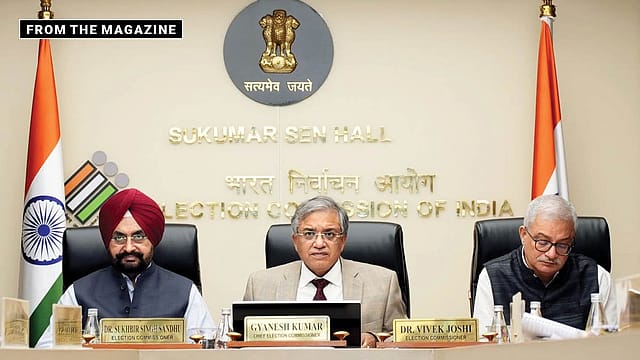
An affidavit submitted to the Supreme Court on behalf of the Election Commission of India (ECI) by Deputy Election Commissioner Bhanu Prakash Yeturu, a Rajasthan-cadre Indian Administrative Service (IAS) officer who holds a law degree and has served as secretary to the state government, chairman of a discom and collector in far-flung Barmer and Banswara, clinically marshals facts relating to ECI’s decisions, constitutional mandate and the apex court’s orders to set out in simple prose why there is no anomaly in the conduct of the Special Intensive Revision (SIR) of electoral rolls and no basis to claims that millions of voters have been disenfranchised.
Responding to a slew of petitions, including ones filed by Congress leader Rahul Gandhi and other I.N.D.I.A. bloc leaders, alleging that ECI’s SIR orders are illegal and that Chief Election Commissioner (CEC) Gyanesh Kumar acted unilaterally and in violation of rules, the affidavit makes an elementary assertion: “The averments in the writ petition are admittedly based on a single newspaper report… (it) is merely based on the extrapolation of a news report. The contents of the writ petition do not demonstrate that the petitioner has ever made any attempt to ascertain the factual positions…” Calling for “circumspection” in any conclusions drawn on flimsy grounds, ECI said it has neither released nor authorised the release of any internal note to any news agency, questioning the very basis of the claim that procedures were violated.
The affidavit opens with the declaration that the document has been filed as the unanimous decision of all three members of the Commission. Its contents do not support reports that Election Commissioners Sukhbir Singh Sandhu and Vivek Joshi wrote 14 times over a period of 10 months objecting to measures relating to the addition and deletion of voters and, on at least one occasion, said ECI’s action was unauthorised. The allegation that Joshi and Sandhu’s notings on being excluded, illegalities regarding new voters, centralisation of the voter database and integrity of software amounted to an “unprecedented rupture” within ECI falls flat in the light of all three commissioners agreeing that suggestions, observations and varying views in the chain of command are part of due process before a final decision. It further states that concerned files are sent to first one commissioner, then the other and finally to the CEC. A query by a commissioner or the CEC is not a decision. Nor is it a violation of Section 18 of the 2023 EC Act, which states that decisions should preferably be unanimous or, failing that, taken by voting. No vote was called for and ECI’s SIR orders of June 24, 2025; October 27, 2025; and May 14, 2026 were unanimous.
The affidavit, filed on October 26, dismantles the case against the CEC and undermines the charges levelled by Rahul Gandhi and other I.N.D.I.A. bloc leaders that the Bharatiya Janata Party (BJP) has won elections due to “vote chori (vote theft)” and that ECI is an accomplice to the crime. The affidavit’s point-by-point rebuttal had, of course, no effect on the opposition’s plans.
Rahul Gandhi has called on people to turn up in large numbers for a November 1 rally at Delhi’s Ramlila Maidan and rejected appeals by trade associations who fear disruption in business, blaming the government instead for locking down the capital. “With a stolen vote nothing is safe—your shop, your savings, your children’s future. Tell Modi to sack accused No 4, Gyanesh Kumar and the protests will stop in 30 seconds,” he posted on X while sarcastically “thanking” BJP for promoting the protest. He refused to consider suggestions that November 1 was not an appropriate date for the rally given its association with the nationwide anti-Sikh riots in the aftermath of the assassination of Indira Gandhi on October 31, 1984. Two days before the rally, the opposition bloc plans a “mock” trial and impeachment of the CEC even as the Supreme Court will next consider the case relating to the SIR and other issues on November 17. In the company of activist Yogendra Yadav, the Congress leader visited Trilokpuri, where he reported that 416 votes had been illegally deleted at four booths. Neither is the number out of the ordinary, as a polling booth in the area averages 1,000-1,300 votes, nor are the reasons for the alleged exclusions evident.
Various petitioners who have sought orders against ECI and a restraint on the CEC’s functioning have demanded that the apex court order the preservation of files and notings relating to the SIR exercise. Senior advocate Menaka Guruswamy, a Trinamool Congress Rajya Sabha MP, argued ECI has in fact accepted the charge that Form 6—used to register new voters and enrol deleted ones—was tampered with. Congress spokesperson Jairam Ramesh insisted that two commissioners had objected on record to “grave violations and illegal actions” but were disregarded, and added that the Commission had been contradictory on Form 6. Solicitor General Tushar Mehta, appearing for the Centre, said ECI’s affidavit would be examined by the court and petitioners should not vent political rhetoric in the Supreme Court. He said those demanding action against the CEC must place evidence before the court. Hearing the submissions, a Bench of Chief Justice of India (CJI) Surya Kant and Justices Joymalya Bagchi and V Mohana promised a thorough scrutiny, stating that it is aware of everything and will examine the records.
The “evidence” Mehta demanded of petitioners calling for a rollback of the SIR is the nub of the matter. It is, at present, scarce and more a case of suggestions and imputations that have been forcefully challenged by ECI. The unanimous affidavit seriously weakens the allegation that the Commission has become dysfunctional and is riven by serious internal rifts, impairing its capacity to conduct free and fair elections in accordance with Article 324 of the Constitution. In doing so, it also knocks the bottom out of the “vote chori” allegation and leaves Rahul and other opposition leaders with the much tougher task of explaining successive electoral defeats. Blaming ECI, electronic voting machines (EVMs) or airing conspiracy theories about votes being deleted and siphoned off remains a case of unsupported claims and courtroom elocution. Evidence of Congress’ inability to counter BJP on the ground is mounting. In the last round of Assembly elections, Congress failed to prevent BJP from winning a third successive term in Assam, a state where the SIR was not conducted. Meanwhile, the party’s governments in Karnataka and Himachal Pradesh face a serious financial crunch due to over-generous spending promises, and the former is riven with factionalism too.
Rahul Gandhi’s embrace of Left student activists and agitators like Yadav has deepened the perception that Congress has become a party willing to support fringe causes. The regularity with which separatist slogans surface during protests organised by leftist student wings and the strong anti-Hindutva orientation of activists such as Yadav, lawyer Prashant Bhushan, economist Jean Drèze and social worker Aruna Roy have fastened the perception that Congress has abandoned the Centre for the far-left. The constant disruption of Parliament and increasingly reckless social media campaigns where party handles think nothing of peddling dubious posts and attacking institutions—the Congress Kerala unit had to apologise for an X post running down CJI Kant—make Congress come across as an irresponsible party driven by its leader’s animus towards Prime Minister Narendra Modi. The “alternative” Rahul seeks to represent, going beyond the promise to undo Modi government policies, often seems a mishmash of reworked Mandalite politics, populism and allegations such as the “vote chori” charge. On the other hand, there is little evidence of a governance model. Exhortations against Manuwad (Manusmriti) and calls to “smash patriarchy” come across as attacks on Hindutva. But it is difficult to discern whether this has resulted in gains among the backward classes even as the middle classes are alarmed by Rahul’s redistributive rhetoric.
The categoric affirmation that Section 18 of the 2023 Act, setting out the preference for unanimous decisions or a vote if this is not possible, has not been violated raises questions about the viability of the opposition campaign and the protests organised by the Cockroach Janta Party (CJP). “The statute recognizes that institutional decision-making should be unanimous, but there may be occasions where the decision may have to be by majority… the allegations based on communications between the election commissioners and the cabinet secretary are misconceived,” the ECI affidavit says, referring to Joshi and Sandhu taking up matters relating to work allocation within the Commission with Cabinet Secretary TV Somanathan. ECI states that an office order issued on July 28, 2026 relating to the matter taken up with the Cabinet secretary was never implemented. This was in view of the “joint direction” dated July 30, 2026 by the two commissioners. In response to RTI filings, the Cabinet Secretariat has said it had no role to play as any intervention would be read as a violation of ECI’s autonomy. It is also a fact that the Cabinet Secretary is below the election commissioners in the official order of precedence.
The affidavit has been questioned by critics on the ground that it fails to address claims that Sandhu and Joshi had raised objections even after decisions were taken. This is not supported by the Commission’s submission, which says decisions were fully vetted and took into consideration “all the views” placed on the table. “The respective divisions put up the concerned file with relevant documents and regulations for the approval… Such approved decisions are duly noted in concerned files and bear the signature of the ECs and the CEC,” the commission has said. ECI rejected the allegation that the commission “amended” Form 6 by adding a declaration, a charge closely tied to claims that the SIR has disenfranchised “millions” of voters. The Commission said a review of the manner in which Form 6 and the accompanying declaration were displayed online gave rise to concerns that this might seem an amendment outside ECI’s powers. But the Commission pointed out that the declaration was, in fact, a measure to help voters by dispensing with the need to file documents during the claims and objections period. Explaining the process, the Commission said that in the first SIR order of June 24, 2025 the concept of “mapping” had not been introduced and was not applicable to the Assembly elections in Bihar in November 2025. The declaration was then altered so that “mapping” to connect details of applicants with the earlier SIR of 2002-03 by requesting electoral roll entries was made feasible. The entries could relate to the applicant, parents or even grandparents. “[This] would obviate the need for submitting further documents for verification and thus, it was a measure for the assistance of voters. This exercise/methodology of submitting an additional declaration is applicable only for the SIR process…” With the state election commission providing searchable 2002 rolls, the process of filling forms was rendered simpler than the normal process of filling Form 6 and providing supporting documents.
The declaration, the Commission said, was a separate and independent document, and there was no change in Form 6. The unstated reason for the bitter opposition to the commission’s procedures might actually lie in the fact that “mapping” would be much more difficult for persons such as illegal immigrants who have acquired voter ID cards. “If the details for mapping are not available or are not furnished, then submit Form 6 and one of the 13 permissible documents,” the Commission states, and points to the leeway provided by the Supreme Court’s observation that the documentation requirement does not work in isolation but as part of a “broader procedural framework” and that the “overall scheme” cannot be characterised as rigid or mechanical. Importantly, the Commission clarified that “Any person who is eligible to be enrolled as a voter, can submit the relevant form/application, even after the completion of the SIR exercise, as per applicable rules, for enrolment in the electoral roll.” These clarifications need to be seen in the context of a large number of deleted voters being in the permanently shifted or absent categories, as they can be enrolled afresh if they provide details or become electors in new places of residence. A large number of deleted voters are those who have died, while there are others registered in two places. The details of the deletions make it quite clear that sweeping claims that 13 crore voters have been knocked off the electoral rolls are extremely misleading.
ECI has dismissed allegations that it reworked or constrained the power of officials to include or delete voters. “It is submitted that the Electoral Registration Officer remains the statutory authority for inclusion, correction and deletion,” it has said, quoting relevant sections of the Representation of the People Act, 1950. The ECINet software is obligated to ensure EROs are able to perform all their statutory functions. “As per provisions of the RP Act, the CEO/DEO/ERO/AERO are authorities in respect of electoral rolls,” ECI said in the context of the large number of appeals in West Bengal which have been filed by officers of the state CEO. The I.N.D.I.A. bloc has repeatedly called for a return to paper ballots, claiming EVMs have been manipulated. In response, ECI referred to six orders of the apex court upholding the validity of EVMs since 2017. In its latest order in a case filed by the Association for Democratic Reforms—a serial petitioner against EVMs—the Supreme Court noted the real intention was to “discredit the system for voting through EVMs and thereby derail the electoral process… by creating unnecessary doubts in the minds of the electorate,” the Commission has reminded the apex court.

The Supreme Court’s remarks in the EVM case, no doubt prompted by a rising exasperation over the repeated raking up of baseless charges, apply to the SIR process as well. A clean-up of the electoral rolls in keeping with the basic eligibility conditions for voter registration, such as being a citizen of India, a major and of sound mental health, is essential. Stalling the SIR effort might protect vote banks and provide a distraction from electoral failures, but that is not the purpose or the mandate of ECI. The attack on ECI is also part of an effort to delegitimise the Modi government, tap into the narrative of “democratic backsliding” and promote discontent to take the sheen off BJP’s electoral success and the Modi government’s economic management that has kept the popular mood upbeat and the Deepavali cheer intact.