BJP Must Recover Its Soft Power: Time for the party to learn from the subversive genius of Gandhi
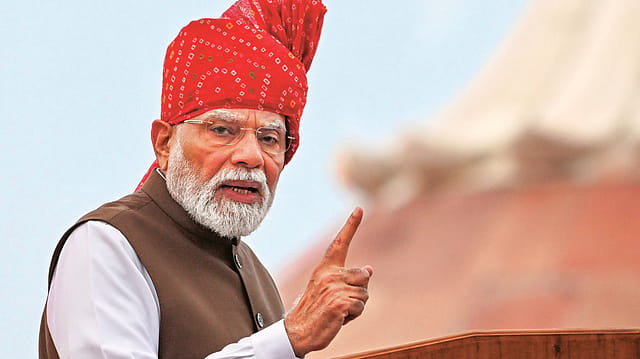
AFTER COCKROACHES, DIMAGI NAXALS? Because the “Dimagi Naxal Party” was created hours after the prime minister’s Independence Day speech from the ramparts of the Red Fort. It garnered over 2 lakh followers within minutes.
DIMAGI NAXALS
Clearly, the ruling regime’s attempts to throttle dissent are backfiring. Not every protester in a democracy is an anti-national. I worry lest we next really have an “anti-national” party that goes viral on social media.
With institutions as with individuals, a reality check followed by corrective measures is necessary. To stay ahead, BJP needs a major rethink of its soft power strategy. Clearly, its ongoing organisational reshuffle may be a direct response to the challenges that it faces.
BJP knows that its grip on the nation’s narrative and youth’s pulse has loosened. No question, then, that the party’s rejig may be the best thing that could have happened under the circumstances.
The ruling party which, only weeks ago, seemed increasingly beleaguered, sorely needed it. Whether it can recover the moral high ground is another question.
The realisation that BJP’s present predicament may be, among other things, a soft power crisis, seems to have sunk in at last.
For more than a decade, BJP enjoyed not merely electoral supremacy but something considerably more valuable: narrative supremacy. It knew what India wanted before its adversaries did. It spoke the language of aspiration, national pride, resentment against old elites, impatience with bureaucracy, and the hunger for recognition of a rapidly changing society. It dominated not merely Parliament and the polling booth but the national conversation.
Lately, that advantage has noticeably diminished.
Or course, BJP still possesses formidable hard power: governments, institutions, organisational depth, money, cadres and probably the most sophisticated election machinery in Indian political history. But hard power becomes brittle when soft power begins to seep away. And the party’s real fear must surely be that the loss of narrative control could eventually lead to the loss of political control. The hard power it has exercised at the Centre for a decade-and-a-quarter is itself under threat.
What better moment, then, for a reset, than the halfway mark of Modi 3.0? The timing could hardly be accidental.
THE NECESSARY REJIG
Under its new and relatively young president Nitin Nabin, BJP has announced a sweeping new national team. Smriti Irani returns as national general secretary; Ram Madhav, after years away from the party’s central organisation, is now its national vice-president; Amit Malviya, who headed BJP’s digital operation since 2015, has been replaced by Deepak Mhaskey; BL Santhosh stays on as general secretary (organisation). The new structure also puts younger faces and women more visibly into the national organisation.
What has shaken BJP out of its complacency?
The immediate answer is obvious. The extraordinary youth mobilisation of the past two months punctured the impression of an invulnerable regime. The so-called Cockroach Janta Party, born partly in the unruly republic of social media, demonstrated something which BJP itself once understood better than anybody else. Memes, mockery, music, humour and irreverence can move politics.
The protests over examination leaks and employment anxieties culminated in the resignation of Education Minister Dharmendra Pradhan on July 25. It was a rare retreat by the Modi government. The role of social media was not incidental; it was the crucial accelerant.
But you cannot solve a social media problem merely by changing the social media manager. Because the problem originates outside social media. Social media merely gives it expression, fuelling the fire so to speak.
Nor can BJP simply rechristen or reconfigure its IT machinery and imagine that millions of dissatisfied young Indians will fall back obediently into line. The memes are symptoms. The disease, if that is not too strong a word, lies elsewhere.

When examination systems repeatedly betray young aspirants, when paper leaks and recruitment scandals dash the hopes of aspirants, when reservations lock out a huge chunk of the population out of the economic system, when brutal competition for too few desirable jobs makes the future of our youth precarious, when a corrupt coaching industry feeds like a succubus on inter-generational insecurity, when youth unemployment and underemployment remain alarmingly high—I could go on and on. But the point is simple: when it comes to the crunch, the economy trumps ideology.
Add to this an increasingly difficult international environment and the fading shine of a foreign policy once marketed as an almost uninterrupted sequence of diplomatic triumphs. Add also the resentment of sections of the salaried and professional classes who believe themselves overtaxed, underserved, and taken for granted.
I would also not dismiss the disaffection in the rightwing and centrist intelligentsia. Once willing to support the Modi ascendency almost unconditionally, they now feel increasingly ignored, patronised, unheard, or simply unnecessary.
Dissatisfaction travels. What begins in seminar rooms, campuses, WhatsApp groups, podcasts and vodcasts eventually percolates into families and voting communities.
Luckily, BJP appears to have noticed.
That, rather than any particular appointment, is the most encouraging feature of the present reshuffle.
Bringing back an energetic communicator such as Smriti Irani and a seasoned strategist such as Ram Madhav signals that the party understands that something somewhere has gone amiss. It has acknowledged that it needs not only different personnel but a different public persona. The people at large crave for a more compassionate, less forbidding, more responsive, less dismissive, regime.
Baijayant “Jay” Panda’s continuing as the party’s vice-president indicates the importance of its polished, liberal, English-speaking face. BL Santhosh, from RSS, continues to wield authority and advisory power, demonstrating the synergy between party and progenitor.
THE RETURN OF GANDHI
Overall, the message is clear: more soft and less hard power.
Criticism does not always conceal conspiracy. The powers that be need to do more than mistaking frustration for subversion or dissent for sedition. I have called this thin-skinned nationalism. It does little credit to a robust modern democracy let alone the age-old Sanatana Dharma.
The contrast is especially striking after Prime Minister Modi’s Independence Day warning against “Dimagi Naxals”— intellectual or ideological Naxals who, he said, seek opportunities to create violence and unrest and must be identified and isolated. Whatever the intended target of that remark, its political risk is obvious. If every dissenter can be placed somewhere on the spectrum between misguided citizen and enemy within, democracies lose their listening capacity.
And this is where Ram Madhav’s return becomes especially interesting.
Political changes have undertows before they have manifestos. Only days before his restoration to BJP’s national leadership, Madhav wrote in these very pages a striking essay, “Behold Gandhi the Hindu”. He located Gandhi firmly within the Sanatana inheritance of Indian nationalism. Gandhi, he reminded readers, repeatedly called himself a Sanatani Hindu, declaring that every fibre of his being was Hindu.
It would, in other words, be a mistake to dismiss the man as a toady or collaborator of the colonial establishment. It would be equally disastrous to cancel him in the name of Hindutva.
For the most maligned of our founding fathers may yet have something to teach the most powerful political formation in contemporary India.
Gandhi, no matter how defamed and maligned, remains our persistent, even pesky, Mahatma. Gandhi has not disappeared ceremonially. Modi dutifully paid homage at Rajghat before proceeding to the Red Fort on Independence Day. But there is a difference between remembering Gandhi and allowing Gandhi to disturb us.
We have reduced him too easily to ritual, iconography and, in the Swachh Bharat era, a pair of spectacles. The physical Gandhi has been progressively dematerialised even as his political method keeps returning to haunt those in power.
But Sonam Wangchuk’s 26-day fast in support of protesting youngsters became one of the moral symbols of the agitation that forced the Union government to concede the students’ principal demands. In Jharkhand, Devendra Nath Mahto went on a prolonged hunger strike over alleged irregularities in JPSC and JSSC examinations, confronting not a BJP government but the JMM-led Hemant Soren administration. The state government has now cancelled the disputed JSSC-CGL examination and other examinations conducted by the firm at the centre of the controversy.
Which is precisely why Gandhi matters, why truth and ahimsa, which combined gave the world a new word and form of resistance, satyagraha.
Gandhi’s most subversive achievement was not merely that he defeated—or helped defeat—the British Empire. It was that he taught ordinary people how to resist vastly superior power without themselves becoming its mirror image. The state possessed police, prisons, law, money, arms and administration. The satyagrahi possessed almost none of these. What he possessed was conscience, discipline, and the willingness to suffer rather than submit.
That is soft power in its most concentrated political form.
Gandhi discovered that legal authority and moral authority are not identical. A government may possess the first and yet squander the second.
That is why Gandhi cannot simply be appropriated by BJP, Congress, Left or anybody else. He was not an ideologue, but an exemplar. Turning him into yet another ancestor of Hindu nationalism would diminish him just as surely as turning him into the private property of Congress. His unsettling legacy lies elsewhere: in the proposition that sovereignty belongs ultimately to morally responsible citizens rather than permanently to those who govern them.
A disciplined and self-regulating citizenry is the foundation of Swaraj. But the corollary is less comfortable. When government ceases to be responsive, the same disciplined citizenry has the duty to resist.
It is perhaps no coincidence that another practitioner of political strategy, Prashant Kishor, has grasped something of this opening. His victory in the recent Bankipur by-election, breaking a BJP hold of roughly three decades, has given Jan Suraaj its first legislative foothold. One by-election does not make a revolution. But it does show that political space opens whenever established formations stop hearing the electorate.
ADVANTAGE BJP
BJP, fortunately for itself, remains perhaps the most alert and adaptive political machine in India. And behind it stands what one might, with some licence, call its Mother Church, RSS. A hundred-year-old organisation whose longevity owes something to its ability to introspect, absorb reverses, change personnel, modify tactics, and course correct without surrendering its core convictions.
That ability is precisely what the opposition repeatedly underestimates.
Congress and other anti-BJP formations have often behaved as if every setback to Modi heralds his imminent collapse. It does not. BJP’s great advantage is that, when sufficiently challenged, it pivots. Its opponents, too, often celebrate while it reorganises.
The next major electoral test, especially Uttar Pradesh, will tell us whether this reshuffle amounts to more than rearranging the furniture. The party may therefore have seized the initiative again. But whether it can seize the imagination by, once again, offering good governance is another matter.
To preserve its hard power, BJP must recover its soft power. And to recover its soft power, paradoxically, it may have to rediscover the political lessons of the very Mahatma whom sections of its ideological ecosystem have spent years diminishing.
For the final irony of this reshuffle may be that changing leaders is relatively easy. Changing the relationship between the ruler and ruled is much harder. If BJP understands that, it could regain the high ground.
And in closing, a word of advice to the new social media team: Truth and humility work much better than spin and arrogance. Please don’t underestimate Janata Janardana: every setback is not a masterstroke, nor is every government, just because it is in power, always right.