Bihar's Samrat Checks In
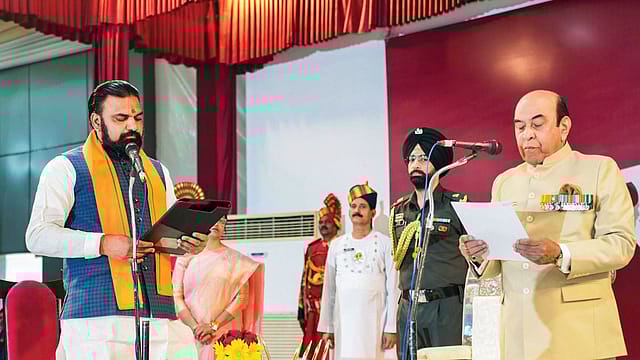
THE APRIL 15 transfer of power in Patna completed a process that began in the October-November 2020 state election when the Bharatiya Janata Party (BJP) won 74 of 110 seats it contested while senior ally Janata Dal (United) unexpectedly slid to 43 seats despite having been allotted 115 seats. BJP’s strong performance ensured the National Democratic Alliance (NDA) remained in office and despite the altered ground realities, the party’s top leaders declared Nitish Kumar will be chief minister again in keeping with a pre-poll commitment. There was no attempt at reworking the deal by seeking a “rotational” occupancy of the chief minister’s post or any other onerous conditions.
The act of good faith did not, however, work out very well. Kumar’s associates muttered about a ‘conspiracy’ wherein Chirag Paswan’s Lok Janshakti Party (LJP) was seen to have selectively damaged JD(U). Just how such minute calculations could be possible and if, as suggested, BJP would opt for the dangerous gamble of discretely propping up Chirag and run the risk of losing the election if things went wrong was not taken into consideration. The distrust bubbled and grew and in August 2022, JD(U) left NDA for a second time and re-united with the Rashtriya Janata Dal (RJD) to form the Mahagathbandan 2.0 government. It was an appalling act of mendacity. Rather than undertaking a sincere introspection of the reasons for decline, Kumar acted out of pique, lending his ear to theories that offered solace to a hurt ego.
JD(U)’s alliance with RJD, as in the case of the previous edition, did not last long and Kumar was back in NDA ahead of the 2024 Lok Sabha poll, and his party’s tally was a significant factor in the formation of the Modi 3.0 government. This time, Kumar’s declaration that he was in NDA for keeps had a ring of conviction about it and his stature as a backward leader along with Prime Minister Narendra Modi’s appeal delivered a thumping win for the alliance in the 2025 state poll. Yet, even at this moment of success, Kumar’s health and increasing episodes of distracted behaviour cast a shadow on his ability to function. His decision to step down and become a Rajya Sabha MP was his own and involved delicate discussions between his close aides and the BJP brass. It could have been a messy affair, but passed without a hiccup.
The change in chief ministership provides BJP an opportunity to expand its voter base among Other Backward Castes (OBCs), and this is reflected in the choice of Tarapur MLA Samrat Choudhary, who was previously deputy chief minister, as Kumar’s replacement. Kumar’s credentials as a symbol of backward empowerment and a leader who eschewed divisive rhetoric were an important factor for NDA’s electoral success since 2005. In a state where caste matters greatly, BJP has the backing of forwards and while it has improved its standing among OBCs, the party has been on the lookout for an opportunity to make deeper inroads. The change of chief minister has come about relatively early in the current government’s tenure and BJP has time to use the solid numbers NDA commands in the Assembly to increase its foothold among non-Yadav OBCs in a state where backwards account for 63 per cent of the population.
Choudhary hails from the Kurmi-Koeri caste, the most numerous OBCs after Yadavs, accounting for 4.2 per cent of the state’s population. The other likely contender for the chief minister’s post, Minister of State for Home Nityanand Rai, is a Yadav and the BJP leadership likely felt it would be better to go with Choudhary and stick to the strategy of consolidating non- Yadav OBCs. So far, the Yadav vote has stuck loyally with RJD, transferring its allegiance from party founder Lalu Prasad to his son Tejashwi. Nominating Rai as chief minister offered no guarantee that Yadavs would reconsider their voting choices and ran the risk of alienating other OBCs who have backed NDA. Choudhary fits the bill, having won three Assembly elections, and has a reputation of being a doer. He is a relatively recent entrant to BJP, having joined in 2017, but has wholeheartedly internalised BJP’s cultural moorings and its Hindutva politics.
The task before Choudhary is challenging. Kumar’s tenure witnessed a remarkable turnaround in Bihar’s law and order—the striking evidence of confident women voters articulating their electoral preferences and a high female turnout— speaks for itself. Bihar also saw a significant expansion of road connectivity and better delivery of welfare services. But it failed to attract industry as Kumar did not seem to attach priority to such efforts. This meant a disproportionately large section of Bihar’s population continues to work in other states and the process of migration has not slowed, with more than half of all households depending on remittances. There is an urgent need for an industrial policy that leverages Bihar’s resources in mineral deposits and its strengths in agriculture, such as fertile alluvial soil, cultivable land and plentiful groundwater.
The elevation of Choudhary marks an opportunity to set right deformities that have begun to manifest in the state’s governance. A common grievance that came to the surface during interactions with voters during the October 2025 election was about the pervasiveness of petty corruption. This did not hurt NDA as much as it might have as the alternative in the form of RJD-led Mahagathbandan is saddled with a serious image deficit on account of its ‘jungle raj’ legacy and pending corruption cases. While caste is a primary denominator of political choice in Bihar, deficiencies is governance can take a toll over time and it would be wise not to take the electorate for granted. After assuming office, Choudhary acknowledged Kumar’s development record but called for greater efficiency and transparency. “Corruption will not be tolerated at any level. It must be eliminated completely,” he told officials.
The installation of a BJP-led government can lead of a more effective “double engine” government as Choudhary will be expected to work in close coordination with the Centre. BJP ‘s ascendance has been expectedly criticised by RJD as a ‘power grab’ and a diminution of backward castes. The saffron party needs to be wary about the allegation and this will require working closely with JD(U) even after Kumar’s move to Parliament is complete. Keeping a check on hotheads in its ranks is one part of the job, and the other is the reiteration of a commitment towards backward interests in a substantial manner with Choudhary not seen as just a figurehead. NDA’s backward-forward applecart has always represented a balancing act and so far BJP has displayed the smarts to make sure it stays in place and keeps RJD at bay.