Assembly Elections 2026: Tamil Nadu: Stalinism on Trial
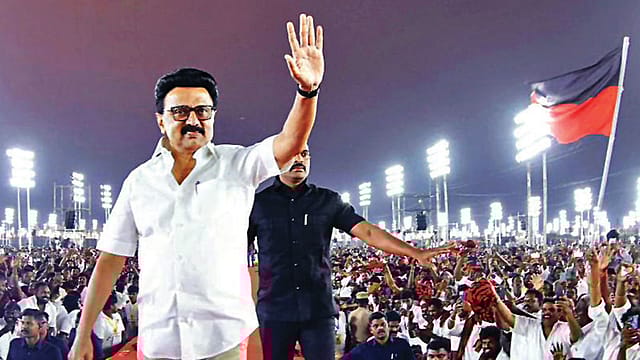
TAMIL NADU CHIEF MINISTER MK STALIN has spent much of his political life waiting for his inheritance. For decades, he lived in the shadow of his father, Muthuvel Karunanidhi, the master scriptwriter and yellow-shawled patriarch with a sixth sense for politics. After he was put in charge of the youth wing of Dravida Munnetra Kazhagam (DMK) way back in 1984, Stalin’s long wait for the chief ministerial post ran through the roles of legislator, party worker, mayor of Chennai and deputy chief minister. Now, it’s time to test whether lineage will receive popular endorsement. The results of the upcoming Assembly election will reveal if Stalin is now a leader with a personal mandate, a worthy successor to Kalaignar.
Born in 1953, Stalin entered the legislature in 1989, later serving as Chennai’s mayor from 1996 to 2002. He led DMK to victory in 2021 after Karunanidhi died in 2018. The win was gratifying but rival All India Anna Dravida Munnetra Kazhagam (AIADMK) was in a shambles. DMK won 133 seats on its own with 37.7 per cent of the vote and AIADMK could only manage 66 with 33.29 per cent vote share. This was after AIADMK’s talisman J Jayalalithaa had died soon after becoming chief minister for a second consecutive term in May 2016, and AIADMK became a much diminished party in 2021. The question remained: Were anti-incumbency after a decade in office and the absence of Amma that eased Stalin’s path to power? DMK did lead the I.N.D.I.A. bloc to a convincing win in the 2024 Lok Sabha election but the state Assembly poll is the real test.
The political scenario has now much changed. In 2026, Stalin is the incumbent and faces a new set of rivals but he is very much the inheritor who patiently bided his time. AIADMK is trying to convert gripes into revival in the company of the Bharatiya Janata Party (BJP), which is now a much bigger talking point than it was. The decision of the parties to contest separately in 2024 did help the DMK-led alliance even as BJP’s vote crossed double digits at 11.2 per cent. And there is now a new political entrepreneur seeking to upset DMK’s plans as actor Vijay’s Tamilaga Vettri Kazhagam (TVK) looks to disrupt traditional vote banks. Many analysts say the DMK-led alliance retains an early edge because it is better prepared and more cohesive and while Stalin may prevail, it’s a long campaign ahead.

If the 2021 Assembly election gave Stalin the state, the 2024 Lok Sabha election gave him stature. The DMK-led I.N.D.I.A. alliance swept all 39 Lok Sabha seats in Tamil Nadu, bagging 46.97 per cent of the vote, ahead of the AIADMK-led front at 23.05 per cent and NDA at 18.28 per cent. That victory reminded BJP that Tamil Nadu is the most stubborn political frontier. It also elevated Stalin to a more consequential leader. He has since paid much more attention to targeting BJP and presenting himself as the voice of Dravidian and federal politics and a wall of resistance to saffron advance in South India. Karunanidhi was an astute practitioner of identity politics but had a knack for striking deals with the Centre too. Karunanidhi-led DMK was hardly out of place as part of the Vajpayee government. He understood the importance of containing AIADMK. Stalin has aligned DMK closely with Congress even though the latter is a diminished force in the state and the proximity only serves to alienate the Centre.
Karunanidhi had the penman’s flourish, an instinct for dialogue and drama and relished ideological debate. Stalin, by contrast, is a manager of power and an organiser. He has, of course, inherited the essential Dravidian grammar: Tamil pride not merely as sentiment but as a constitutional argument and regional identity as a critique of centralisation. Under him, the language question, the NEET dispute, fiscal complaints against the Centre and the delimitation debate all fit the frame. In February, Stalin called for a constitutional strengthening of federalism and described the country’s federal structure as needing a “structural reset”. On delimitation, he has argued that states that control population growth should not be punished with diminished political weight.
Stalin’s career was once dogged by the complaint that he lacked charisma, that he had inherited a throne but not the magnetism required to hold it. What he has done is to build authority through years in local government and inside party machinery. He has shown the smarts of appointing efficient officers to implement key schemes even as complaints of graft circulate and the questions over the influence of the ruling family linger. At DMK’s Tiruchirappalli conference earlier this month, Stalin framed the election as a fight between Tamil Nadu and Delhi. “The saffron brigade wants to swallow Tamil
Nadu somehow. But it will never happen as long as the red and black army is here. They know this. That’s why they are trying to slowly swallow AIADMK,” he said, drawing a parallel with BJP’s “sidelining” of Janata Dal (United), or JD(U), leader Nitish Kumar in Bihar.
The DMK chief knows rhetoric alone does not win seats. He told district secretaries that ministerial posts would go not by seniority but to those who deliver the most seats, setting a test of performance within the party. DMK’s electoral strategy rests on a carefully layered social coalition, blending ideological positioning with granular caste arithmetic and minority consolidation. Vanniyars in the north, Thevars in the south, Kongu groups in the west, and Dalit blocs mobilised through allies like the Viduthalai Chiruthaigal Katchi (VCK) remain central, particularly outside urban centres. While DMK emphasises its secular appeal, the formula needs to work as regions such as western Tamil Nadu do not look secure. If the AIADMK-BJP arithmetic works there is a possibility that other constituents of NDA such as Anbumani Ramadoss’ Pattali Makkal Katchi (PMK) might find their legs again.
STALIN’S DEFENCE ALSO rests on the political durability of welfare and on the state’s claim to competent administration. From May 2021 to March 2025, women availed themselves of roughly 625.10 crore free bus trips under the Vidiyal Payanam scheme. The state’s social welfare performance budget reports 4.06 lakh beneficiaries under the Pudhumai Penn scheme in 2024-25 and 3.80 lakh male students under the Tamizh Pudhalvan scheme in 2024-25. The Chief Minister’s Breakfast Scheme, launched in 2022, received a `600 crore allocation in the 2025-26 citizens’ budget guide, with an additional 3.14 lakh students expected to benefit. Stalin’s government also recently credited `5,000 in one go to over 1.3 crore women under the Kalaignar Magalir Urimai Thogai scheme, effectively advancing months of entitlement into a single transfer and turning a routine income support programme into a visible, immediate intervention just ahead of the polls.
In fiscal terms, the 2026-27 interim Budget projects capital expenditure of `59,561.72 crore and a fiscal deficit of 3 per cent of GSDP, and presents Tamil Nadu as a continuing growth engine with a strong manufacturing base and fast-growing services. The state says it has secured over `12 lakh crore in investment commitments since 2021. Critics of the Stalin administration, however, argue against the state’s fiscal profligacy and allege corruption and rue infrastructural issues and law and order failures. They point to the mismatch between the state being a MGNREGA—now renamed G-RAM-G— “high performer” and claims of low unemployment and being a manufacturing powerhouse. AIADMK, under Edappadi Palaniswami, is meanwhile looking to redeem itself from irrelevance, fractured as it is by years of internal splits and Jayalalithaa’s absence. The coming election is a test of whether Palaniswami can consolidate disparate factions, rebuild a credible alliance, and recover from the humiliation of the 2024 Lok Sabha election, where his front failed to win a single seat in the state.