Assembly Elections 2026: Race of the Warhorses
AHEAD OF VOTING FOR RAJYA SABHA ELECTIONS IN BIHAR ON March 16, All India Majlis-e-Ittehadul Muslimeen (AIMIM) leader Asaduddin Owaisi agreed to support the candidature of I.N.D.I.A. bloc nominee AD Singh. Apart from the votes of five AIMIM MLAs, Owaisi also spoke to Bahujan Samaj Party (BSP) MLA Satish Yadav. The AIMIM MLAs and the BSP man voted for the opposition candidate but three Congress MLAs and one from the Rashtriya Janata Dal (RJD) remained uncontactable on voting day, leaving Singh stranded four votes short while the National Democratic Alliance (NDA) nominee Shivesh Kumar won. A similar story unfolded in Odisha where three Congress and six Biju Janata Dal (BJD) MLAs cross-voted for NDA-supported independent former Union minister Dilip Ray, ensuring his win. In Haryana, Congress saved itself the blushes by a whisker with its candidate just about making it after five MLAs cross-voted and four votes were declared invalid.
The embarrassment of missing MLAs and cross-voting was not limited to Congress alone, but the party once against emerged as most vulnerable to defections and factionalism that was exposed by the Bharatiya Janata Party’s (BJP) ability to win close Rajya Sabha contests despite lacking the numbers. Congress lost no time in blaming “money power” and manipulation by BJP for its reverses but the lack of cohesion in its ranks is now more than a passing phase. The fiascos unfolded even as Congress leader Rahul Gandhi was sipping tea and having snacks on the steps of Parliament along with opposition MPs protesting shortages in cooking gas supply. While Rahul has scripted repeated disruptions of Parliament which get due media coverage, the party organisation has languished. In state after state, Congress suffers from organisational deficits due to festering factional feuds, lack of competent oversight, and confused decision-making.
In Tamil Nadu, Congress’ somewhat premature demand for a power-sharing commitment from the Dravida Munnetra Kazhagam (DMK) strained ties with a close ally and it required the intervention of senior leader P Chidambaram to sort out matters with Chief Minister MK Stalin who let it be known that he considered previous intermediaries to be rather “lightweight”. The party’s electoral strategy in Assam is coming apart at the seams after high-profile exits of leaders like former state chief Bhupen Borah and Nagaon MP Pradyut Bordoloi. The decision to name Gaurav Gogoi, seen as close to Rahul Gandhi, as party chief has not worked well. For one, he has come under intense fire from Chief Minister Himanta Biswa Sarma for alleged “Pakistan” links; for another, Gogoi has not been able to carry the party with him. Failure to seal a deal with Akhil Gogoi’s Raijor Dal has further weakened Congress ahead of a tough election. BJP is seeking a third consecutive term in Assam and a long stint in office should have provided Congress with opportunities to revive its fortunes, but the incumbent is the frontrunner.
West Bengal, Tamil Nadu, Puducherry, and Kerala are difficult geographies for BJP and even in Assam the breakthrough happened only in 2016 after Narendra Modi had become prime minister. The presence of strong regional parties, which have been more effective in countering BJP than Congress, has long thwarted the saffron party’s bid to break cultural and political barriers. Although BJP has indigenised itself in the southern states, it retains a ‘national’ flavour with its preferred orientation on issues such as illegal immigration, Hindutva, secularism, and language, often placing it at odds with regional identities, sometimes veering on exceptionalism, espoused by parties like DMK and the Trinamool Congress (TMC). Even in Kerala, the CPM-led Left Democratic Front (LDF) endorses a “Kerala model” that emphasises social welfare, education and healthcare and distinguishes itself from “capitalist” or “market economics”. The BJP-led Centre has repeatedly clashed with West Bengal, Kerala, and Tamil Nadu over sharing of tax revenues, policies like the National Education Policy (NEP), and the recasting of major schemes like MGNREGA which has been renamed Viksit Bharat- Guarantee for Rozgar and Ajeevika Mission (Gramin). The rivalries and animosities are now poised to come to a head in the next five weeks of intense campaigning.
Although it starts with a disadvantage in terms of past performances, BJP has built up sizeable momentum in the run-up to the approaching political duels. Having won important state elections after the setback of falling short of a majority in the 2024 Lok Sabha polls, BJP is on a comeback path and Prime Minister Narendra Modi has thrown himself into the thick of the battle in a busy schedule that saw him launch projects worth thousands of crores. BJP’s current effort to break the stranglehold of regional satraps goes back a decade when the party prepared a blueprint for electoral inroads into southern and eastern states. Under then party President Amit Shah, discussions were held at the old BJP headquarters at Ashoka Road to identify 113 Lok Sabha seats, later revised to 120, which BJP had not held across states such as West Bengal, Tamil Nadu, and Kerala ahead of the 2019 Lok Sabha elections. Satisfied with the strategy’s outcome, Shah had said that many had been sceptical of the plan but winning new territories was crucial for BJP’s claim to a pan-India presence. At the 2017 BJP National Council meeting in Bhubaneswar, Shah said BJP’s golden era would begin only when the party had chief ministers in every state and was in power from panchayats to Parliament.

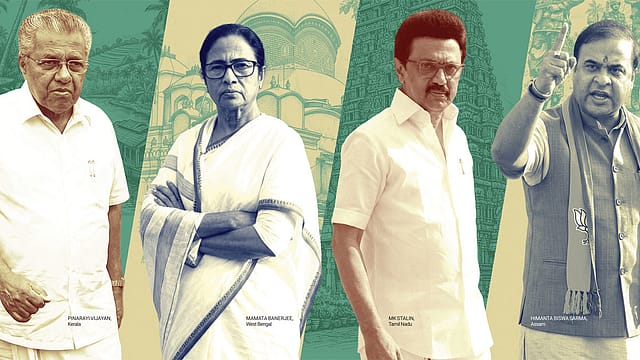
In varying degrees the electoral battles will see a fierce contestation between BJP’s efforts to consolidate Hindu votes by presenting itself as the only party serious about stopping illegal immigration from Bangladesh and capable of dealing with external threats like Pakistan without being hamstrung by vote-bank considerations and the I.N.D.I.A. bloc parties’ efforts to mobilise the support of Muslims and other minorities. Despite the conventional advantages enjoyed by parties such as TMC and DMK, they are leaving nothing to chance. Rallying the Muslim vote is crucial to West Bengal Chief Minister Mamata Banerjee’s bid for a fourth consecutive term and leaders like Owaisi are being pressured not to put up candidates and split the ‘secular’ vote after AIMIM won an unexpected five seats in Bihar’s Seemanchal region which has a high Muslim population. DMK leader and Tamil Nadu Chief Minister MK Stalin is keenly aware of new entrant actor Vijay’s Tamilaga Vettri Kazhagam’s (TMK) threat to weaning away minority votes alongside his broader appeal with younger voters. In Kerala, the Congress-led United Democratic Front’s (UDF) prospects of unseating LDF hinge on its perceived support among Christian and Muslim voters. The prominence of the Indian Union Muslim League in UDF has led to a sharply polarising campaign where not just BJP but CPM is taking potshots at Congress’ pampering of the League. In Assam, Sarma has unabashedly played the Hindutva card, warning against demographic changes due to Bangladeshi illegals and taking credit for freeing forest land from the clutches of such settlers.
In Kerala, BJP has identified 35-40 seats where it expects a significant vote share, based on its performance in the 2024 Lok Sabha polls and local body elections late last year. According to a party leader, BJP is concentrating on seats in Thiruvananthapuram, Kollam, Pathanamthitta, Alapuzha, Kannur, Palakkad, Kozhikode, and Thrissur, the last represented by actor Suresh Gopi in Lok Sabha. BJP got a vote share of 19.4 per cent in the 2024 Lok Sabha elections, up by over 3 per cent from 2019. In the local body polls, though its vote share fell to 14.2 per cent, the party wrested the Thiruvananthapuram corporation, securing the highest consolidated votes in Nemom. State party chief Rajeev Chandrasekhar will contest from Nemom, the only Assembly seat BJP has ever won in Kerala, when veteran leader O Rajagopal contested in 2016. LDF, which had defeated BJP in Nemom in 2021, has fielded incumbent and state minister V Sivankutty.
With the Modi government’s welfare schemes and infrastructure projects seen by BJP as part of its “double engine” plank, Chandrasekhar is focusing on the development mantra in the state where Christians and Muslims are estimated to constitute around 45 per cent of the population. “We are the only party talking of Kerala’s development. All our advertisements and campaigns concentrate on development. LDF and UDF are fighting the polls on the lines of religion and caste politics. We will make substantial gains. Earlier, people felt that voting for BJP will not count, but that has changed now,” says Sreedharan Pillai, who has been state party chief between 2003 and 2019 and was governor of Goa and Mizoram.
According to Revolutionary Socialist Party (RSP) MP NK Premachandran, who has won the Kollam seat five times, UDF has an advantage owing to “anti-incumbency and authoritarian approach of the LDF government.” The UDF campaign is expected to focus on Chief Minister Pinarayi Vijayan’s “failings”, such as high-handedness, deterioration in health services, and graft charges.
BJP also hopes to gain from “anti-incumbency” against the Pinarayi Vijayan government, which has been in power for a decade. LDF is in turn trying to play the “Hindu card”.
WEST BENGAL HAS been a rollercoaster ride for BJP where it surprised TMC by winning 18 of 42 seats in the 2019 Lok Sabha polls, a major gain from the two it had won in 2014. At the time Mamata Banerjee appeared to have underestimated Modi’s appeal and spent much of her time in forging a national-level opposition alliance anticipating the prospects of a presence at the Centre. In 2024, BJP’s numbers slipped to 12 and while it is the main opposition with 77 seats in the Assembly, it could not break TMC’s grip on the state in the 2021 election. A well-entrenched cadre and Banerjee’s energetic presence offer a stiff challenge but there are chinks in the armour due to serious law and order incidents, such as the RG Kar Medical College rape and murder case and another abduction and rape of a student from Odisha who was snatched right outside the private medical college she was studying at. These have given BJP ammunition to attack the TMC government. BJP has sought to link criminal incidents with patronage of the ruling party and reluctance to act against offenders in a bid to placate communal vote banks.
A senior BJP leader said the focus is on “anti-incumbency, women’s security, delay in Dearness Allowance (DA) of state employees, infiltration, corruption cases and governance failure.” BJP has dubbed the last-minute decision to pay enhanced DA as ordered by the Supreme Court just before the Election Commission (ECI) announced the poll schedule an election gimmick.
BJP’s first list of 147 candidates sets the stage for a face-off between Banerjee and state chief and leader of opposition Suvendu Adhikari in Bhawanipur. The seat is held by Banerjee. Adhikari, once a Banerjee confidant, defeated her in 2021 from Nandigram, the second seat he will be contesting. “Our strength is the organisation and Prime Minister Narendra Modi’s image. People of West Bengal are wary of Trinamool Congress’ rule. Women are insecure. There’s rampant corruption. Around 50 lakh youth go out of the state seeking jobs,” says Dilip Ghosh. BJP has taken care to form thousands of booth committees well in advance as this “last mile” gap was seen to hurt the party in 2021.
TMC’s bitter opposition to ECI’s Special Intensive Revision (SIR) of the electoral rolls—the party has done its best to thwart it—and the judicial interventions to ensure the clean-up happens marks a major political fault line. BJP has attacked TMC, arguing that its opposition to SIR is rooted in its indulgence of ineligible voters. For the chief minister, the issue serves to present herself as the benefactor of minorities who she says face disenfranchisement. Banerjee’s appearance in the Supreme Court in her lawyer’s robes was a typically dramatic move on her part. More recently, she hit the streets to protest against the Centre over a shortage of LPG cylinders due to the war in the Middle East.
With BJP and the All India Anna Dravida Munnetra Kazhagam (AIADMK) resurrecting their partnership in Tamil Nadu, the alliance is training its guns at the ruling DMK, hoping to end Stalin’s run in office. BJP has raised issues like the controversy over lighting the lamp on the sacred Thiruparankundram hill near Madurai, looking to counter the Dravidian control of shrines through a state-run board. State BJP chief Nainar Nagendran has also targeted DMK over “unfulfilled” promises, law and order, and dynastic politics. The party is amplifying its development pitch, highlighting the Union government’s infrastructure projects in the state.
Meanwhile, like other chief ministers, Stalin has reached out to women with a direct benefit transfer (DBT) scheme. In February, `5,000 reached 1.31 crore women who are beneficiaries under the Kalaignar Magalir Urimai Thogai scheme, covering entitlements for February, March, and April.
In Assam, Census 2011 put the Muslim population at 34.2 per cent, and this is estimated to have risen further, providing Congress and the All India United Democratic Front of Badruddin Ajmal an advantage in nearly 50 seats. Sarma’s direct attack on Congress’ “minorityism” is intended to counter this mobilisation with a larger unity of Hindu voters that subsumes other divides like resentment against Bengali speakers. BJP has managed to balance interests and has done well in both Upper Assam and the Barak Valley. For Congress, out of office since 2016, it is a crucial election. “Why is the chief minister resorting to communal politics if he is confident of a third term? There are big-bang projects, but these have not percolated on the ground. Congress, on the other hand, faces massive challenges. It has to find candidates, make them win and ensure they remain in the party fold,” says TMC Rajya Sabha MP Sushmita Dev, a former Congress Lok Sabha MP from Silchar. She said TMC was going it alone to offer an alternative to both Congress and BJP. Congress has been out of office in Kerala for a decade as well, and the perception of being the favourite makes it imperative for the party to win to break an almost unbroken losing streak since the 2024 Lok Sabha polls.