Assembly Elections 2026: Kerala: The Last Tower
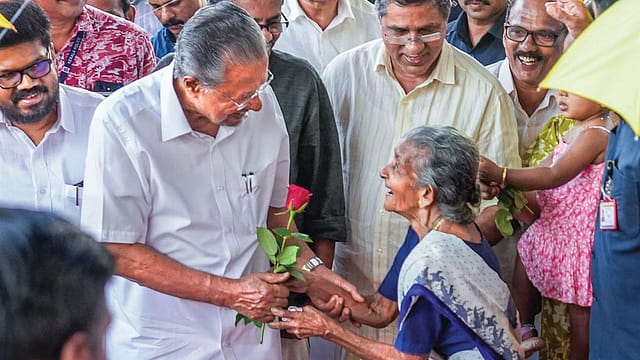
PINARAYI VIJAYAN IS destiny’s child, in a way. He is the 14th child of his parents, of whom only three reached their early teens. The premature deaths of 11 of her children meant that his devout mother developed a special affection for her youngest and resolved that he would not drop out of school to take up odd jobs for a living but would go to college—unlike the other two sons. Vijayan, who came under the spell of communism in his late teens while still at school, would soon become a student leader and rise to become president of the Kerala Students’ Federation at a young age. In 1970, when he was 25, he won his first Assembly election and became an MLA. The rest is history.
As of now, Vijayan is the most powerful communist leader in the country—he is the only Kerala chief minister in the state’s 70-year history to win a second straight term. But that is only part of what makes him a formidable political figure. As the 80-year-old seeks re-election for a third consecutive term in the upcoming election to be held on April 9, he is the undisputed leader of his party, the Communist Party of India (Marxist), or CPM. Kerala today is the last outpost where Indian communists remain in power, having shrunk electorally elsewhere since 2011 and losing strongholds such as West Bengal and Tripura to rivals. The central leadership of Vijayan’s party no longer wields the authority it once did, not least because of its dependence on Kerala for financial and organisational support. Unlike in the past, Vijayan is a CPM chief minister who holds the reins of his party organisation, even though he ceased to be the secretary of the party’s state unit some 11 years ago.
Again, his nearest political rivals in the state, be it from Congress or the fledgling Bharatiya Janata Party (BJP), are several notches lower in experience and stature, at least two generations junior to him in the political scheme of things, and all of them pale in comparison. He is an administrator and an organisation man who rose through the ranks of his party from the early 1960s, in the turbulent years preceding and following the rise of the Naxalite movement; through Emergency, when he was mercilessly beaten in custody; surviving cycles of political violence, especially against the Rashtriya Swayamsevak Sangh (RSS); emerging through the street-fighting years of the 1980s and a period of pragmatism among communists in the 1990s. Vijayan had a formidable start: a young, fire-breathing opposition MLA who launched tirades against the treasury benches in the early 1970s, rising to the top echelons of the state CPM while still in his early forties, becoming a minister handling two plum portfolios in the government of EK Nayanar in 1996 while in his early fifties, and then the state secretary of CPM at 53 in 1998.

Since then, Vijayan, notwithstanding a prolonged feud with his one-time mentor and CPM icon VS Achuthanandan, had managed, almost improbably, to consolidate power within the rigid confines of his party by the time he became chief minister in 2016. Unlike previous communist chief ministers who had the party breathing down their necks, Vijayan retained control within the organisation as well.
Which is why this election in Kerala is centred on him, with voters split broadly between those who admire him and those who loathe him. Much more than the elections in 2021, which were held in the aftermath of the Covid-19 lockdown when he appeared before the media daily to update the public, this time round the Vijayan government faces an anti-incumbency wave, directed more at him than at the government’s record, which even some of his detractors concede was not entirely wanting.
Since his days as an MLA in the 1970s, Vijayan has never been one to appease the media or to cultivate charm. He has been a dyed-in-the-wool communist, saying what he feels at public rallies, challenging police officers as well as political rivals without visible hesitation or restraint. He was seen as blunt, even excessively forceful, in his speeches, inside the Assembly and outside. The ‘nice enough’ persona that many politicians strive to project was never his template. He was abrasive as much as he was militant, in speech and in confrontation, particularly in his younger years.
Regardless, Vijayan is famously disciplined. Once a chain smoker, he quit overnight while still in his thirties, a telling display of willpower. He drinks neither tea nor coffee and adheres to a strictly punctual diet and exercise regimen. He has often maintained that it was his discipline and physical fitness that enabled him to withstand the brutality he endured during Emergency. Upon his release, he dramatically held up his blood-soaked clothes in the Assembly, a stark testament to that ordeal.
Vijayan did evolve over time and has mellowed, though his relationship with the media remained strained, and the media returned the favour. As a result, he became one of the most scrutinised political leaders in Kerala’s contemporary history. Political power ensured that he remained both a focal point of attraction and a target of relentless critique. In the past, every communist leader in Kerala had a counterweight within. For instance, MN Govindan Nair was a formidable presence when EMS Namboodiripad made history after the 1957 polls by becoming the first head of a communist government in Asia and the third in the world. Even the widely popular Nayanar had Achuthanandan and others watching his every move. Achuthanandan, when he became chief minister in 2006, had to contend with a domineering Vijayan. Vijayan as chief minister, however, has had no such challenger, with Achuthanandan retreating to the sidelines due to ill health until his death in July last year.
Just as he has his critics, Vijayan is admired for being a hard-nosed politician who means business. As chief minister, he is not a prisoner of ideology but capable of flexibility. Despite resistance from within, he ensured relatively smooth land acquisition for the GAIL pipeline project in Kerala. The same holds true for the Vizhinjam International Seaport and several crucial infrastructure projects across the state—initiatives that many other chief ministers might have found nearly impossible to execute. Being a strongman also meant that his own party could not easily rein him in.
Vijayan is, by all accounts, a tireless worker. His aides recount how he responded to the 2024 Wayanad landslides in the early hours of July 30. The chief minister was about to retire for the night when he was informed of the disaster. They assumed he would take stock in the morning. Instead, the lights came on in his study at Cliff House. He worked through the night, coordinating with officials, ministers and even the opposition leader, before flying out by helicopter at daybreak to oversee relief efforts. On March 1 this year, he inaugurated the first phase of the Wayanad Model Township Project for the rehabilitation of landslide survivors, promising to hand over houses before the next monsoon.
In a state that prides itself on a redistribution-oriented economic model, Vijayan has also sought to push growth, courting investment while emphasising governance. Much to his visible frustration, this election has drawn an unusually sharp media focus to his alleged ‘arrogance’ and authoritarian streak within and outside the party, alongside accusations from sections of both Hindus and Muslims that he is hostile to their interests. Whether Vijayan can overcome these headwinds and secure yet another term for his party is the question. The answer will not be long in coming.