Assembly Elections 2026: Assam: A Nationalist on the Offensive
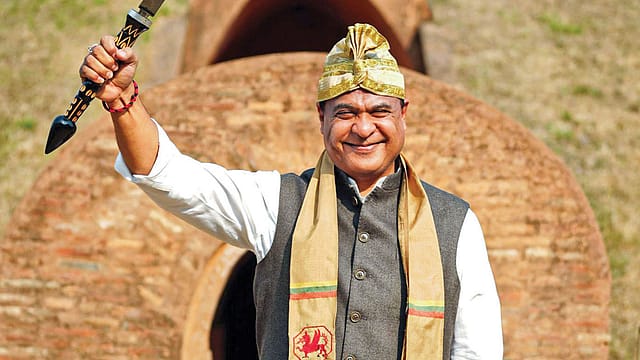
IN LATE OCTOBER 2021 violence erupted in Gorukhuti, a hamlet in Darrang district of Assam. An eviction drive against encroachments and illegal immigrants who had occupied government land turned violent. Two persons died in the drive after the police were subjected to stone-pelting by local residents, most of whom were of doubtful citizenship.
The reports in the national press, however, sought to blame Chief Minister Himanta Biswa Sarma for animosity towards Muslims. The reality was different. The sustained anti-encroachment drive made the chief minister a hero in the eyes of most people of Assam. Barring the illegal migrants from Bangladesh, of course.
Five years later, on the eve of Assembly elections in the state, Sarma proudly declared that more than 1.5 lakh bighas of land (approximately 50,000 acres) had been freed of encroachment. Critics will carp that this is just a tiny sliver of land in a vast sea of encroachment. But the truth is that immense handicaps—legal and political—await any chief minister of Assam who tries to evict illegal immigrants from his state. A cabal of activists and lawyers quickly appeal to any judicial forum available to them to halt measures against illegals. Once the government is halted in its tracks, a double-edged politics takes over. On the one hand, Muslim opinion in the state is roused and, on the other, the Assamese populace becomes cynical and resigned to being over-run by illegal immigrants.
Sarma has broken this cycle where his predecessors failed. That is the secret of his success and the confidence with which he approaches the Assembly elections. Behind this lies a simple fact. Of all the chief ministers in recent decades, Sarma realised the importance of curbing land encroachments at the hands of the miyas—illegal immigrants from Bangladesh—and checking the adverse effects of the influx of an alien population in Assam. This leads to apoplectic reactions from activists and academics—mostly located in New Delhi—but has struck a chord with the people of Assam.
Unlike the impression created by misleading headlines, these steps have legislative backing from the Assembly where Sarma has been shepherding important Bills. The Assam Land and Revenue Regulation (Second Amendment) Bill, 2024 passed in August that year by the Assembly, provides that land sales in a five-kilometre radius around heritage sites older than 250 years will be restricted. Key religious and cultural institutions such as sattras and thans across the state had their lands encroached upon and taken away in the absence of laws preventing their alienation. Other laws—again piloted by the chief minister— such as those on compulsory registration of Muslim marriages and ending of polygamy have been introduced or passed by the Assembly. This was in no small measure due to the political capital expended by Sarma.

Political will does not flow out of ether but out of a close ear to the political realities of a state. The space to take corrective steps in a frontline state like Assam was never available to Sarma as long as he was in Congress. He continued to win regularly from the Jalukbari Assembly constituency on the outskirts of Guwahati, cementing his political credentials as a giant killer after defeating Bhrigu Kumar Phukan, one of the signatories of the Assam Accord of 1985 and a senior Asom Gana Parishad (AGP) leader. One can only speculate what would have happened if Congress had not made the mistakes that forced Sarma to leave his political home and join the Bharatiya Janata Party (BJP). But it is clear that given Congress’ policies of appeasement—which continue till today in Assam—he would not have found room to achieve all that he did after 2016, when a BJP government was formed in the state and especially after 2021 when he became chief minister.
There is little doubt that Sarma is a skilled politician. Much of what he has attained is due to his political will. But there is a more complicated terrain where skills and errors of rival parties interact. In this domain, errors open up the space needed to further one’s goals that, in turn, induce further errors by the rival party. That is the sequence of events that has played out between Congress—making errors—and BJP—gaining from them—all the while being mediated by Sarma as a sutradhar or director of events.
In February, Bhupen Bora, a former state chief of Congress quit the party. Sarma welcomed him into BJP’s fold. Even before Bora had quit, there was a steady trickle of leaders who were haemorrhaging Congress of talent. Significantly, after Bora left, the chief minister said, “Bhupen Bora was the last recognised Hindu leader of Congress. Apart from him, if you ask about Debabrata Saikia, he is the son of Hiteshwar Saikia; Gaurav Gogoi is the son of Tarun Gogoi; Pradyut Bordoloi himself wins from a minority seat. Bhupen Bora was the last legitimate Hindu face of Congress. His resignation is, in a way, like Congress separating itself from Hindu society.” That sums up Assam’s politics on the eve of the Assembly elections.
On March 17, Pradyut Bordoloi, too, called it a day from Congress. At this stage, Congress tried to stitch up an alliance with Akhil Gogoi, the enfant terrible of Assam politics and the leader of the Raijor Dal. But Gogoi hinted that Congress’ call to his outfit was too late. Not that Congress has much of a chance in Upper Assam. At each such juncture, Sarma made most of the mistakes made by Congress and, in turn, forced the party to make still more errors. Congress, wedded to the minority vote bank since the days when it forced its veteran freedom fighter Bishnu Ram Medhi (1888-1981) out of the chief minister’s chair, is structurally unable to course correct.
Sarma is now a key leader of BJP. From his initial innings as the Convenor of the North East Democratic Alliance (NEDA), the outfit created by BJP to expand its political presence in the region, to chief minister of Assam, Sarma has delivered the goods. Congress has, more or less, been reduced as a political force in the region. This was in no small measure due to Sarma’s skills and his utilisation of every opportunity Congress provided him even as it continued to make error after error.
Assam is a state that now defines the ideological frontier of Indian nationalism. It is also the state where demographic dangers will continue to pose threats to the unity and integrity of India. Activists, academics and political forces inimical to India will try to fish in troubled waters in Assam and states that adjoin it. The region does not permit the luxury of political licentiousness that goes in the name of secularism. Happily for Assam, and for India, there is a political leader on the scene who understands these dangers and is taking the necessary steps to meet the menace posed to the country. He is well-poised to continue his political journey.