An Invitation to Anarchy: Is the street threatening to overrule the state?
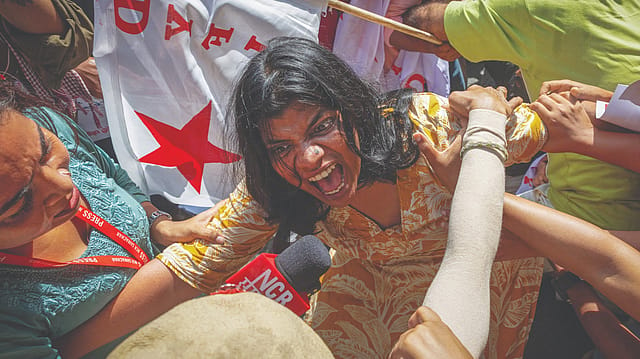
The two cities may be thousands of miles apart, on different continents, but Paris and Delhi are both bestirred by the same impulse: a redoubtable faith in the power of the street to deliver justice. And so, the streets have turned into battlegrounds for ‘revolution’. On these streets, truculent ‘anarchists’ march to the beat of slogans that lustily valorise a central objective: provide governance solutions to complex problems by bypassing democratic institutions. In France, that objective is summed up by ‘Levez-vous’ or ‘Rise Up’; in India, it is ‘Sansad nahin Sadak pe Faisla’ or ‘Not Parliament but the Streets Will decide’.
But the two cities aren’t just joined by the slogans through which protesters demand their due but also by the means deployed to realise their ends.
First, in both Delhi and Paris, the police and other state security forces have been provoked. The slightest reaction is then litigated to shame and immobilise the state security apparatus. Second, social media is used to seed young voters with the notion that the state is deaf to their pleas and redress is possible only through direct action. Third, there is a common belief that the liberal democratic project itself cannot be trusted to serve the larger public interest.
But that’s where the similarities end. While the protests in France centre on education, those in Delhi began with student frustration over paper leaks before snowballing into a catch-all agitation aimed at discrediting the Election Commission, delegitimising the ruling NDA’s mandate and opposing government policies, including those concerning gender rights.
There is increasing reason to scrutinise overseas advocacy networks invested in challenging the Modi government’s authority. Before this is dismissed as a paranoid conspiracy theory, it might be useful to look at the facts, while distinguishing documented links from allegations of coordination.
A few weeks ago, Florida moved to designate the Council on American-Islamic Relations (CAIR), an American Muslim civil-rights and advocacy group, under its state terrorism law. Ordinarily, a dispute over an American civil-rights group might hold little consequence for Indian audiences. But CAIR, which has connections to Indian NGOs, has repeatedly lobbied Washington over India’s policies, including through its support for sanctions advocated by the US Commission on International Religious Freedom (USCIRF).
George Soros’ Open Society Foundations funds civil-society initiatives internationally. Soros has warned against “Hindu-nationalist exclusivism” and questioned whether Narendra Modi is a democrat. Soros too urges Washington to pressure India over religious freedom and has endorsed USCIRF reportage.
While claims that Soros directly funds CAIR need documentary substantiation, the ideological alignment is there for all to see. Whether and how these arguments are amplified by Indian organisations and opposition political leaders deserves scrutiny, even though admittedly links between advocacy groups do not, by themselves, establish a coordinated campaign to drive street protests.
The censorious anti-Modi campaigns have elicited bitter rebuttals from top NDA officials like External Affairs Minister S Jaishankar, who dismissed Soros as an “old, rich, opinionated person sitting in New York” who still thinks his views should determine how the entire world works. Jaishankar believes that calls for open society and transparency can disguise attempts at “regime change”.
Rahul Gandhi, Leader of the Opposition in Parliament, has repeatedly said he is “fighting the Indian state itself”. He has also shared platforms with ultra-leftists who swear by “bloody revolution”. These associations do not, by themselves, prove a common plan. But they raise a legitimate question: Is political contest now seen as a struggle against the constitutional order?
Those speaking for the opposition and allied civil-society groups will argue that NDA and its ecosystem blithely paint all democratic dissent with the broad brush of state subversion, as a dark art practised by malefactors committed to breaking India. They aren’t entirely wrong. NDA managers often use the phrase ‘Dimagi Naxals’ to delegitimise those bearing grievances against the Modi administration.
However, the question is not whether dissent is legitimate. Of course it is.
The question is whether activists, advocacy groups and political actors are using the freedom to dissent to undermine constitutional institutions. Whether they think they can ultimately substitute street pressure for democratic process.
‘Sansad nahin Sadak pe Faisla’ is an invitation to anarchy. Protest is democratic. And there is nothing democratic about using the street to overrule the state.