An Alliance Reforged
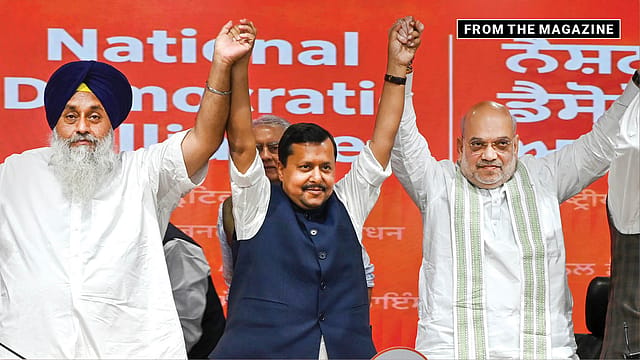
The return of the Shiromani Akali Dal (SAD) to an alliance with BJP was long expected, if entirely predictable. The two parties, the oldest partners in NDA, had drifted apart in the wake of the three farm reform laws in 2020.
If the timing of the move was apposite, given that Assembly elections in Punjab are scheduled for early next year, the reaction from opposition parties in the state was uncharacteristically vehement. Within a day of SAD chief Sukhbir Singh Badal and the BJP leadership announcing the alliance in New Delhi, the opposition began hurling charges at the two parties.
That’s understandable, to an extent. Perhaps for the first time in its electoral history, Punjab is witnessing a multi-cornered contest. On one side is the incumbent AAP, while Congress, too, sees an opportunity to return to power.
Not to be left behind, the Akali Dal (Waris Punjab De) (WPD), an extremist outfit led by Amritpal Singh, the MP from Khadoor Sahib, is also in the fray. A typical election in Punjab has largely been a two-cornered contest between SAD and Congress, with the two parties taking turns to govern the state. Every now and then, an independent candidate throws his hat into the ring, but the state had never seen a third political party come to power. Then, in 2022, AAP managed to win the state.
With one alliance and three other parties in the fray, predicting the political outcome in Punjab is, for now, a matter of statistical modelling. All parties are still trying to find their feet and get their campaigns underway.
The past four-and-a-half years of AAP rule have witnessed protests and agitations. The party dismisses these as mere propaganda, but the reality is that the gap between what AAP promised in 2022 and the rising expectations of the people has remained a problem. To take one example, the promised financial assistance scheme for women was launched less than a year before the elections.
This is hardly surprising, given Punjab’s exceptionally poor financial health. The state has barely any money left after meeting its committed expenditure and funding the government’s populist measures. The situation is no better for Congress, often regarded as the one party with a clear path to victory next year, even as it remains mired in internal conflicts and factionalism.
Matters are no better for the SAD-BJP alliance. The Punjab Assembly has 117 members. SAD has just one MLA, down from 15 in the 2017 election. In 2012, when the SAD-BJP alliance won the elections, SAD had 56 MLAs. Reversing this precipitous decline will take some effort.
What also complicates the equation for the SAD-BJP alliance is the presence of WPD, a party that espouses an extremist ideology. The risk that it will eat into SAD’s fringe vote in the so-called panthic constituencies is very real.
What complicates matters for Congress and AAP is that they are competing for nearly the same pool of voters. In Malwa, for example, AAP has managed to arrest its decline somewhat since the cash transfer scheme for women kicked in. It is trying to master the politics of appealing to women voters, now in vogue across India, and this appears to be working to some extent. This region of Punjab (Malwa) has the lion’s share of seats (69), and unless Congress wrests a substantial number of them from AAP, it has no clear path to victory.
While AAP has a somewhat stronger position in Malwa—once SAD’s citadel—its strength in the state’s two other regions, Majha (25 seats in the old Amritsar and Gurdaspur districts) and Doaba (23 seats in Jalandhar, Hoshiarpur, Kapurthala and Nawanshahr districts), is not organic but the product of an unusual wave election in 2022. Congress has its own areas of strength in these two regions.
What about the SAD-BJP alliance? What does it offer Punjab’s weary voters? For one, rampant substance abuse across the state, and the inability of the last two governments to arrest its spread, remain major issues.
Corruption, which was always a problem in the state, has now assumed a particularly vexed form. This has not gone unnoticed among the people of Punjab and has become a livewire issue as AAP had promised to clean up the state’s governance. That promise lies in tatters.
Then there is the rapid deterioration in law and order under the AAP government. Both issues have electoral salience, and a section of the electorate believes that these problems cannot be solved without the Centre’s help.
BJP is not popular in rural Punjab, but there is a grudging acknowledgement that if any party can rid the state of these problems, it is BJP. If SAD gets its act together, a change in the political environment is distinctly possible.
Here is the paradox of Punjab’s politics: its mental make-up is shaped by “resistance” to anything that allegedly comes from the Centre. Yet the people of the state, at least ordinary voters who have no recourse to power, also know that the Centre alone can do what is necessary to pull the state out of its current morass.
The challenge for the SAD-BJP alliance is almost alchemical, but unlike the medieval art, it is not impossible. It is best, however, not to stretch that metaphor too far. Punjab is a harried state in which all political parties have made serious political and policy errors while taking turns to govern.
The people want some respite, even as they must be told honestly that the road back to the Punjab of yore will not be easy. If the state is to become viable once again—and viable is the right word—it will need to undergo restructuring in painful ways, beginning with a drastic overhaul of its expenditure priorities. This is never easy in a state that has fallen prey to populism.