AAP Promised to Change the System But Was Changed By It
IN THE BEGINNING, it felt like a cleansing.
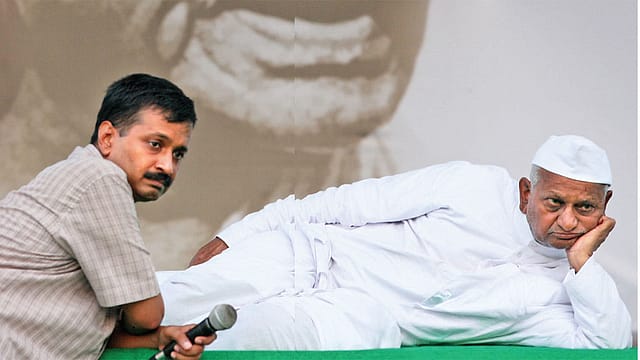
Not easy, perhaps not even winnable in any obvious sense—but clean. In that fateful year of 2011, on the pavements of Delhi, a new grammar of politics was being conjured up, as if from a séance board. One image, in particular, travelled far and fast. An ageing figure, frail but resolute, seated amid a sea of followers, his back turned just enough to the camera to suggest a saintliness. It carried an echo of another time, of another moral theatre, of a man now called the Father of the Nation.
If Anna Hazare was the image, the still centre of the frame, the suggestion of an older moral authority, the more consequential presence stood just to his side. At Jantar Mantar, enveloped in the carefully choreographed austerity of the fast, it was Arvind Kejriwal, in his untucked, unkempt shirt, the now-familiar Gandhi cap perched lightly, his voice measured, slowed almost to the cadence of restraint, who seemed to embody the movement’s forward motion. There was something studied about it: the pauses, the quiet insistence, the air of a man shaped, even purified, by the fast-induced cracks on his lips.
Hazare held the symbolism; Kejriwal held the direction.
By the second term of Manmohan Singh, the promise of technocratic stability had begun to look shaky, besieged as it was by scandals like the one over telecom licences. The prime minister’s silence on these matters almost felt as if he would someday stand up in Parliament and say Daag acche hein (“stains are good” a la Surf Excel’s ad campaign) to explain away his tainted Cabinet colleagues. From episodic outrages, corruption had curdled into the national mood. There was, in the air, a sense of depletion.
At that moment, Kejriwal looked like a man who would decisively do something about it. He did not have the heft of legacy or the halo of charisma. His role almost seemed accidental, as if he were propelled more by anger than ideology.
As India felt that tide rising, even the most watchful hawks ignored or chose to largely ignore the curious and unlikely fellowship around him—an assortment of soft and hard rightwing and leftwing, and several other faces, who in the delayed halogen light of history turned out to be rank opportunists. Kejriwal was the man who could take us out of the quicksand of circumstances we had long accepted as our destiny.
Within a year, Kejriwal made a break from Hazare, paving the way for a party from protest. So far, the enemy had been singular (and external). But once the party was formed on the hilltop of moral capital accumulated at Jantar Mantar, the righteousness of fasting had to shift to accommodate the arithmetic of electoral politics.
But even then, in the early days, the edges of power were yet to reveal themselves. In 2014, Kejriwal pitted himself against Narendra Modi in Varanasi in a drama which portrayed him as part-activist, part-ascetic. A few months earlier, with Congress’ support, he had managed to form the government in Delhi, but then resigned after less than two months over his failure to get the Jan Lokpal Bill passed. For some, the grandstanding, as they called it, was a shrewd gamble. For his admirers, though, it was a sign that he had refused to be co-opted. With this image, the party decided to put all its muscle in Varanasi, even at the cost of other symbolic activist-candidates it had fielded in places like Chhattisgarh and Uttarakhand. Led by volunteers, perpetually pulled by hands, by notes, by expectation, Kejriwal moved on to the tune of ‘Bande main hai dumm’ only audible to him. He brought a stubborn physicality to the campaign, his party cap so soaked in sweat that it could have sunk in water. In the political galaxy of sprinters, he looked like an endurance runner. He created a hope—a spring of optimism so blossomy that in their party office in Varanasi, Manish Sisodia, his deputy, would tire of receiving calls from a despondent place like Kashmir, from people who wanted the party to make a debut there.

The movement that gave rise to Kejriwal also paved the way for Modi. The relentless attack on the moral legitimacy of the Congress-led order created a vacuum that could have been filled by multiple players, but none of them was more prepared (and aggressive) than Modi. In Varanasi, Kejriwal lost to him, but the party won four Lok Sabha seats, all from Punjab. A year later, in 2015, the party made a landslide comeback in Delhi, winning 67 out of 70 seats.
By this time, the earlier language of openness had begun to dissipate. Fighting for the spirit of democracy is one thing, allowing it internally is another. The break came suddenly when in a dramatic way—a drama of ruthlessness not associated with Kejriwal so far— the party’s two important pillars, Yogendra Yadav and Prashant Bhushan, were removed. Yadav later alleged that Kejriwal’s side had used bouncers to subdue them—an act that would have hardly raised an eyebrow had it happened in another party. But it also proved that the founding principles of the Aam Aadmi Party (AAP) were a myth, or in more popular Indian-political lingo, a jumla.
Unfazed by this, AAP turned to governance, accompanied by subsidies calibrated with clever precision. Improving the lot of government schools, opening up clinics, providing free water and free electricity up to a limit—winning the votes of the poor became a model. Along with it, the attacks on Modi continued. But at some point, especially after AAP failed to win any seats in Delhi in the 2019 Lok Sabha elections, Kejriwal seemed to conclude that a majority of those who had voted for the party had no desire for anti-Modi rhetoric, that the perpetual confrontation with Modi yielded diminishing returns. The utterances against Modi pared down, and the ideological combat of Varanasi shifted to the granular governance of Delhi vihars. The dream of expansion was curtailed, except in Punjab where the party saw promise, since in 2017 it became the main opposition party in the state. In states like Goa, despite earlier promises, AAP did not succeed.
IN 2020, BECAUSE of its hyper-local model, AAP again won in Delhi. More than a chief minister, Kejriwal became the CEO. This was followed by AAP’s impressive victory in Punjab. As AAP’s Bhagwant Mann became chief minister, the optics of power made it seem like an inversion, as if Mann held the office only to keep it warm for somebody to be anointed later. The opposition picked this up, with BJP alleging that Mann had been reduced to a “Puppet” while Kejriwal acted as ‘super-CM’. With it, they also charged AAP for using Punjab’s resources for extraterritorial priorities.
It was proving to be easy because Mann did not seem to be holding the reins tight. There was no improvement in Punjab. Its rampant drug problem remained undeterred, while the new government’s administrative inertia became palpable. A parallel anxiety ran through the state: the resurgence of gangster activity. In Punjab, incidents of targeted killings, extortion networks, and the continued reach of gangs operating from within and beyond prison walls began to re-enter public conversation.
Concerns about media freedom formed another strand of the critique. Independent journalists in Punjab and watchdog groups alleged that the AAP government had increasingly resorted to legal and quasi-legal instruments—defamation notices, FIRs, and even copyright claims—to discipline unfavourable coverage. Earlier this year, activists and journalists found themselves booked by Punjab Police over alleged misinformation relating to the chief minister’s helicopter usage, an episode critics described as a form of “narrative policing” where contestation over facts itself became grounds for coercive action. “The filing of FIRs gives away the intent of the Punjab government of silencing the press into submission in violation of Article 19(1)(A) of the Constitution,” said a national press body in its statement, urging Punjab Police and the state government to withdraw the charges against the journalists.
The irony was difficult to miss. Kejriwal had emerged from the world of transparency campaigns, his early politics shaped by the use of the Right to Information Act, 2005 as a tool to prise open the state. It is on this legacy that his political journey had been built. The way the party was now behaving suggested a reversal of its founding instinct.
While this was unfolding, attrition too became part of AAP’s story. Figures such as Yadav and Bhushan had already marked an early schism, but they were followed, in different ways and at different moments, by others like Ashutosh, Kumar Vishwas, and Alka Lamba. Their departures were rarely uniform in cause, but with Swati Maliwal, a long-term insider, the party’s internal chaos spilled into the open quite bitterly. This was also a time when the party found itself drawn into an expanding web of legal and political scrutiny. The liquor policy case became the focal point, with the crisis sharpening in 2024 when Kejriwal himself was arrested. The party framed its response as political reprisal but the waters of legitimacy are subject to public perception. Suddenly, AAP’s hold over Delhi seemed not so invincible. To lose Delhi in 2025, therefore, was not merely an electoral setback. With unsteadiness in Punjab brought about by Raghav Chadha and, frankly, more than him by Mann’s own limitations, the party appears to confront, for the first time, the fragility of a model it had long treated as self-evident.
What happens hereafter? Can AAP reconcile centralised control with the participatory ethos it once advertised? Can it sustain a governance model outside Delhi and Punjab? More importantly, will it remain a political party that can withstand turbulence? Answers to these questions depend much on Kejriwal’s own evolution that sits at the heart of this story. None of its features has rendered AAP distinguishable from its predecessors, except maybe a little in terms of public debate over education and healthcare. But the sheen of moral exceptionalism which the ‘muffler man’ and his comrades wore with gusto has faded.
And that is where the sense of failure lies.
Not in electoral setbacks or administrative shortcomings, but in the collapse of an idea—the idea that politics could be purified without being transformed by the very power it seeks to wield.