A major reform push helped Modi Govt boost growth, tackle tariff & other challenges
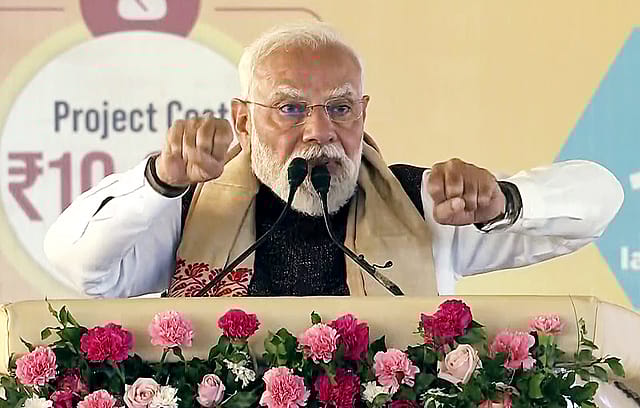
The re-election of Prime Minister Narendra Modi for a third successive term in office provided a rare opportunity to press ahead with financial and other pending policy reforms. While outcomes of the 2024 Lok Sabha election did not deliver a majority to the Bharatiya Janata Party (BJP), the Janata Dal (United) and Telugu Desam Party (TDP) offered strong support without conditions and this resulted in in a stable National Democratic Alliance government held together by a solid 240 seats won by the BJP. Despite gains, the Opposition was not in a position to form an alternate government at the Centre.
The BJP clawed back soon after, flipping the Lok Sabha results and registering a convincing hattrick of wins in Haryana in October, 2024. In fact, BJP improved its tally and won a majority on its own as in 2019 it had needed the support of the Jannayak Janta Party (JJP) and a clutch of independents. In November, 2024, BJP won a bigger victory, winning the Maharashtra state poll in the company of the Ajit Pawar Nationalist Congress Party and the Sushil Shinde Shiv Sena. In both states Congress and its allies could not replicate the bounce they had exhibited in the Lok Sabha election.

Iran After the Imam
06 Mar 2026 - Vol 04 | Issue 61
Dispatches from a Middle East on fire
BJP’s political comeback, Modi factor
BJP wrested another prize in February, 2025, ousting Aam Admi Party (AAP) from the Capital despite the contest largely boiling down to a straight fight as Congress failed to make it triangular test. In eight months since the Lok Sabha result, BJP won significant battles. More importantly for the party, Modi campaigned extensively in all the state polls and it was apparent his capacity to carry voters remained undiminished. Despite not winning Jharkhand, which polled alongside Haryana, BJP had turned the tables on opponents who perhaps made the mistake of celebrating their Lok Sabha gains pre-maturely.
After the Delhi election, the next state poll was not due till the end of 2025, and this was an opportunity for Modi 3.0 to get off the blocks. The Union Budget announced a major relief for the middle class income tax payers who contribute regularly to government revenues and were hoping that the government will acknowledge their role in nation building. Finance Minister Nirmala Sitharaman announced a transformative shift that reflected the realities of monthly household budgets. The Modi government put money in the wallets of tax payers and for the first time, persons earning Rs 12 lakh a year faced no income tax burden at all. This provided meaningful savings provided money for families to make discretionary purchases, spend on essentials or invest.
The big tax break was followed by the 1961 income tax act being replaced by a new law that rationalized exemptions, reduced litigation and strengthened incentives for compliance. “It was a decisive break from colonial-era drafting and signaled India’s entry into a new era of transparent, technology-driven tax administration,” said an official. The tax reduction reflected a core belief of the Modi government – that making taxation simpler and more affordable will boost growth, consumption and compliance and that might significantly offset revenue losses. The same principle was behind the 2019 corporate tax cuts that offered a base rate of 22% for existing companies if they forgo certain exemptions and 15% for new firms willing to make fresh investments in manufacturing.
Betting on lower tax rates pays off
The year 2025 has proved challenging. The India-United States negotiations over a Bilateral Trade Agreement (BTA) that initially seemed to be proceeding well, hit a roadblock and stalemated. US President Donald Trump made tariffs the center piece of his economic policy as well relations with other countries and imposed a 25% basic rate on Indian exports. India’s principled refusal to endorse Trumps claims to have mediated an end to the May 7-10 India-Pakistan conflict seems to be the cause for an additional 25% imposed on India for allegedly “helping” Russia by buying its oil. The double standards were glaring and while Modi remained committed to the partnership with US, he refused to yield on the American demand for access to India’s agriculture, dairy and small-scale industry. Nor did he endorse fairy tales about how the conflict with Pakistan ended.
Trump announced the 25% additional tariff on Indian exports on August 6. This was a crucial moment for the Modi government as the trade troubles could well have seen the domestic sentiment slipping into a steep negative spiral. Addressing the nation from the Red Fort on August 15, Modi announced that the “next generation” reform of the Goods and Services Tax (GST) were on the anvil. “In this Diwali I am making arrangements for a `double Diwali’…Citizens are going to get a very big gift this Diwali…The rates for goods and services used by the common person will be reduced by big margins,” he said, adding that the measures will benefit small and micro industries. Modi’s announcement, in retrospect, was a crucial intervention. It kept the market and popular sentiment buoyant.
On September 4, the GST council took just one day of a two-day schedule to clear changes in the GST rates that reduced the tax to essentially a two-slab structure. The reform aimed to reduce disputes and strengthen digital oversight and India witnessed record Diwali sales of Rs 6.05 trillion. According to projections by leading banks, GST revenues despite lower slabs and rationalization are expected to exceed FY2026 Budget estimates. This is again a vindication of the Prime Minister’s view that a simpler tax regime can be both people-friendly and fiscally responsible. A tax which finds wider acceptance and delivers benefits to consumers will deliver on growth and provide steady revenues.
A New Deal for Labour
Not long after Diwali, the long awaited implementation of the four labour codes was announced on November 21. The codes had been passed by Parliament in 2019-20. The consolidation of 29 laws into four well-defined codes created a modern framework for business. The focus on fair wages, better worker-employer relations, a more effective social security net and safer work places are intended to support a work force of 64 crore and encourage female participation. The attention to gig workers was particularly relevant as this large and growing section of the work force required attention and support.
Earlier in the year, a new definition for medium, small and micro enterprises (MSME) removed socialist-era choke points in the law that discouraged scaling and bogged down businesses in red tape. The limits for micro enterprises was raised from Rs 5 crore to Rs 10 crore, small enterprises from Rs 10 crore to RS 25 crore and medium enterprises from Rs 250 crore to Rs 500 crore. The businesses are thus able to retain MSME status and expand without losing benefits and incentives.
The Jan Vishwas law and the massive overhaul of the Indian legal system as per the Bharatiya Nyaya Snanhita (BNS), 2023, are significant development that impact the daily lives of people. The Jan Vishwas Bill decriminalized 200 minor offences and scrapped hundreds of outdated laws. Jan Vishwas 3.0 is due to be introduced soon, The important signal in both initiatives is the promise fair and efficient justice rather than retribution. The BNS expanded the coverage of the legal-police system to address current day and emerging threats such as cyber terrorism, organized crime syndicates using technological deception, economic sabotage and new forms of gender-based violence with the spread of social media and internet-based platforms.