2029 on Modi’s Mind
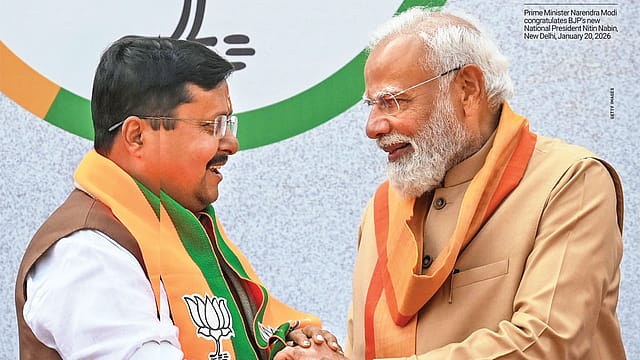
DURING THE BIHAR ASSEMBLY ELECTIONS, A VISITING senior Bharatiya Janata Party (BJP) leader spent several hours at the residence of Nitin Nabin, then a minister in the state government. On the face of it, this was not unusual as Nabin was tasked with important election-related assignments but the visit did not go completely unnoticed. As the election campaign for the November 2025 polls progressed, requests for swift constituency-specific actions were often directed to Nabin, indicating a growing importance in party affairs. By early December, the buzz about the five-term MLA had grown even stronger. Yet, the speculation was often about the post of state president; and when the BJP parliamentary board on December 14 named Nabin as National Working President, the announcement took the party rank and file by surprise.
The BJP leadership’s preparedness to pitch relative unknowns onto leadership roles is not new. It has gone against conventional wisdom in choosing chief ministers who do not conform to conventional calculations or have been low-profile performers but who it feels demonstrate the potential to lead. Nabin’s selection overlooks contenders who have been subject to media speculation, and at 45 years of age he skips an intermediate rung of leaders after the top tier of the party’s current hierarchy. It is almost as if the party took the decision to speed up the generational shift by choosing a leader in his mid-forties to infuse energy into organisational processes that were seen to have become somewhat sclerotic in the past couple of years. Nabin’s formal installation as BJP president on January 20 promises to bring about urgent and hands-on attention to the functioning of the central party and improved coordination with state units—a demanding task given BJP’s 14 crore membership and a vastly increased footprint.

Youth Issue 2026
24 Apr 2026 - Vol 04 | Issue 68
50 Portraits of Icons and Achievers
Nabin’s three-year term would conclude in January 2029 and this, for all practical purposes, means he will be a crucial part of the BJP campaign planning for the next Lok Sabha elections. In that sense, the BJP leadership, which banks on Prime Minister Narendra Modi to helm the party’s electioneering, sees Nabin as the key man to deliver on the organisational front. The new BJP chief indicated a keen awareness of his tasks during a lengthy interaction with the party’s central office bearers a day after he formally assumed office. In his opening remarks, he pointed out that he was much like a mukhia (chief) for the party cadre, with an attendee seeing the colloquial reference in the nature of “first among equals”. Nabin is understood to have underscored the role of BJP General Secretary (Organisation) BL Santosh, a key appointee in the party set-up, as a responder to matters requiring coordination and communication. While he heard state units reporting on organisational matters, his concluding remarks at the end of the day emphasised the need to precisely monitor and follow up implementation of plans and decisions.
Although he has held organisational responsibilities only in a couple of states, Nabin’s stint as in-charge of Chhattisgarh and his familiarity with the working of the Bihar BJP unit has seen him value interpersonal relations and he suggested that functionaries and workers at the mandal (block) level should meet regularly over a meal and share food from their homes. The simple-sounding advice puts into practice the prime minister’s reference to BJP ethos embodying “relationship” over mere “membership”. Soon after his appointment, the party announced Maharashtra leader Vinod Tawde as observer for the election of the Chandigarh mayor and senior functionary Ram Madhav as poll in-charge for the Greater Bengaluru municipal polls. Tawde, along with Union minister and Karnataka leader Shobha Karandlaje, has also been put in charge of the Kerala elections.

In the BJP scheme of things, the party organisation and its president are essential links to ensure effective transmission of the government’s messaging on key electoral issues. Nabin appeared to have understood the challenge when he emphasised to party functionaries the importance of waging and winning perception battles. “He conveyed that setting the narrative and pushing back at disinformation and negative portrayals was a necessity in political battles,” said a party office bearer. Nabin’s job would be to provide a seamless interface between government and party and also finetune BJP’s strategies on hot-button issues like the Election Commission’s Special Intensive Revision (SIR) of electoral rolls that was discussed during the January 21 meeting. Nabin suggested senior and experienced hands be named booth-level agents rather than state legislators, even as he underlined the need to be fully engaged in the revision of electoral rolls.
The prime minister’s remarks on Nabin’s appointment set out the context and significance of the new party chief’s task. Modi’s reference to Nabin being his “boss” in party affairs and that his job includes coordinating with National Democratic Alliance (NDA) partners is a strong endorsement of the BJP president’s authority. The prime minister underscored the importance of “process” over “post” and said, “In our party, presidents change but not our ideals.” At another point in his speech he said that while BJP began its journey as a “party with a difference” it is now a “party of governance”. The references were far from casual, pointing as they do to the need for organisational discipline and well-defined, accountable norms for party work.
“When he became general secretary of the BJP Yuva Morcha in 2010, he was an MLA, and was very innovative and positive in his approach. He remained active through his tenure in the youth wing,” says former Union minister and BJP leader Anurag Thakur, who then headed the Morcha. Nabin participated in several BJP yatras at the time when it was in opposition at the Centre. Thakur says Nabin’s attributes are commitment and a corruption-free political life. By selecting a leader born in 1980, the year BJP was founded, Thakur says the party has reached out to the youth, keeping in mind India’s demographic dividend as around 65 per cent of the population is below 35. The average age of the Council of Ministers sworn in, in 2024, is 58. In August 2024, Modi called on a lakh youths with no political lineage to join politics, saying it would bring new thinking and capabilities, an appeal Nabin recalled in his speech after taking over as party chief. “I want to tell the county’s youth that keeping distance from politics is not the solution but active engagement is,” Nabin said, flanked by Modi and Union ministers who are also former party chiefs— Rajnath Singh, Nitin Gadkari, Amit Shah, and JP Nadda.
ALTHOUGH NABIN IS the son of veteran and late BJP leader Nabin Kishore Prasad Sinha, he took the plunge into politics only after his father died in 2006. He was 26 when he won the Patna West by-election that year and after delimitation contested from Bankipur, winning the following four consecutive Assembly elections. A Kayastha, an upper caste, he does not represent a numerically weighty section. A family man, Nabin is seen as amiable and willing to meet party cadres and, importantly, is free of controversy. His reputation for integrity is an important consideration for the party leadership where the prime minister is seen to lead by example. Former Uttar Pradesh (UP) minister and BJP leader Sidharth Nath Singh, who was media in-charge of Chhattisgarh in 2023 ahead of Assembly polls when Nabin was organisational co-in-charge, recalls him as meticulous about the job assigned to him and being methodical in monitoring work. “It’s a churning in the party. Advaniji (veteran BJP leader LK Advani) created a young brigade inducting leaders like Arun Jaitley, Sushma Swaraj, Pramod Mahajan, Narendra Modi, Venkaiah Naidu, and Ananth Kumar. Unlike other parties, there is always a new tier of leadership.” Nath says.
During the 2014 Lok Sabha elections, when Defence Minister Rajnath Singh was party chief, the BJP campaign was largely controlled from Gandhinagar where the Modi campaign’s brains trust was based. After the formation of Modi 1.0, Amit Shah became party chief. He was 49 when he took charge after having, as national general secretary, done a sterling job in UP where BJP won 71 of 80 seats. Shah was a master of organisational work, bringing energy and a keen politically attuned mind to the job. After BJP won a second and increased consecutive majority of 303 seats in 2019, Shah became home minister and Nadda succeeded him. The BJP tally of 240 in the 2024 Lok Sabha polls was a sub-par result as the party suffered setbacks in states like UP, Maharashtra, and Haryana and leaked seats in many others. Thereafter BJP has clawed back to centrestage winning important state polls and important local body elections, such as the recently concluded municipal corporation polls in Maharashtra. The party now braces for stern tests in just a couple of months. Barring Assam and Puducherry, BJP has never been in power in West Bengal, Tamil Nadu, and Kerala which are also heading for elections. The states came in for detailed discussion with the West Bengal unit reporting that it has formed verified booth-level committees at 60,000 of some 80,000 booths. BJP leaders said the party was functioning in the shadow of strong-arm tactics and measures like enrolling as party members through the “missed call” strategy was working as it allowed people to join remotely. Kerala BJP leaders felt that the party could zone in on 10-15 seats where it could be a winning option. After the return of TTV Dhinakaran, nephew of Sasikala, close associate of late All India Anna Dravida Munnetra Kazhagam (AIADMK) stalwart Jayalalithaa, to the NDA fold, further smaller additions are on the cards.
BJP has been gradually increasing its footprint in these states. In West Bengal, the party increased its tally to 77 of 294 seats in 2021 from three in the previous Assembly, seizing the main opposition space from the Left and Congress even though it failed to dislodge the Trinamool Congress (TMC). Its vote share increased from 10.1 per cent in 2016 to 38.1 per cent in 2021. In Left-ruled Kerala, the party’s vote share has remained nearly stagnant, rising to 11.3 per cent in 2021 from 10.53 per cent in 2016. The civic body elections in Thiruvananthapuram, where NDA won 50 of 101 wards, ending four decades of the Left Democratic Front’s (LDF) rule, has infused hope of more gains. In Tamil Nadu, BJP is in alliance with AIADMK, and had won four of the 234 seats with a vote share of 2.6 per cent in 2021, marginally dropping from 2.8 per cent in 2016 when it did not win any seat. The party is citing its 2024 Lok Sabha vote share of 11.2 per cent, an increase of 7.58 per cent from 2019, as evidence of its growing appeal.
In 2027, seven states, including UP, where Akhilesh Yadav’s Samajwadi Party (SP) stung BJP by winning 37 seats in the 2024 Lok Sabha, go to polls. The other states are Gujarat, Himachal Pradesh, Uttarakhand, Punjab, Manipur, and Goa. Before the next Lok Sabha elections in 2029, yet another round of Assembly polls in 2028 will see contests in Madhya Pradesh, Rajasthan, Chhattisgarh, Karnataka, Telangana, Mizoram, Meghalaya, and Tripura. The tough duels require an alert and responsive party network since BJP is the incumbent—sometimes for several terms—in UP, Gujarat, Tripura, and Madhya Pradesh. Karnataka and Telangana are two Congress bastions standing amid the main opposition party losing ground elsewhere and are led by strong, politically savvy regional leaders despite internal rivalries. Rajasthan has a well-founded reputation as a swing state and BJP opted for a new face in Bhajan Lal Sharma who will need to prove his mettle. While all these states can be expected to witness hard contested, bitter battles, the performance of other BJP governments and the party can hardly be ignored. While Nabin’s induction has raised expectations of younger leaders being given responsibilities, the party can be expected to make use of experienced war horses whether in government or in organisation.
The BJP brass will look to frame the next national elections on big-picture issues such as the Modi government’s accelerated reforms push and Centrally driven welfare measures. A buoyant economy that does not forget the less privileged is a mantra that, however, needs to connect at the grassroots. Modi hit the nail on the head when he said, “BJP’s mantra is to prioritise those who are lagging. Those who have not been cared for by anyone, we have to care for them,” while welcoming Nabin’s elevation.
BJP has kept a steady focus on cultural issues and has made Hindutva a crucial campaign issue. Nabin emphasised this by visiting Tamil Nadu on January 10 and criticised the Dravida Munnetra Kazhagam (DMK) government over its refusal to implement the court order on the Karthigai Deepam festival and lighting of the lamp on the Thiruparankundram hill. In the 2024 election, gaps in the BJP narrative and, importantly, organisational weakness and complacency were seen as reasons for the party’s failings. In many cases, such as Haryana and east Rajasthan, local disgruntlement and the opposition of influential communities like the Jats weakened BJP. Intra-party frictions and failure to appreciate SP’s smart caste selection of candidates were serious shortcomings in UP while in Maharashtra the alliance among BJP, Ajit Pawar’s Nationalist Congress Party (NCP) and Eknath Shinde’s Shiv Sena did not fully jell. The lessons from the 2024 General Election and the readjustments the party made in subsequent state contests point to a commitment towards putting in place a formidable electoral machine before Lok Sabha 2029.
The well-attended meeting of central office bearers was long and intense but the functionaries left with a very good idea of the priorities and tasks—intended to articulate the political agenda outlined by the BJP brass—the new president will pursue. Nabin lost no time in hitting the ground and his day-long interaction with party functionaries marked the beginning of a new chapter in the party’s journey as it looks to defend and consolidate its dominance of India’s political landscape.