2026 Forecast: The Modernisation Momentum
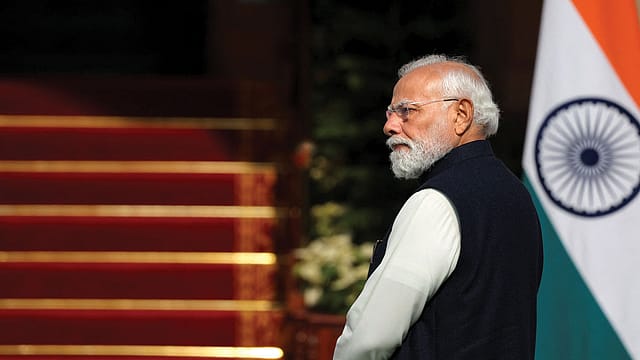
AFTER AN INITIAL PERIOD OF STOCK-TAKING AFTER THE 2024 Lok Sabha elections, Prime Minister Narendra Modi hit his stride in typical fashion. Beginning with vigorous campaigns in state elections in Haryana, Jharkhand, and Maharashtra, he took important decisions to build the momentum for his third term in office. The 2025-26 Union Budget offered big-bang tax breaks that led to incomes of up to ₹2 lakh becoming tax-free without any significant dilution of the Modi government’s post-Covid focus on capital expenditure. The tax treat hit a sweet spot. It addressed a growing sentiment in the middle class that its contributions to the tax kitty were not sufficiently recognised and that it was treated as a dutiful milch cow. The rebates had the intended effect of perking up consumer spending with the rise in disposable incomes.
There is little doubt that handsome electoral wins in Haryana and Maharashtra, despite the failure to unseat the Hemant Soren government in Jharkhand, added wind to the government’s sails. The bold move on taxes turned the discussion in board rooms to a more positive and forward-looking direction while households got busy counting gains and whether to make purchases they had been delaying or salt away the tax bounty in savings and investments. The mutual funds assets under management crossed ₹80 trillion in October 2025, and while there is a debate over the extent of new inflows, it is evident that retail investor confidence is high as a growing number of individuals choose to be part of the India growth story. On February 8 last year, days after the Budget perked up the spirits of the salaried classes, the Bharatiya Janata Party (BJP) crossed a major milestone by ousting its bête noire Aam Aadmi Party (AAP) from Delhi and finished the year with a gratifying victory in Bihar, a state where caste and communal tripwires are never easy to negotiate.
The year gone by saw a massive surge in reforms with the Centre notifying the four labour codes passed by Parliament in 2020, taking the scalpel to the Goods and Services Tax (GST) rates while making the tax essentially a two-slab system, passing landmark legislation to modernise India’s maritime governance, removing mandatory compliance of Quality Control Orders (QCOs) for 76 product categories, expanding the definition of ‘small companies’ and overhauling the categorisation of Micro, Small and Medium Enterprises (MSMEs), permitting 100 per cent FDI (foreign direct investment) in insurance, framing a new Securities Market Code Bill, Jan Vishwas reforms that decriminalised hundreds of minor offences and scrapped outdated laws, facilitating private and foreign participation in making and running nuclear power stations, and bringing about a much-needed fiscal and administrative recast of the Mahatma Gandhi National Rural Employment Guarantee Scheme (MGNREGA) by way of a new name and form.
Having recovered its mojo, the Modi government is set to keep the reforms pedal pressed in 2026 even as it negotiates global uncertainties and the weaponisation of tariffs by the Trump administration.

Despite his long record in public life and office, commentators continue to misread and often underestimate Modi’s governance style, priorities and resolve to implement his plans. The view that Modi’s political duties, such as leading the BJP campaign in important state elections in Assam, Tamil Nadu, Puducherry, West Bengal, and Kerala, will limit his attention and prevent him from undertaking big-ticket reforms misses past evidence. It can be argued that US President Donald Trump’s tariff shock—the imposition of cumulative 50 per cent duties on several Indian exports—injected a sense of urgency in the Modi government. But as the decision to reduce personal income tax rates shows, the government was in proactive mode. Also, even if decisions such as reduction of GST rates and implementation of the delayed labour codes are seen in the light of the Trump tariffs, they point to swift reflexes to prevent the punitive measures from pushing the economy into a funk. Energetic negotiations with other nations and success in signing free trade pacts with the UK, New Zealand, and Oman helped in part to offset reduced exports to a major market like the US. Analysts often miss a basic element of Modi’s mental make-up—his belief that batting defensively does not help in the long run. It is not that the prime minister does not know when to consolidate, but he is more than willing to up his game and take the battle to his opponents.
The basis of Modi’s confidence and the reason why deregulation and reforms will get top billing in 2026 can be read in decisions like the reinvention of MGNREGA as Viksit Bharat-Guarantee for Rozgar and Ajeevika Mission (Gramin), or G-RAM-G. It is a mistake to read the newlook MGNREGA as political optics alone or by way of arguments put forward by the law’s Congress-era authors. These viewpoints fail to take into account the sea change in India’s politics and economy since May 2014 when the United Progressive Alliance (UPA) was voted out of office and BJP led by Modi won a single-party majority in Lok Sabha.
Since then, Modi has outflanked critics keen on accusing him of being ‘pro-rich’ by vastly expanding the web of Central welfare programmes and expanding the role of government in social sectors. The welfare schemes have been a clever mix of direct support (free rations and cash payments to small farmers) and income generation initiatives (access to banking, MUDRA, and drone and lakhpati didis) while the government was quick to seize the opportunities offered by digitalisation that have grown the economy and made it more resilient. As was the case during his tenure as Gujarat chief minister, Modi is untouched by the taint of personal corruption that hurt his rivals and continues to disadvantage Congress and many regional parties, the latest example being the Rashtriya Janata Dal’s (RJD) inability to shake off the ‘jungle raj’ tag in the Bihar elections. Modi has often said that he might make a mistake but will not do anything wrong due to bad intentions. The evidence so far is that India’s voters do not suspect his intent or motives.
AN ASPECT OF Modi’s policies that has a strong bearing on his appetite for reforms is the government’s success in maintaining and accelerating a dramatic reduction in poverty. The decline in extreme poverty was visible towards the latter part of the Congress-led UPA’s 2009-14 second term but corruption cases, a fractious coalition and an overreliance on rights-based welfare handouts proved to be the Manmohan Singh government’s undoing. Although the subject of India’s success in reducing poverty has been studied in detail, economist and current head of the Sixteenth Finance Commission Arvind Panagariya and Vishal More, founder of Interlink Advisors, in their 2025 paper, ‘Mapping Poverty across Social, Religious and Economic Groups in India’, bring out just how much India has changed, pointing out that poverty rates of Muslims—often seen to lag socio-economic indicators—are nearly 1 per cent below that for Hindus. Using the Tendulkar poverty line for 2011-12, 2022-23 and 2023-24, they conclude: “The estimates indicate that the decline in poverty over the 12 years from 2011- 12 to 2023-24 has been substantial and broad-based, to the point that the country has virtually eliminated extreme poverty.” They point out that even in the Scheduled Caste (SC) population, seen to struggle to access growth and redistributive programmes, poverty fell to 8.7 per cent in 2023-24, less than half the level observed in the general population in 2011-12. “At 1.5% the poverty rate among Muslims is now nearly a percentage point below the 2.3% rate among Hindus,” the paper says.
No state or Union territory reports a poverty rate in double digits while it has declined to zero in Himachal Pradesh, Sikkim, Goa, and the Union territories of Chandigarh, Delhi, and Daman and Diu. The decline shuts down claims that poverty rates have spiked since Covid or that rural distress has increased. Batting for growth as the basic requirement to lift lives, Panagriya and More say: “The common refrain that growth benefits only the affluent deserves to be firmly set aside. India offers a clear example of substantial poverty reduction through growth while maintaining a democratic polity.” Authoritarian regimes in South Korea, Taiwan and Singapore and, of course, China, have registered faster growth but India, despite the uneven pace of its reforms, has brought about population-scale improvements. Complementary welfare-redistributive programmes have obviously helped with growth, generating the required revenues. “India’s central challenge is no longer the eradication of extreme poverty but the attainment of broad-based prosperity,” the authors provocatively claim.
THE ACHIEVEMENT OF delivering basic food security and creating a wide welfare net coupled with a decrease in poverty made the reform of MGNREGA feasible. It was apparent that while the number of beneficiaries accessing the programme remains limited, the Centre’s commitment to meet demands had turned the scheme into a bottomless pit. State governments, too, would be tempted to draw on the funds without any incentive to increase accountability. Having dealt with basic necessities, the Modi government is on a sound footing to move on reforms. Its challenge lies not so much in the internal situation or upcoming state elections but in managing the maverick ways of the Trump administration. The US president, who loves to wield the tariff stick menacingly, might be hoping to extract concessions beyond what negotiations have yielded so far and it is unclear as to when the India-US bilateral trade deal will be finalised. Since Modi is unlikely to endorse Trump’s peacemaking claims in the context of the May 7-10 India-Pakistan conflict or step back too far from no-go zones in trade talks, the relationship with the US remains unpredictable. The lessons of 2025 show the Modi government did not pin its hopes on an elusive settlement but took some urgent measures.
The elections in Assam, Kerala, Tamil Nadu, Puducherry, and West Bengal in March-April are a stern test for BJP and the National Democratic Alliance (NDA). Of these, BJP looks best placed in Assam where it has won two successive elections and can count on the shrewd leadership of Chief Minister Himanta Biswa Sarma. The rest are difficult geographies but the fight might be closer and fiercer than currently anticipated. The scale of the Bihar victory has energised BJP and made voters turn towards the party with new interest. Although the states going to polls are very different, there is a buzz about BJP and Modi. In a worse-case scenario, the results could read 4-1 in favour of the I.N.D.I.A. parties. But if BJP were to make a breakthrough in Kerala where it currently does not have an MLA, it would be a big deal. As BJP’s win in the Thiruvananthapuram municipal election shows, the party’s support can reach a tipping point. In the 2019 Lok Sabha polls, BJP sprung a surprise by winning 18 of 42 seats with a 40.2 per cent vote share in West Bengal. The Trinamool Congress (TMC) has since recovered lost ground and is a tough opponent. In Tamil Nadu, BJP is in alliance with the All India Anna Dravida Munnetra Kazhagam (AIADMK). Its vote touched double digits in the 2024 Lok Sabha elections but BJP did not win a seat. The alliance with AIADMK makes BJP the junior partner but DMK seems to have made the saffron party its principal target, indicating whom it sees as a threat.
Crystal-ball gazing to pick likely victors in the Assembly polls is an unproductive task. What can be said with greater certainty is that Modi will retain a relentless focus on larger goals even as he pays attention to micro details, such as land-use policies and municipal reforms pursued by the Cabinet Secretariat practically below the radar. The year 2026 is a case of reforms which, when added up, are intended to improve the lives and prospects of Indians from every walk of life.