2026 Forecast: Politics: The Battle for Regional Supremacy
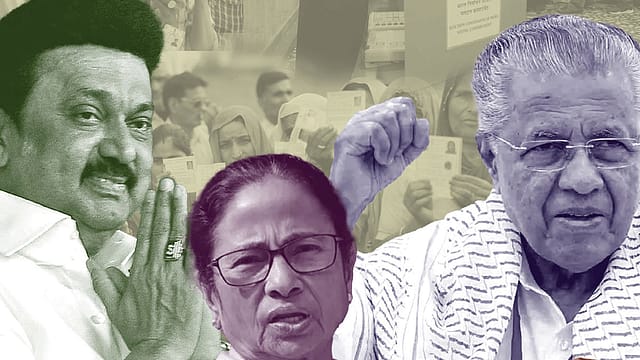
AS PRESIDENT OF the Dravida Munnetra Kazhagam (DMK), MK Stalin has done spectacularly well in the polls. Since the death of his father M Karunanidhi in 2018, he has led his coalition in Tamil Nadu to resounding successes in two Lok Sabha elections and an Assembly election, securing all but one of the 39 seats in the 2019 General Election, all 39 seats in 2024, and 159 of 234 seats in the 2021 state polls. These triumphs make him the most powerful regional leader in the country and this year he will face the biggest test yet of his prowess as party chief, five years after he was sworn in as chief minister of Tamil Nadu.
Political analysts based in the state and those who have closely followed Stalin and his father say DMK is sure to face anti-incumbency amid a growing perception of the party being a family
incorporated one, run through a large network of leaders bound by transactional relationships and hierarchical obligations to ensure mutual gains. Responses of the public in Madurai, Chennai and Nagercoil are the same whether or not the respondent is pro-DMK or against them: “They look after each other.” The talk of DMK being a Dravidian party committed to its socialist roots never arises in these conversations, and the propensity of its leaders to seek new ways to generate profit is always the talk of the town.
However, the closely knit party—where each member is made to assume they are part of a large family—has some advantages and these are conspicuous this time round too, including its secular credentials. The DMK alliance in the state includes Congress, the communist parties CPM and CPI, Indian Union Muslim League and the Viduthalai Chiruthaigal Katchi (VCK), formerly known as the Dalit Panthers of India. Which means their social base covers Dalits, Muslims, the working classes, several Other Backward Classes (OBCs), and traditional voters of both DMK and Congress.

Yet, Congress, which has won elections successfully from the state thanks to DMK’s support, is known to have raised some demands this time round, and at least one DMK constituent has also backed the main opposition party at the Centre over cabinet posts if elected to power. Since the late 1960s, neither of the Dravidian parties—DMK and the All India Anna Dravida Munnetra Kazhagam (AIADMK)—had offered any of the national parties a cabinet post in the state. Congress, it is learnt, wants DMK to break the habit. Although Stalin and Congress leader Rahul Gandhi are on friendly terms, certain other Congress leaders want to punch above their weight and demand more seats and hefty posts in the run-up to the polls this year. One of them has entered into parleys with the Tamilaga Vettri Kazhagam (TVK), launched by actor Vijay, in a ruse to bargain for more from DMK. “Whether all this is being done with or without Rahul Gandhi’s knowledge is not clear,” a person close to the matter said.
A PTI report quoting All India Professionals Congress Chairman Praveen Chakravarthy said there was nothing wrong in seeking a share in power. Chakravarthy also revealed that he had met Vijay. “All these years the Congress party did not seek a share in power, but that does not mean it should never make that demand,” PTI quoted him as saying. AIADMK, too, had never yielded to any demand for greater accommodation for national parties that are part of its coalition. For his part, on January 4, Bharatiya Janata Party (BJP) leader and Union Home Minister Amit Shah said while on a tour of the state that the National Democratic Alliance (NDA) will form the government after polls even as AIADMK leader Edappadi K Palaniswami reiterated that his party will form a majority government on its own. Meanwhile, the Pattali Makkal Katchi (PMK) faction led by Anbumani Ramadoss returned to the AIADMK-led alliance on January 7. More small parties that were earlier part of NDA are said to have expressed their willingness to align with the AIADMK-led alliance. Interestingly, a section of political analysts is of the view that Seeman-led Naam Tamilar Katchi (NTK) is expected to pull in votes across the state and eat into the non-DMK vote base.
For DMK though, the hurdle it faces is primarily the new demand from allies, apart from a sense of fatigue typical among the state’s voters who, analysts say in a lighter vein, are “fair-minded”.
MAMATA BANERJEE, LEADER of the All India Trinamool Congress (TMC), is a heavyweight among India’s opposition leaders who still retains the street fighter’s passion of her youth. Since 2009, she has steadily steered her party to electoral wins in both the General Elections as well as Assembly polls, wresting power from the Marxists after 34 long years. In 2021, despite projections of a neck-and-neck fight with BJP, the Banerjee-led coalition won by a landslide in the state polls, securing 217 of 294 seats while BJP won 77, in an election that saw the Left Front and Congress fail to win any seat at all. In the Lok Sabha polls of 2024, again, Banerjee’s winning alliance won 29 of 42 seats while BJP won 12.
This year, analysts expect a tough battle in the state polls with the opposition BJP trying to take advantage of anti-incumbency against TMC which has been in power for more than 14 years. As she seeks her fourth consecutive victory as chief minister, Banerjee and her party face an aggressive opposition highlighting law and order problems and issues to do with governance; the safety of women, especially following rapes of medical students such as those at RG Kar Medical College in 2024 and in Durgapur in 2025; the so-called infiltration from across the border; and so on. In her defence, Banerjee and her party have attacked the Election Commission of India (EC), alleging that in the Special Intensive Revision (SIR) exercises, several voters are being deleted. On January 3, she wrote a letter to Chief Election Commissioner (CEC) Gyanesh Kumar stating that “the SIR process is deeply compromised and strikes at the basic structural framework of our democracy and the spirit of the Constitution”. She also said, “I strongly urge you to immediately address and rectify the glitches, address the flaws and make the necessary corrections, failing which this unplanned, arbitrary and ad hoc exercise must be halted. If allowed to continue in its present form, it will result in irreparable damage, large-scale disenfranchisement of eligible voters, and a direct assault on the foundational principles of democratic governance.”
Again, BJP is pinning its hopes on Bengal’s Hindu nationalist past to make gains. Open had reported earlier that, historically, Bengal is one region in India where the roots of Hindutva politics run deep thanks to a raft of reasons. The state is home to various revivalist movements that overlapped with reformist ones more than a century ago. The long-term influences of the 1905 partition of the province largely along communal lines cannot be ruled out. Add to that the hostilities triggered by bloody communal riots that crippled Bengal in the run-up to the second partition of the province when the country became independent in 1947 and East Bengal became part of Pakistan. Wounds tend to fester through word of mouth and propaganda (‘Will its Hindu revivalist past haunt West Bengal’s future?’, Open, April 8, 2019).
In the north-eastern state of Assam, where Assembly elections are due this year apart from Tamil Nadu, West Bengal, Kerala, and Puducherry, it is unlikely that regional entities outside of the NDA fold will make a major impact. “But then, many election trends are not visible until weeks before the election dates,” notes a political analyst who has worked for years in the state. He says the opposition is divided while there are no signs of any lack of cohesion in the ruling alliance comprising BJP, the Asom Gana Parishad (AGP), and the United People’s Party Liberal (UPPL). Of the 14 Lok Sabha seats from the state, NDA won 11 and the I.N.D.I.A. bloc three (Congress). In the 2021 elections, BJP cruised back to power with 75 seats, the first time a non-Congress alliance won straight terms in the state. I.N.D.I.A. won 50 seats compared with 26 in 2016.
The political analyst adds that the recent announcement by a ministerial panel in Assam recommending that six more communities in the state be granted Scheduled Tribe (ST) status may snowball into an election issue with existing STs turning against it in the months leading to the polls. “It is going to be a headache for the government,” he says. Chief Minister Himanta Biswa Sarma does not see an eruption of any such trouble. The opposition does not have a common plank against the government and as of now it doesn’t appear that a consensus is emerging with public opinion coalescing around the tribal reservation issue. It also doesn’t seem likely that an anti-BJP regional entity may put up a fight against BJP while the entire opposition plays catch-up. Although there are aspirations among smaller communities and regional groupings, they may have to wait.
In Kerala, where elections are due most likely in April, Chief Minister Pinarayi Vijayan faces his biggest battle yet. As the sole communist chief minister in the country, the 80-year-old is seeking to win a third consecutive term in office, but the challenges are many. With the rise of BJP as an electoral force, securing close to 16 per cent of the vote in the 2024 Lok Sabha polls and winning its first parliamentary seat, CPM, which is effectively a regional party with widespread organisational presence in Kerala alone, fears that its Hindu vote base may see erosion. The signs of it happening were evident in the recently concluded local bodies polls in which the Congress-led opposition United Democratic Front (UDF) made surprise gains along with NDA as the CPM-led Left Democratic Front (LDF) lost polls, even in some of its strongholds, to UDF and NDA. The NDA candidate was elected mayor for the first time in the Thiruvananthapuram Corporation, unseating the Left. While UDF won in 367 gram panchayats, LDF won only in 234. In 14 district panchayats in the state, UDF won in seven and LDF in six.
When he won the elections the second time in a row five years ago, Vijayan was the only chief minister in Kerala, formed in 1956, to record such a win. Open had reported back then that even the very popular CPM Chief Minister EK Nayanar had VS Achuthanandan and others breathing down his neck whenever he was chief minister. Achuthanandan, when he became chief minister in 2006, had to contend with a domineering Vijayan, his arch-rival. As he was sworn in chief minister in 2021, Vijayan had no challengers within, a big departure for CPM in which heated debates over a leader’s choices and decisions were par for the course at any party meet. The party had often watched over the chief minister’s moves and intervened whenever it thought wise (‘Pinarayi Vijayan: The Invincible’, Open, May 17, 2021).
Vijayan still doesn’t have any powerful challenger within his party, but he faces headwinds with a section of pro-Muslim commentators alleging that he is playing the B-team of BJP while Hindutva proponents allege he disregards the interests of Hindus in the state. While such charges appear trumped up, polarisation along religious and caste lines is for real, and Vijayan comes under sharp attack in the local media, who justify their debates against him as a journalistic duty of being adversarial to the ruling party. A section of commentators in media organisations run by Islamist groups is harsher than ever, portraying his dispensation as Islamophobic. Vijayan’s gestures of friendship with Vellappalli Natesan, who makes frequent anti-Muslim comments, has clearly put the Marxist leader in a bad spot. And yet, as a leader who has survived numerous odds, several analysts aver that he won’t fade away without fighting to the finish at the hustings.
COME NEXT YEAR, there will be more regional leaders whose political stamina will be put to the test, most importantly that of Akhilesh Yadav. He had proved naysayers wrong in the last Lok Sabha polls to revive the fortunes of the Samajwadi Party (SP) and I.N.D.I.A. in the most populous state, Uttar Pradesh, winning 43 seats to Lok Sabha (of which SP won 37) while NDA won a mere 36 (BJP winning 33).
With BJP bending over backwards to establish its presence across states and regions, it is not just Congress but also regional parties not aligned to NDA which have borne the brunt. This year will see some of them resisting the onslaught and over the next few years, more such battles will be fought on diverse terrain with political parties vying to capture the public imagination.