2025 In Review: Politics: For the Sake of the Nation
A YEAR OF SEVERAL surprises is ending with yet another first. Dravida Munnetra Kazhagam (DMK) leader Kanimozhi on December 9 submitted a letter seeking a motion for removal of Justice GR Swaminathan of the Madurai Bench of the Madras High Court. Accompanying her were I.N.D.I.A. bloc leaders Akhilesh Yadav and Priyanka Gandhi, among others. Justice Swaminathan’s crime, according to his accusers, is that he is deciding cases on the basis of political ideology. The case in point? His ruling allowing devotees to light a traditional lamp at the Ucchi Pillayar shrine in Madurai. His order upholding the rights of Hindu devotees comes in the backdrop of Muslim groups claiming the area where the shrine is located as Waqf property and asserting that lighting the lamp would spur communal tensions.
Justice Swaminathan has previously faced flak for his “Sanatani” beliefs and alleged indulgence of the Rashtriya Swayamsevak Sangh (RSS), a charge that led his critics to question his allegiance to the Constitution.
The charge of being motivated by “political ideology” is interesting given that DMK doesn’t hesitate in claiming the “Dravidian” model— more specifically its particular interpretation—as the reasoning for decisions ranging from rejection of the three-language formula to opposing the Centre-state tax devolution. But with the Tamil Nadu Assembly election due in March-April 2026, the political cue is fairly evident as it might be the right time to fire up emotive political divides and solidify vote banks. Using Hindu practices as click bait is seen as a costless measure since rallying minority votes is much more profitable. Then there are subtle political strands within the DMK first family too. Taking the lead on the removal motion provides Kanimozhi traction as a leader in her own right. The move sharpens DMK’s attacks on the Bharatiya Janata Party (BJP) which it has increasingly singled out as a rival force apart from old enemy All India Anna Dravida Munnetra Kazhagam (AIADMK). Clearly, the ordinary course of an appeal in the Supreme Court was not enough.
War on Iran: The War That No One Won
10 Apr 2026 - Vol 04 | Issue 66
And the price of surviving it
The rising chorus of polarised politics has created a strange new normal. One where starkly politicised actions of parties and governments are discussed without any sense of alarm about a sitting judge being made a target in a political shooting match. Somehow, Justice Swaminathan’s alleged Hindu sensitivities make him fair prey, preventing the DMK action from being examined for its obvious cynical political calculations. The judge then is more likely to be accused of promoting a majoritarian agenda—never mind that the cultural and religious rights he is seen to have protected have long been relegated to the margins in Tamil Nadu—rather than being at the receiving end of sectarian politics. Those who submitted the demand for his removal are aware that the motion is unlikely to move further and even if it does, it will face certain rejection. But the idea is to make an example of the judge and deter others from going against the ruling dispensation’s political and social interests. Justice Swaminathan’s case is only the latest example of political polarisation being almost an end in itself and the heat will increase as Tamil Nadu hurtles towards a very significant election in the new year.
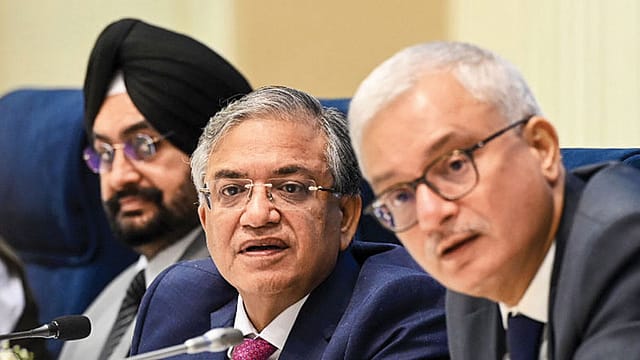
It is in such circumstances that the Election Commission of India’s (EC) role and conduct needs to be considered as nothing short of sterling in preserving and, in fact, improving the quality of India’s democracy. In times when political parties simply refuse to accept that they lost and I.N.D.I.A. bloc constituents like Congress, Samajwadi Party (SP) and Trinamool Congress (TMC) regularly accuse the EC of being in cahoots with BJP without producing any credible evidence, the commission has trod a brave path and relied on the strength of conviction to conduct elections fairly and make them more accountable.
The EC’s decision to clean the Bihar electoral rolls through a Special Intensive Revision (SIR) was criticised by most commentators and editorial comment. It was seen to be a logistical impossibility and very likely to disenfranchise voters, particularly Muslims, as the SIR would consider determining citizenship as eligibility to vote. The argument went that the move to rid electoral rolls of illegals, such as Bangladeshis and the Rohingya, would make legitimate Muslim voters targets. Yet, this did not happen. The commission faced down a battery of heavyweight legal luminaries in court who kept producing cases of voters allegedly knocked off the voter list but whose claims could not be substantiated. This did not deter the litigants that include a self-styled psephologist-turned political savant and an NGO which, while claiming to espouse electoral reforms, has spared no effort to undermine electronic voting machines (EVMs). They kept returning to the court with cases of alleged exclusion, creating more paperwork for the EC but without altering the results. In the final analysis, there were just 5,000-10,000 deletions from Bihar’s electoral rolls that did not fall in the categories of removal due to death, permanent shifting of residence, or duplication.

The crusade against the SIR was pursued with the same vigour as the campaign against EVMs which activists and several Opposition leaders claimed had been hacked to favour BJP. Since they were used on a large scale in 1998, EVMs have made voting easier and more transparent, reducing ills like ballot stuffing and booth capture. Election commissioners and officials showed great determination and courage in taking on the political mafia by effectively deploying Central forces during elections. An EC official, KJ Rao, hit the headlines in the 2005 Bihar elections when he acted firmly against powerful Rashtriya Janata Dal (RJD) figures like Mohammad Shahabuddin and Sadhu Yadav. RJD boss and then Bihar Chief Minister Lalu Prasad fulminated but could not stop Rao. The shrewd decision to place Central forces at polling booths with automatic weapons strategically placed on the roofs proved an effective deterrent. The idea behind booth capture was simple enough. Firing at the polling booth would convince voters to stay away, allowing supporters of the ruling party to rig the vote. The determined action of Central forces convinced booth raiders that caution is the better part of valour.
THE SIR IS a continuation of the process to make elections credible and a reliable barometer of public opinion. Its great success can be seen in the participation of women voters who did not hesitate to inform visiting journalists about their opinions and who turned up at polling booths in record numbers in the recent Bihar elections.
The government of the day might have its differences with the EC but is bound to defend the constitutional authority from partisan attack, particularly in Parliament where the election watchdog cannot defend itself. It is not that BJP did not differ with the EC in the past. The party had bitter differences with then Chief Election Commissioner (CEC) James M Lyngdoh when he put off the Gujarat Assembly election in the aftermath of the February 2002 post-Godhra riots. Lyngdoh was accused of catering to Congress’ interests, but in retrospect it was perhaps a good thing that the election was delayed. Holding an election at a time when emotions were raw and inflamed would not have been correct. In December 2002, then Gujarat Chief Minister Narendra Modi and BJP returned to office winning a convincing 127 seats in a House of 182 and the results were rendered more credible by the passage of time. By and large, successive CECs have understood the sanctity of their mandate even if their appointment was backed by the government in office. They recognised that they have a higher duty to the Constitution, the nation and the people in ensuring that India’s elections and its democracy remain in sound health.
The primary responsibility of protecting the reputation of constitutional authorities, whether the EC or the courts, lies with the government of the day. The political executive is duty bound to uphold the dignity of constitutional bodies so that they can carry out their tasks as best they can. But this responsibility rests on the Opposition as well. Often enough, regional parties have been less able to resist electoral compulsions and are more prone to the path of least resistance. There are exceptions but the record shows they lean towards populism. It is fair to say that national parties are not immune to such considerations but are expected to show more discretion.
BJP, given its social base and nationalist orientation, balances empowerment of the disadvantaged with advocating the interests of sarv samaj, a call for a unified and equitable society. Congress has pitched itself as the vehicle for the poor, Dalits and tribals, and dabbled in caste and communal alignments. Yet, for long it took care not to move too far from the centre and sought to reassure the middle classes that it had not lost sight of their interests. Priyanka Gandhi’s presence in the delegation that met Lok Sabha Speaker Om Birla is more than an ally’s act of solidarity. That job could have been done by any Congress functionary.
Since 2014, when Modi assumed office, Congress has subscribed to fringe interests, such as supporting ultra-Left causes or openly backing casteist appeals for quotas based on demography. In associating with DMK’s opposition to the restoration of Hindu rights at the Madurai shrine—there is no other way to put it— Priyanka Gandhi reinforced the impression that her party has embraced communal agendas. Congress’ excoriation of the EC is not just an attack on a commissioner, though Priyanka Gandhi’s naming of individual commissioners to target them at political rallies is a new low. The I.N.D.I.A. bloc parties, in their pursuit of political gains, have thought nothing of besmirching India’s democracy. The EC deserves recognition for withstanding this unfair assault and holding firm to its dharma towards the Indian nation.