The Forest Beyond the Trees

WILL CARE FOR THESE TREES ONCE THE CAMERAS HAVE LEFT?
It is a deceptively simple question, but one that sits at the heart of India's environmental future. Across the country, millions of saplings are planted every year under government programmes, corporate social responsibility initiatives, and community campaigns. Yet the true challenge of ecological restoration has never in ownership, responsibility, and behavioural change.
That conviction has become the cornerstone of her environmental vision and the driving force behind Sankalp, M3M Foundation's flagship climate action initiative. What began as a plantation programme has gradually evolved into a compelling experiment in community stewardship—one that offers important lessons for India's sustainability journey.
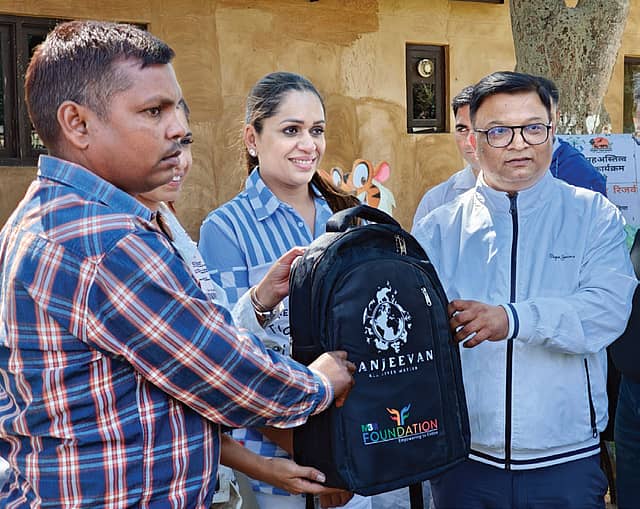
Her environmental commitment is deeply rooted in the principle of water stewardship. Through initiatives such as Sankalp and our watershed programmes, we have created 30 million litres of additional water storage through rainwater harvesting structures. We have revived traditional water bodies and promoted decentralised water management systems—ensuring that ecological balance remains undisturbed. In 2025, we planted over 52,000 saplings, supported natural farming practices for 2,500 farmers—of whom 60% are women—and enabled 25,000 villagers to coexist harmoniously with wildlife. These efforts are closely aligned with national priorities on water security and the goals of the Jal Jeevan Mission.
Her environmental interventions today benefit nearly 31 lakh individuals annually—from rural recharge systems to urban conservation models. In ecologically sensitive zones such as the tiger reserves of Tipeshwar and Pilibhit, our work focuses on securing water resources while simultaneously protecting biodiversity, reflecting the conservation ethos embedded within Mission LiFE.
Equally important is our work in advancing the circular economy. Through waste-to-wealth models in packaging and natural farming, we are actively reducing dependence on linear systems and contributing to sustainable production and consumption patterns. As Lead Partner, we are proud to support zero-fee awards that recognise outstanding initiatives across key categories such as Renewable Energy, Green Manufacturing, and Community Engagement.
As we look ahead to the vision of Viksit Bharat 2047, it is clear that partnerships will be the cornerstone of progress.
M3M Foundation works in close collaboration with government bodies and more than 15 NGOs, aligning our efforts with the Sustainable Development Goals. While Mission LiFE calls for individual action, our approach is to scale these actions collectively—through women-led farming initiatives, educational support for migrant communities, and sports programmes that have enabled 104 athletes to win 310 medals.
Dr. Kanodia's environmental philosophy emerges from a simple but profound observation: nature flourishes where communities feel a sense of belonging.
For decades, environmental conservation has largely operated through a top-down model. Institutions design interventions, communities participate temporarily, and implementation agencies monitor outcomes. While such efforts often generate short-term gains, they frequently struggle to create long-term behavioural ownership.
Dr. Kanodia sought to challenge this paradigm.
Her belief was that environmental sustainability cannot be outsourced to governments, corporations, or civil society organisations alone. It must become woven into the social fabric of everyday life. The idea aligns closely with India's civilisational ethos. For centuries, Indian communities protected sacred groves, rivers, forests, and biodiversity not because regulations compelled them to do so, but because culture and tradition fostered a sense of stewardship. Nature was viewed not as a resource to be consumed but as a legacy to be preserved.
"Sustainability is not a modern concept for India," says Dr. Kanodia. "It is deeply embedded in our civilisational memory. The challenge before us is to revive that consciousness in a contemporary context". It is this philosophy that underpins Sankalp. Rather than approaching environmental conservation as a transactional intervention, the programme seeks to cultivate an emotional relationship between communities and the natural world.
The turning point came with the national momentum generated by Hon'ble Prime Minister Shri Narendra Modi's call of 'Ek Ped Maa Ke Naam', an initiative that encouraged citizens to dedicate a tree to their mothers as a symbol of gratitude and environmental responsibility.
Inspired by the emotional resonance of this idea, Dr. Kanodia sought to deepen its community impact. The result was an innovative extension: 'Ek Ped Ghar Ke Bachche Ya Bachchi Ke Naam.'
The concept was elegant in its simplicity.
Every family would plant and dedicate a tree to a child within the household. The tree would become more than a sapling. It would become a living symbol of aspiration, growth, and continuity. As the child grew, so would the tree. The family's hopes for the child would become intertwined with the wellbeing of the plantation. The environmental intervention would become personal. This seemingly modest shift transformed the dynamics of conservation. Communities no longer perceived the saplings as part of a corporate programme. They became part of family identity.
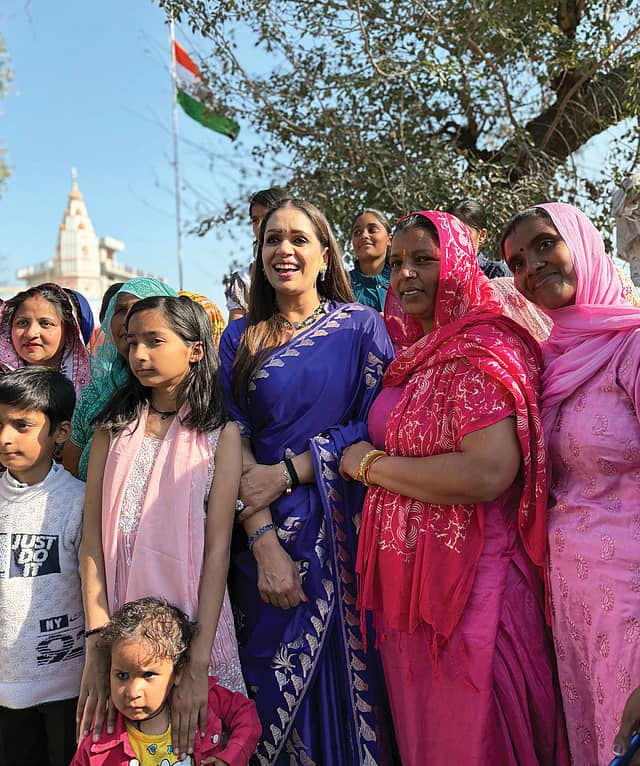
Parents watered them. Children proudly claimed ownership over them. Villages collectively protected them. The tree ceased to be an environmental asset and became a social asset.
What emerged was not merely a plantation model but a behavioural innovation in environmental governance. Under Dr. Kanodia's leadership, Sankalp expanded across villages, panchayats, schools, and communities. The Foundation began integrating environmental action with public participation, recognising that ecological resilience is strongest when communities themselves become custodians of change.
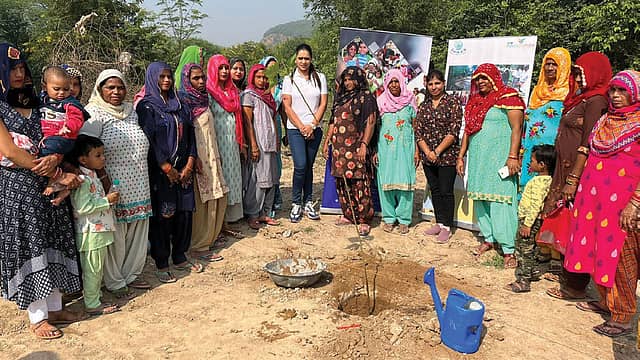
Today, the initiative has facilitated the plantation of over 6.7 lakh trees across six states, including more than 1.70 lakh trees across 54 Panchayats. However, for Dr. Kanodia, scale has never been the most important metric.
Survival is. Ownership is. Longevity is.
This insistence on measuring meaningful outcomes led to one of the programme's most significant milestones. To assess the long-term effectiveness of the initiative, an independent study was undertaken by researcher Ravinshu Harlalka of NMIMS Mumbai, examining plantation sites across the Tauru Block of Haryana's Nuh district.
The findings were remarkable. Across sixteen plantation sites, researchers evaluated 1,835 trees, of which 1,570 were found healthy and thriving, resulting in an impressive 83.29 percent survival rate.
For environmental practitioners, the statistic was noteworthy. For Dr. Kanodia, however, the real story lay elsewhere.
The numbers merely confirmed what communities had already demonstrated: when people feel ownership, sustainability follows. The success of Sankalp was not ultimately a triumph of plantation. It was a triumph of participation.
The significance of Sankalp lies not merely in the number of trees that have taken root across the landscape, but in the quiet transformation that has unfolded within the communities themselves. Environmental restoration, Dr. Payal Kanodia believes, is ultimately a question of human behaviour before it becomes one of ecological science. A forest cannot survive on institutional funding alone; it survives because people decide, every single day, that it is worth protecting.
This understanding has fundamentally distinguished M3M Foundation's environmental philosophy from conventional plantation campaigns. While many initiatives conclude once the final sapling is planted, Sankalp begins its most important journey thereafter. For Dr. Kanodia, planting a tree is merely the commencement of a relationship—one that must be nurtured through ownership, participation, and collective accountability."The real measure of climate leadership is not how many trees an organisation plants. It is how many communities begin to see those trees as their own," she observes.
It is precisely this shift, from participation to ownership that has enabled Sankalp to transcend the limitations of a traditional CSR intervention. Across villages in the Tauru Block of Haryana's Aspirational District of Nuh, communities gradually evolved from passive beneficiaries into active custodians of their local ecosystems. The Foundation did not merely distribute saplings; it cultivated a culture of stewardship. Village Panchayats assumed responsibility for plantation sites, families voluntarily monitored the health of young trees, and children became enthusiastic ambassadors of environmental responsibility within their own households.
Perhaps the programme's most profound success lies in the fact that environmental conservation ceased to be perceived as an external obligation. Instead, it became woven into the social and cultural fabric of everyday community life. Trees were no longer regarded as assets belonging to a Foundation or a government initiative; they became symbols of familial pride, collective identity, and intergenerational responsibility.
This philosophy found its most compelling validation through an independent impact assessment undertaken by researcher Ravinshu Harlalka of NMIMS Mumbai. Covering sixteen plantation sites across the Tauru Block, the study evaluated 1,835 trees, of which 1,570 were found healthy and thriving, resulting in a remarkable 83.29 per cent survival rate—a figure that significantly exceeds the average outcomes associated with large-scale plantation drives.
Yet Dr. Kanodia insists that the statistic itself tells only part of the story.
"Survival rates are not merely ecological indicators; they are social indicators. Every thriving tree represents a family that chose to nurture it, a village that accepted responsibility for it, and a community that recognised nature as part of its shared future".
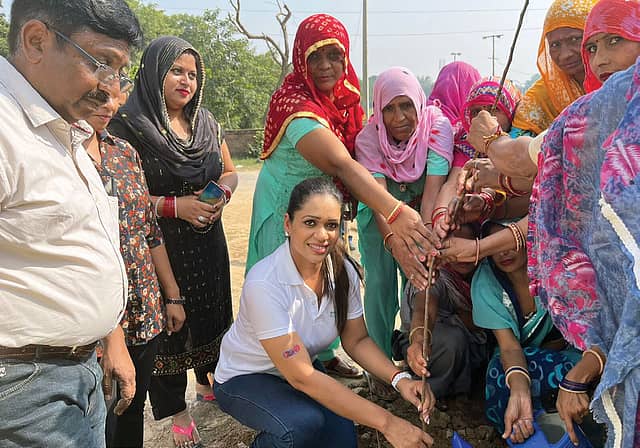
Indeed, the study documented behavioural transformations that cannot be quantified solely through numbers. Farmers began watering plantation sites before tending to their own fields. Families protected saplings from grazing cattle without external supervision. Schoolchildren proudly identified trees dedicated in their names, while Panchayats initiated additional
plantation efforts of their own accord. Such seemingly ordinary acts collectively revealed an extraordinary shift in environmental consciousness.
For Dr. Kanodia, these stories matter as much as the statistics. They demonstrate that ecological restoration becomes truly sustainable only when environmental responsibility is internalised by society itself. In this regard, Sankalp is less a plantation programme than an exercise in rebuilding India's traditional ecological ethos—one that once regarded rivers, forests, mountains, and trees not as commodities but as living inheritances entrusted to future generations.
The Foundation's environmental strategy has therefore evolved far beyond afforestation. Under Dr. Kanodia's leadership, Sankalp today embraces an integrated approach to landscape restoration, biodiversity enhancement, and climate resilience. Across multiple geographies, the initiative has facilitated the development of Miyawaki urban forests, promoted orchard-based agroforestry, encouraged the plantation of indigenous and fruit-bearing species, strengthened green buffers within villages, and contributed to improved groundwater recharge and soil health.
This holistic perspective reflects an increasingly important reality within contemporary sustainability discourse: climate action cannot exist in isolation from livelihoods, biodiversity, water security, and community well-being. Every environmental intervention inevitably intersects with economic resilience and social development. A healthy ecosystem supports agriculture; restored biodiversity enhances food security; tree cover improves water retention; and resilient landscapes strengthen the adaptive capacity of rural communities in the face of climate uncertainty.
"Nature never works in silos," Dr. Kanodia remarks. "Neither should we. A single tree offers shade, restores biodiversity, improves soil, conserves water, captures carbon, and nurtures livelihoods. Sustainable development demands that we recognise these interconnections rather than addressing each challenge independently".
It is this systems thinking that increasingly defines her approach to philanthropy. Rather than viewing environmental protection as a standalone programme, she positions it within a larger framework of nation-building—one that integrates ecological security with economic opportunity and social progress. Her environmental interventions consistently seek to demonstrate that conservation is not opposed to development; rather, it is development's most enduring foundation.
Equally noteworthy is the Foundation's emphasis on engaging young people as future custodians of environmental stewardship. Schools, local institutions, and community gatherings have become important platforms for nurturing environmental awareness among children and adolescents. By encouraging younger generations to associate personal identity with environmental responsibility, Sankalp seeks to cultivate not merely greener landscapes, but greener mindsets.
Dr. Kanodia often observes that every generation inherits two legacies from those who came before it: the institutions they built and the natural resources they preserved. While infrastructure may define the prosperity of a nation, its forests, rivers, biodiversity, and climate resilience ultimately determine its long-term survival. The true responsibility of leadership, therefore, lies in strengthening both.
As climate change intensifies across the globe—manifesting through erratic rainfall, rising temperatures, declining biodiversity, and increasing environmental vulnerability—the need for community-led ecological stewardship has never been more urgent. Technological innovation, climate finance, and policy reforms undoubtedly remain indispensable. Yet, as Sankalp quietly demonstrates, the most transformative environmental solutions often emerge not from sophisticated technologies alone, but from restoring the timeless relationship between people and nature.
For Dr. Payal Kanodia, that relationship is not nostalgic—it is profoundly strategic. It represents perhaps India's greatest comparative advantage in addressing the climate crisis: a civilisational philosophy that has long regarded humanity and
nature as partners rather than adversaries. By rekindling that philosophy through community participation, she is helping shape a model of climate leadership that is at once deeply Indian and globally relevant.
In doing so, Sankalp offers something far more significant than a successful environmental programme. It offers a blueprint for how conservation can become culture, how responsibility can become habit, and how communities themselves can emerge as the most enduring guardians of the landscapes they call home.