CM Bhagwat Singh Mann's Punjab’s 4-Year Report Card: A Governance Model Built on Scale, Speed and Delivery
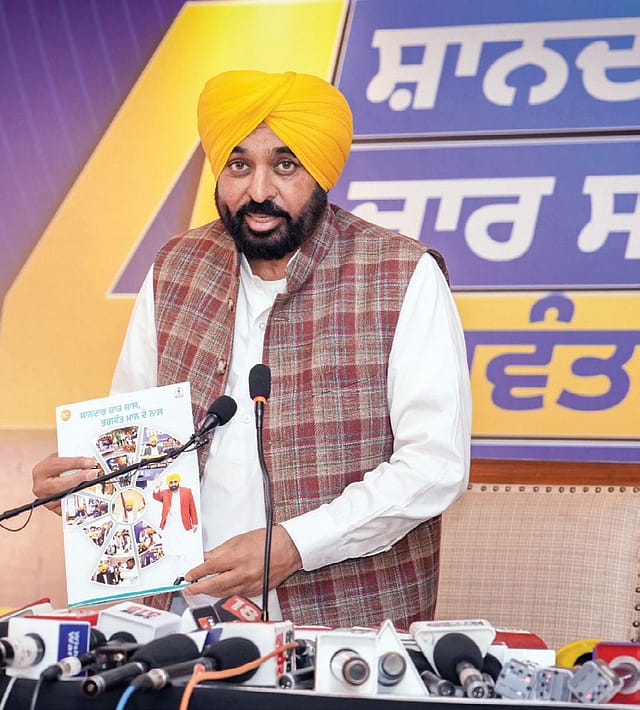
Positioned as a cornerstone of the state’s welfare architecture, the scheme reflects a broader shift towards risk protection-led governance, where reducing financial vulnerability is as critical as driving growth. Around this healthcare backbone, Punjab’s policy framework across power, agriculture, jobs, and infrastructure is beginning to show measurable outcomes. At the centre of this model is Chief Minister Bhagwant Singh Mann, whose administrative approach has consistently emphasised execution and delivery, with healthcare emerging as a defining pillar.
Healthcare as the Core: Access Meets Financial Protection: Punjab’s healthcare expansion is notable for both scale and integration. The Mukh Mantri Sehat Yojana provides a safety net that significantly reduces out-of-pocket expenditure for families, especially in high-cost treatments. This financial protection layer is supported by a rapid expansion of primary healthcare infrastructure. The state has operationalised 881 neighbourhood clinics, collectively recording over 5 crore outpatient visits, bringing accessible care closer to communities. Capacity building has followed. With 1,575 doctors recruited and seven new medical colleges under development—expected to add around 600 MBBS seats, Punjab is attempting to strengthen both access and long-term medical capacity.
Energy and Agriculture: Cost Relief Meets Structural Reform: Beyond healthcare, Punjab’s power sector has delivered measurable household-level relief. Nearly 90% of households now receive zero electricity bills, lowering recurring expenses. In agriculture, eight hours of uninterrupted daytime power supply has improved farm productivity, while irrigation reforms have expanded canal water coverage to 78% of cultivated land. Backed by the rehabilitation of over 15,500 km of canals and 18,000+ watercourses, the state is gradually shifting towards more sustainable water use.
Jobs and Capital: Public Hiring Meets Private Investment: Employment generation reflects a dual-track strategy. Over 65,000 government jobs have been filled through formal recruitment, while approximately 5.5 lakh employment opportunities have emerged from private sector expansion. Investment inflows reinforce this trend. Punjab has secured `1.55 lakh crore in commitments, supported by digitised approval systems and faster clearances, reducing friction for businesses and accelerating project timelines.
Education: Public System Regains Ground: In education, infrastructure upgrades are being paired with outcome improvements. Government schools now feature over 1 lakh desks, 9,000+ smart classrooms, and 5,000 computer labs. Teacher recruitment-15,000 educators -and global training exposure have strengthened delivery. Early indicators show progress: in 2026, 305 government school students cleared JEE Mains, while 845 qualified NEET.
Rural Economy and Welfare: High-Volume Delivery: Rural infrastructure continues to see large-scale investment, with over 40,000 km of roads under reconstruction and 13,000+ village ponds rejuvenated. Social welfare programmes are operating at scale. Pension schemes now cover 35.7 lakh beneficiaries, with `23,102 crore disbursed over four years. Public transport accessibility has also expanded significantly, with 14.5 crore free bus journeys annually.
Public Safety and Digital Governance: Punjab’s road safety initiatives have led to a 50.12% reduction in accident fatalities, with 47,000 individuals assisted through emergency response systems. Digital governance is expanding access and efficiency. 406 government services are now available remotely, while transport-related services alone account for over 30 lakh digital transactions annually.
Leadership Signal: Welfare Anchored in Delivery: Policy observers note that the distinguishing feature of Punjab’s current governance cycle is its integration of welfare with measurable outcomes. Bhagwant Singh Mann has framed healthcare—not just as a social sector priority, but as an economic stabiliser— ensuring that households are protected from financial shocks.
The Road Ahead: Punjab’s evolving model suggests a governance strategy anchored in financial protection, infrastructure scale, and administrative efficiency. With the Mukh Mantri Sehat Yojana as its central pillar, the state is attempting to build a system where growth and welfare move in parallel. As India’s states compete on both investment and human development metrics, Punjab’s approach offers a case study in how healthcare-led security can underpin broader economic momentum.