Building Differently: India's Path to a Just Transition
One more number belongs here: MSMEs account for well over a third of India’s manufacturing output and close to half our exports. That means our green transition runs through millions of small, cost-conscious units, not a handful of large corporations that can absorb a green premium without noticing. Any transition plan that isn’t built around that reality isn’t built for India.This is also what makes India different from the economies usually regarded as climate leaders. Most are replacing infrastructure that already exists: a coal plant for a solar farm, an old building for a retrofitted one. India is still building: our roads, housing stock, factories, much of our grid don’t fully exist yet. That’s not a disadvantage; it’s the one chance older economies no longer have—to build it right the first time.
THREE MAJOR CONSTRAINTS
Let us name the constraints plainly than talk around them. First, we are energy-starved—demand is growing faster than clean supply can keep pace with. Second, capital is short; the money a green transition needs at India’s scale isn’t sitting idle waiting to be deployed. Third, and this is the one which is crucial, is awareness and willingness to change. You can build all the solar capacity in the world, but if people don’t believe climate change is coming for their own lives, adoption stalls.
It is already here. Heat stress isn’t a future risk for other, hotter countries to deal with—it is cutting into labour productivity in our fields and construction sites today, raising cooling demand, and straining public health systems. Seen this way, climate change stops being an environmental talking point and becomes what it is: a development challenge.
That’s why awareness has to come first. Every citizen needs to understand how their own choices feed into this. That’s the premise of Mission LiFE (Lifestyle for Environment): turning climate action from a government programme into something people actually do. I believe in the old line: what gets measured gets managed. The same holds for climate behaviour.

ELECTRIFIED IS NOT THE SAME AS RELIABLE
Every village in India is electrified today—a genuine achievement, and schemes like Saubhagya (Har Ghar Bijli) and Pradhan Mantri Ujjwala Yojana deserve credit. But electrified isn’t the same as reliable or affordable, and that gap is where the next decade of work has to happen. True for electricity, and just as true for LPG.
This is where decentralized renewable energy (DRE) becomes a genuine gamechanger, not a conference talking point. Rooftop and village-level solar bring generation closer to where it’s used. Biogas does something even better; it solves two problems with one investment, managing organic waste and generating clean energy at once. Agricultural residue, livestock waste, municipal organic waste, all of it stops being a liability and starts being a resource.
TERI has seen this up close through our Lighting a Billion Lives (LaBL) programme. It started as a way to replace kerosene lamps with solar lanterns in villages the grid hadn’t reached and has since become something bigger: lighting for livelihoods, not just lighting for its own sake—power for a sewing machine, a flour mill, a small cold store. That shift, from access to income, is the whole argument for decentralized energy as a development tool.
JUST TRANSITION, NOT JUST AN ENERGY TRANSITION
What we need is not simply an energy transition—it is a just one, where the benefit reaches every individual, not only those who could already afford to go green on their own.
The barrier is upfront cost. Schemes are generous on paper—subsidies of 70 to 90% aren’t unusual but many communities can’t raise even the remaining share. And even where the money exists, delivery doesn’t scale: solar pump set connections a state can process in a year are a fraction of what its farmers need. The subsidy exists; the bottleneck is administrative capacity, and it deserves as much attention as financing.
Get this right and the payoff extends past electricity bills. If jobs exist in villages, fewer people are forced to migrate to overcrowded cities. Villages can grow into Tier-2 and Tier-3 towns, with renewable energy as the anchor industry—schools stay open, produce gets processed locally instead of spoiling, and artisans reach markets, including international ones, once out of reach. That’s the growth engine we would wish under Make in India: distributed, not concentrated in a handful of metros.
WE WERE NEVER A WASTEFUL ECONOMY
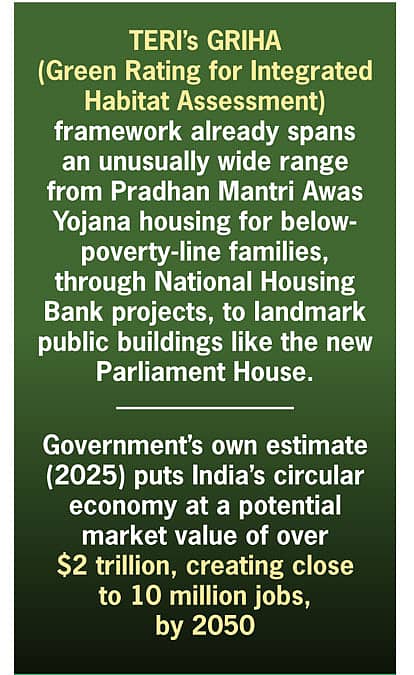
India has been cost-conscious long before ‘circular economy’ became a boardroom term. We were never a wasteful economy. What’s changed is that this instinct now has a name and a serious economic opportunity behind it: the government’s own estimate (2025) puts India’s circular economy at a potential market value of over $2 trillion, creating close to 10 million jobs, by 2050.
People often use ‘green economy’ and ‘circular economy’ interchangeably. That’s not right. Take cement. If I’m building green, I use a green building process, power the plant with green energy, manufacture green cement, and move it by a hydrogen-fuelled truck—every link in that chain is clean. That’s a green economy: the entire process, end to end. Circularity is a different axis. Making that same cement generates wastewater; instead of discharging it, I recycle it back into the process. That’s circular—waste from one step becomes input to another, a loop rather than a line. A sustainable economy needs both: processes clean by design, and processes that don’t throw anything away.
BUILDING THE INFRASTRUCTURE OF TOMORROW
The same logic must extend to how we build, not just how we power. In this context, TERI’s GRIHA (Green Rating for Integrated Habitat Assessment) framework already spans an unusually wide range from Pradhan Mantri Awas Yojana housing for below-poverty-line families, through National Housing Bank projects, to landmark public buildings like the new Parliament House. That range matters: green building isn’t a premium add-on reserved for those who can pay for it. The goal is to use sustainable building material, better insulation, and cut electricity load in these buildings and manage natural resources such as water.Transportation is moving on a similar track. India’s shift toward electric mobility, alongside the National Green Hydrogen Mission and rising investment in carbon capture, are deliberate steps toward decarbonization, and toward energy security that doesn’t depend on imported fuel.
GREEN GROWTH, NOT GROWTH AT ANY COST
We don’t have to follow the high-carbon path industrialized economies took to get where they are. Our goal is not simply to grow, but to grow differently and sustainably.If India succeeds in building a green economy that is affordable, inclusive and rooted in sustainability, it will not only secure a better future for its own citizens but also offer a practical model for the developing world. We must go green, and in doing so, India can show the world how sustainable growth can truly be achieved.