Atomberg vs Native vs Aquaguard vs Livpure - Which Water Purifier Brand to Buy in 2026?
Buying a water purifier often begins with comparing RO, UV, UF and the number of purification stages. But once the purifier is installed in your kitchen, another set of questions starts becoming important.
How often will the filters need attention? What happens when the membrane needs replacement? Is service included? And how much water gets rejected during purification?
So you can't understand the cost of water purifier ownership from the purchase price alone. Atomberg, Native, Aquaguard and Livpure approach these questions differently. Understanding those differences can make a buying decision much easier.
First, Look Beyond The Number Of Purification Stages
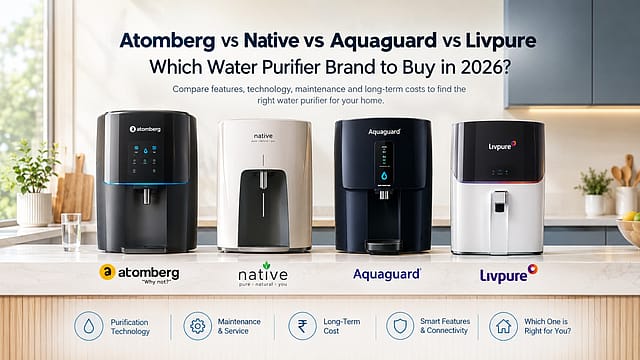
It is tempting to assume that nine stages must always be better than seven. However, the number alone tells you very little about whether a purifier suits the water entering your home. Here is a quick look at the four models.
The more useful comparison starts with what happens after these systems begin processing water every day.
Livpure Keeps The Approach Familiar
For someone looking for a fairly conventional multi-stage RO system, the Livpure Water Purifier takes a straightforward approach. The Pep Pro Star provides 7 L storage and combines RO, UV and UF treatment with mineralisation. Its filtration arrangement includes sediment and carbon treatment along with the RO membrane, UV treatment and UF stage.
It also supports input TDS up to 2,000 ppm and lists a filter capacity of 6,000 litres. Its 7 L tank also provides a reasonable stored-water supply for regular household requirements.
Buyers should pay attention to warranty coverage. The supplied model has a one-year manufacturer warranty covering eligible manufacturing defects. Damage arising from misuse, improper care and unauthorised repair is excluded.
Hence, the Livpure Water Purifier represents a more traditional ownership model: familiar purification technologies, useful storage and standard warranty coverage rather than app-based management or an unusually long service-free promise.
Atomberg Tries To Make Purification Adaptive
Water entering two homes in the same city may not have identical TDS levels. Atomberg builds much of the Intellon's proposition around this problem. Instead of treating every input condition the same way, its Intelligent Filtration System offers four modes and adapts operation to water quality. Other notable features include:
● 8 L storage capacity
● 25 L/hour filtration capacity
● Up to 12,000 L stated filtration capacity
● Wi-Fi connectivity
● Filter-health monitoring
● Service alerts
● TDS information through smart features
● Pre-filter included
The Atomberg Home App also allows users to monitor the purifier and raise service requests. More importantly, it offers a two-year warranty with zero-cost service during the covered
period. Filters, membranes and electrical components are included when the issue falls within the warranty conditions.
After that period, Atomberg promotes a pay-for-required-service model rather than a mandatory AMC. Therefore, the value here is not simply “smart purifier equals better purifier”. The real question is whether you value visibility over filter condition, adaptive operation and a different approach to servicing.
Native Makes Maintenance The Main Selling Point
Native M0 approaches the problem differently. Rather than giving you more maintenance information, it attempts to reduce how much maintenance you need to think about during the initial ownership period.
The M0 has a 5 L tank and uses RO, UV and mineralisation across its eight-stage purification system. It also includes an external pre-filter.
Its standout proposition is the stated two-year no-service requirement. Native combines this with a two-year unconditional warranty that includes filters, membranes and electrical components under its stated terms, with no service or visitation charges during the covered period.
That can matter because the initial cost of water purifier purchase is only one part of household budgeting. Filter changes and technician visits can alter what an appliance effectively costs to own.
The 5 L tank is smaller than the tanks on the other three models, though. So households with higher stored-water needs should consider capacity alongside maintenance convenience.
Aquaguard Focuses On The Water That RO Usually Rejects
RO purification creates another easy-to-overlook concern: rejected water. The supplied Aquaguard Water Purifier addresses this through Aquasaver technology.
The manufacturer claims up to 60% higher water recovery compared with older-generation RO systems. This is a comparative manufacturer claim, so actual recovery can vary depending on operating and input-water conditions. The model provides:
6 L storage
RO, UV and UF purification
20 L/hour filtration
10,000 L stated filtration capacity
Mega Sediment Filter
Mineral Charge for calcium and magnesium
Two-year advertised filter life
Two free cleaning services
One distinction buyers should not miss. The advertised two-year filter life does not mean the complete appliance carries a two-year warranty.
The Aquaguard Water Purifier provides a one-year manufacturer warranty. Its RO membrane coverage is stated as one year or 6,000 litres, whichever occurs first, subject to applicable input-water conditions.
Conclusion
A new purifier looks almost maintenance-free on installation day. The reality comes months later, when filters have processed thousands of litres and servicing becomes relevant.
That is where these four models separate themselves. Livpure follows a familiar multi-stage purification approach. Atomberg adds adaptive filtration and connected monitoring, Native concentrates on reducing maintenance intervention during its initial two-year period and Aquaguard places greater emphasis on water recovery and extended filter life.
Before paying, imagine owning the purifier in its second year. Check what the warranty still covers, whether filters are included, how service is arranged and what replacement costs may appear.
The purifier that makes sense today is not simply the one with the most stages. It is the one whose purification method, storage, maintenance requirements and after-sales terms fit your home's water and routine.