Unspoken Life: The emotional cost of male loneliness
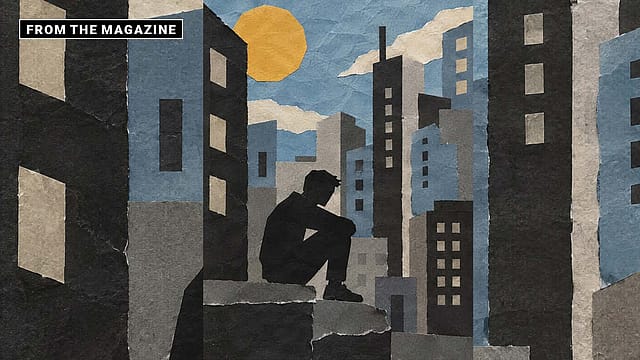
The technicians repairing an air conditioner in a 43rd-floor apartment saw the man cross the balcony and stand on its ledge. This was in an adjacent flat, registered on Airbnb, which the young, stocky man had rented a day earlier, on October 2, in Noida, Uttar Pradesh. The workers rushed towards him; his intentions were clear to them. “I am depressed,” he mumbled. Then he let go of his grip, falling into the courtyard below to a ghastly death.
The man, Sambhav Jain, was just 28, and life had not been kind to him. A resident of Manesar, near Gurugram, Haryana, he had been drained by the medical expenses of his child. These had also strained his marriage, eventually leading to a divorce. Preliminary reports suggested the court had asked him to pay a certain amount to his wife. Before jumping, he had sent a message to his father: “Papa, you won’t have to pay anyone now.”
There is a temptation, when a man dies this way, to make his death explain something larger than what the facts tell us. The full interior of Jain’s life is not known to us, and that is why we cannot attribute his death to loneliness alone. Still, his death leaves a question worth asking: What does society expect of a man who is struggling to meet the very obligations by which he has been taught to measure his worth?
This is a tragedy that men in urban India increasingly grapple with; it is, no matter how much one tries to avoid calling it that, a loneliness that doesn’t always look like loneliness. On the face of it, the man is living as he is supposed to. He goes to work every morning, pays his bills, takes care of his ageing parents and tries to hold a marriage together. But in this daily sequence, he finds it difficult to speak about what it is costing him. He has to appear stoic, even brave, as conventional ideas of masculinity demand. “I have seen men being shut down by their parents, who tell them that the loneliness they feel is just in their head and that they need to face life like a man,” says Vrinda Kabra, a psychiatrist based in Delhi. In India, where a man’s worth is often measured by his ability to provide and protect, admitting to fear or emotional exhaustion sometimes feels like another failure in itself. It is not that men may not have family or people around them; it is that they may still have nowhere to turn when the life they built feels as if it is closing in on them.
“Men have a problem being seen as victims because they associate it with being weak, incapable, good for nothing and worthless,” says Deepika Narayan Bharadwaj, director of Ekam Nyaay Foundation, an organisation that provides legal and emotional counselling to men in distress. “While women vent and feel free, men bundle it up and continue suffering, thinking no one will understand them in any case.”
The circumstances in which Indians live, work and form relationships have changed dramatically over the past few decades. The promise of upward mobility has led millions to leave the places where they grew up for big cities, living in apartments and housing societies where everyday intimacies are limited and it is considered normal to not even know one’s neighbour. The old family structures, even when they felt suffocating, offered a greater likelihood of human contact. As migration drew people away from home, these networks weakened. “We see that for many people, there is hardly any life beyond office hours. Instead of socialising on weekends, they prefer working because, in their professions, that is how they show their superiors that they are not weak,” says Kabra.
In cities, along with competitiveness at office, exhausting commutes leave little room for anything beyond the demands of the day. Social media gives them the illusion of being connected to family or friends, but the superficiality of those timelines cannot replace one’s need for meaningful conversation. These changes alone do not explain male loneliness. But when shrinking social networks meet the expectation that men should be self-reliant and emotionally restrained, a man can find himself surrounded by people and still have no one with whom he feels able to speak honestly.
“Three of my batchmates from engineering college committed suicide one after another,” says Aditya (last name withheld on request), 48, a senior sales professional based in Mumbai. On the face of it, everything seemed fine with his friends, judging by what they regularly posted on Instagram. “We would often see pictures of them having a drink at a bar, on a family outing or running a race,” he says. One of the three, who used to work in Delhi, left home one day around four years ago and jumped off a bridge into the Yamuna. Later, some of their friends called the spouses of the men who had died. One woman said that her husband had not spoken to the family at all about what was happening. “Imagine this happening after 15–20 years of marriage. Obviously, there is some gap that men seem unable to fill,” says Aditya.
Psychology offers some clues. Research on masculine norms has linked strong adherence to traditional expectations with lower emotional expressiveness and a reduced willingness to seek help. Psychologist Ronald F Levant, whose research examines the relationship between masculinity and emotional expression, has described how boys learn to restrict their emotions. In an interview with the American Psychological Association, he observed that boys’ facial expressiveness begins to decline between the ages of four and six. He attributed this, in part, to other boys policing emotional displays and enforcing what he calls the masculine code.
Several men interviewed for this story described childhoods shaped by familiar circumstances. Many came from smaller towns and built their lives in big cities such as Delhi and Mumbai. In college, they made friends, and while some of these friendships endured, others drifted apart as adulthood imposed its demands. At some point, the old, easy intimacy of friendship gives way to relationships that must be deliberately maintained.
Somewhere in the middle of this transition, the pressure to provide increases manifold. Parents grow older and need care. Children grow up, bringing their own needs and responsibilities. A good man is dependable: he works long hours and does not complain. He provides; he juggles. As a career becomes an identity, parents and spouses, too, can become implicated in this arrangement. The man is expected to hold everything together. His worth is measured not simply by whether he earns but by whether he continues to earn and remains capable of meeting everyone’s needs.
The same pressure follows men into their relationships. The expectation that they must always perform leaves little room for uncertainty, dependence or vulnerability. Even at home, where they might reasonably expect to let their guard down, they can find themselves occupying the role of the person who must have the answers. Over time, the distinction between a man’s work and his sense of self begins to disappear. In the fast-paced, cut-throat world of work, if a man’s job is threatened, the fear no longer remains confined to the workplace. It can easily feel like a failure of the self. “The problem also is that our society has raised sons in a certain way. We tell them: don’t cry because that makes you feminine; deal with your problems. We even tell them that they don’t deserve romance until they can stand on their own feet,” says Kabra.
Aditya believes that certain factors contribute significantly to male loneliness and that schools should teach children how to deal with them. “We are never taught financial management, for example,” he says. “I have many friends who have no investment skills and suffer as a result.” Although women also earn well and are capable of investing money, some financial responsibilities still end up being treated as the man’s burden. One feature of middle-class sentiment is an obsession with owning a house. Before moving to Mumbai, Aditya lived in another city, where, at his family’s insistence, he bought a flat. Some years later, they moved to Mumbai. “Now the onus of that flat fell on me,” he says. Since its market value had not increased much, they decided to keep it. “It became an additional responsibility. Collecting rent, maintaining it—all the processes fell on my shoulders,” he says.
Then there is the constant worry about what happens tomorrow. His job offers no pension, and he keeps checking his savings corpus, wondering whether it will be enough if his son wants to study abroad. “Every few months it becomes overwhelming,” he says. “So the fight against loneliness is a continuous fight.”
A study published in the International Social Science Journal in 2024 examined the relationship between loneliness, mental health and cognitive functioning among approximately 1,500 Indians aged 45 and above. The researchers found significant associations between loneliness and both mental-health outcomes and overall cognitive function. The research also says that marital status plays a significant role in these relationships, suggesting that the social circumstances in which people live may matter to their well being.
But sometimes those in marriages feel lonelier than those who are single. V works for a multinational company in Delhi and is married to a woman he fell in love with at an earlier workplace. They decided not to have children. V says he feels lonely and is unable to share what is happening inside him. “We talk, but it increasingly feels as if we are having an enforced conversation, as if we have to tick boxes two or three times a day, after which we pretty much live our lives separately,” he says.
V has a female friend at work. She is what is now commonly known as a “work spouse”—a colleague with whom someone shares a trusting relationship at work. “We navigate workplace challenges together, but after that I am pretty much on my own,” he says. He has friends, too, but says they are hardly interested in deeper, more meaningful conversations. “They have their own mess to deal with, so they just want to drink and talk politics or about some cricket match; and that is it,” V says.
At this stage, it is important for men to recognise when they are struggling and take steps to address it. “A lot of men take to alcohol or substance abuse to relax their minds and shed inhibitions, and eventually become addicted to it, only accentuating their problem,” says Bharadwaj.
Seeking help, however, means that men have to step forward and do something their life so far has made them learn to avoid; they have to accept and acknowledge that they cannot manage everything alone. Once this is done, the next step would be to speak to a friend and speak without hiding behind a joke; or having an honest conversation with a parent—in one of the conversations a man interviewed for this story recalled how, while he was having a conversation with his mother about his ageing father, he had to remind her that he too had diabetes. It may also mean seeking professional support without worrying about what a parent may think of it. It also requires families and workplaces to make room for conversations that do not begin and end with things related to what they require of a man.
At one point in Shakespeare’s Much Ado About Nothing, Benedick declares, “The world must be peopled.” Beyond the bard’s wit, the statement carries a simple truth that humans cannot be islands and that they need each other. For men who have been taught that self-reliance is the measure of their worth, perhaps the first step is to understand that asking for help does not diminish them. It does not make them less of a man. To ask for help is manly.