The Radha Mystique: She teaches us that to love is to transcend our limitations
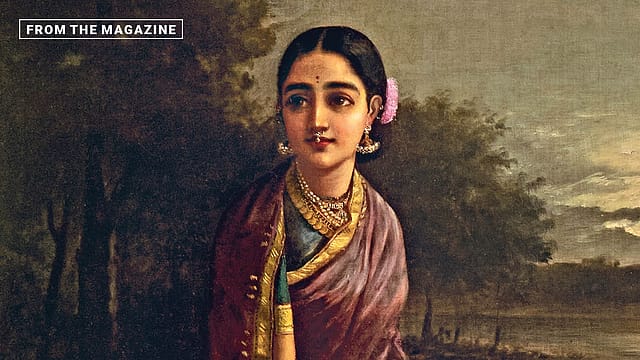
Radhashtami, celebrated on the eighth day (ashtami) of Bhadrapada, was observed on September 19 this year. I was travelling from Bengaluru to Delhi. Early in the morning, I got a message from one of the ISKCON groups reminding me of the day’s significance and inspiring me to renew my earlier meditations on her extraordinary power and importance.
Radhashtami, though hardly observed elsewhere, is accorded the greatest importance in Vaishnava traditions of Braj, especially in Gaudiya Vaishnavism. In Barsana, traditionally regarded as her birthplace, the festival has particular splendour. Devotees fast, sing Radha-Krishna kirtans, perform abhisheka, and seek darshan. The daily repetition of “Radhe Radhe” for every possible purpose, from greeting, prayer, mantra, and declaration of faith, is a well-known hallmark of daily social interaction here.
Radha is also worshipped in the Vallabha tradition, Nimbarka Sampradaya, and related Bhakti lineages. Drawing ultimately from the idea of the Divine Feminine, Radha is understood as Krishna’s hladini-shakti, his bliss-giving or bliss-experiencing potency. Krishna and Radha are therefore simultaneously two and one.
Krishna is shaktiman, the possessor of power, while Radha is shakti, that power itself, their mutuality as inseparable as Brahman and Maya. Their apparent rift permits the drama of love—longing, meeting, separation, jealousy, surrender, and reunion—which becomes the vocabulary for the soul’s relationship with the divine.
Radhashtami is not Radharani’s birthday in the conventional sense. Rather, it is believed to be the day of her emergence, about a fortnight after Krishnajanmashthami, or Krishna’s birthday. That is because we know very little about Radha before the Middle Ages. She is neither a classical historical nor a mythological figure.
Radha, Lord Krishna’s soulmate and greatest devotee, is a unique phenomenon in the religious and spiritual history not just of India but of the world. A humble milkmaid elevated to the supreme status of the erotic as well as divine beloved of the Supreme Godhead. Our unexpected reward as we try to understand the importance of being Radha will be Krishna or the supreme consciousness itself. Janmashtami celebrates the appearance of Krishna; Radhashtami celebrates the supreme surrender by which Krishna can truly be known.
The rise of Radha coincides with the widest popularity of Vaishnavism in the post-Chaitanya ecstatic mode of Krishna-bhakti. The male-dominated theology of Vaishnavism before Radha suffered from a particularly acute Goddess-deficit. The first three avatars, matsya, kurma, varaha, are sub-human. Vaman is single, not to mention rather small; Narasimha, half-man, half-lion, though later paired with Lakshmi, has no real relationship with her.
With Sri Rama, we see the beginning of a real love story. The romance of Sita-Rama is indeed charming, especially their first meeting resulting in the svayamvara, and their enchanting honeymoon in Chitrakoot.
But Sita’s subsequent humiliations, her trial by fire and, finally, her banishment when pregnant, turn the love story into a tragedy. That is why not just the Vaishnava revival but even feminine-dominant Shaktism needed the special kind of love-Goddess that Radha became. In the process, she also made Krishna the most attractive and irresistible of the avatars.
Radha has the kind of agency and independence that Lakshmi or the other consorts of Vishnu lack. Even if she is shown often as subservient to Krishna, her life history, as several scholars have argued, can be read as demonstrating extraordinary female agency and empowerment.
What makes Radha’s story unique is that she is hardly mentioned in the classical sources or scriptures. Even later, during the medieval period after the 12th century CE, while the name of Radha is in wider circulation, her rise to prominence as an important Goddess alongside Krishna is actually a comparatively later phenomenon, possibly as late as the 16th century.
In the Bhagavata Purana (8th to 10th century CE), the source of much of the later Krishna cult, there is no reference to Radha. The only clue to her identity is the mention of the single, unnamed girl with whom Krishna disappears in the Tenth Canto, which celebrates Krishna’s amours in the forest on the night of the full moon, better known as the Raas Leela.
While all the Gopis cavort with Krishna in that scene, there is one he takes aside, much to the consternation, even dismay, of the others. Perhaps that exceptional partner gave our medieval myth-makers the germ of the story of Radha which Jayadeva narrates in Gita Govinda.
The prehistory of Radha, thus, at best remains elusive. As Jayadeva’s translator, Barbara Stoler Miller, points out:
“The figure of Radha is one of the most elusive in Sanskrit literature. Until Jayadeva made her the heroine of his poem, she appeared only in stray verses scattered through anthologies of Prakrit and Sanskrit poetry, works of literary aesthetics, grammar, poetry, and drama, and a few inscriptions.”
But a traditional explanation often cited draws upon the Bhagavata Purana 10.30.28: anayārādhito nūnaṁ bhagavān harir īśvaraḥ– surely, Bhagavan Hari has been especially worshipped by this one.
There is an especially attractive theological play here. Because aradhana means worship or loving propitiation, Radha is simultaneously the supreme worshipper of Krishna and the one whom Krishna himself worships or seeks to please. This enables famous devotional wordplay around Radha, aradhana, and aradhya.
Grammatically, Radha is derived from the root radh—to prosper, succeed, please, satisfy, accomplish. But if we resort to Nirukta, we might consider that ra = light/effulgence and dha = bearer/holder. Thus Radha is she who bears or embodies divine radiance. This derivation is spiritually satisfying too. It makes Radha prakasha embodied, the luminous manifestation of Krishna’s own inner power. She is not simply one who loves Krishna; she is, in a sense, the radiance and bliss of Krishna made personal.
Thus, the question “What does Radha mean?” need not have one answer. Sanskrit permits layered derivation: grammatical, semantic, exegetical, and theological. And that is probably the better way to approach many divine names, whether of Siva, Visnu, Krsna, Devi, Radha, rather than asking for one supposedly definitive modern-style derivation.
In addition to etymology, Radha also came to carry overtones of meaning from “astral mythology”. Associated with the arrival of Vasanta ritu or spring in India, Radha is identified with the Visakha nakshatra, or the alpha Libra star system. In addition, she is also linked to its neighbouring constellation, Anuradha, which literally means that which follows or is alongside Radha. The somewhat ‘esoteric’ character of these associations may have increased the appeal of Radha as a consort for Krsna in a secret, erotic relationship.
That is why viraha, separation, is so important in the Radha tradition. Ordinary religious intuition might suppose that union with God is the highest condition. After which, the cliché—“And they lived happily ever after.” The Radha-Krishna tradition makes the more paradoxical claim that separation itself intensifies love as its culmination. The absent Krishna can occupy Radha’s, and hence our, consciousness even more fully than the present Krishna. This is one reason Radha became such a potent figure for poets from Jayadeva onward.
Radhashtami consequently celebrates several interconnected ideas: the Feminine Divine, not merely a consort subordinate to a male deity, but divine power itself; prema, rather than merely ritual observance, as the highest path to Krishna; self-forgetting devotion, in which the lover seeks the beloved’s happiness rather than her own; and, finally, the extraordinary theological idea that God himself becomes dependent upon the devotee’s love. Krishna may be Bhagawan, but without Radha’s prema even Krishna cannot be attained.
It is to Jayadeva and his remarkable Gita Govinda that the real credit for developing fully the complex character of Radha goes. But when Jayadeva makes her a full-fledged nayika or heroine of his most influential poem, Gita Govinda, it seems as if we have always “known” or at least craved for Radha’s presence, nay, predominance in the love story of Krishna.
Once created by Jayadeva, Radha steadily rises in importance as Krishna’s chosen paramour, partner, spouse (as she was later in the Radhavallabha sect), and thus the supreme Vaishnava Goddess. Chaitanya Mahaprabhu (1486–1534), who gave the Krishna cult its decisive form, at least in much of northern and eastern India, contributed a great deal to the theology, if not character, of Radha. As Guy L Beck points out:
“Radha’s presence in poetry and her theological importance increased with the growth of the Caitanyite sect of Vaishnavism in Bengal, which saw the integration of poetic theory of the sringararasa (the erotic sentiment) and its taxonomies of the nayaka-nayika with theology concerning the love of Radha and Krishna” (Alternative Krishnas: Regional and Vernacular Variations on a Hindu Deity, SUNY Press, 2005, p. 72)
While the Gita Govinda institutionalised and legitimated Radha’s centrality in Vaishnavite Bhakti literature, her character, persona, and role were further embellished and moulded by eastern Indian poets like Chandidas and Vidyapati, who created the platform for the great devotional and political upsurge marked by the advent of Chaitanya. Others, notably Nimbarka, who was closer to Jayadeva, and Vallabha, Chaitanya’s contemporary, also played a crucial role. Later, most of the great Krishna-worshipping poets such as Surdas also adored Radha till she became his secularised and universalised erotic partner in the Riti Kala poets like Bihari Lal (1595-1664).
With the beginnings of colonial modernity in India, Radha the Goddess underwent another drastic modification, now coming more often than not to represent illegitimate sexual desire. In the new puritanism fostered during the so-called Indian renaissance, Radha and her dalliance with Krishna proved an embarrassment to the agenda of social reform that the proponents of Hindu respectability espoused.
Yet, Radha persisted in folk songs and, later, in many popular art and craft traditions. The final twist in the Radha tale was added by 20th-century representations, by feminists who began to see in her a victim of patriarchy or even by male writers as their special symbol and voice, as in Ramakant Rath’s celebrated Sri Radha. Sometimes, Radha became a symbol of the degraded and exploited woman, even a fallen or abandoned woman, her tale a cautionary reminder of what happens to women in our society.
All told, the story of Radha is extraordinary, not only in itself, but in the larger context of the history of Indian art, culture, religion, and spirituality. The reasons for the rise of Radha are not merely historical, but theological, metaphysical, and spiritual too. If such a methodology has explanatory power, then it may also account for the decline of Radha.
But it is Radha, as Krishna’s fittest spouse, though never married to him, that makes her so special in Krishnology. Her radical apotheosis unites the metaphysical and spiritual with the sensual and human in unprecedented ways. True that Radha may have been largely a medieval phenomenon. She doesn’t exist in the classical world, nor does she quite survive as a Goddess in the harsh dawn of modernity.
Yet, there is none like her. Which is why we need her so badly in our modern, fragmented, alienated world. For it is Radha who teaches us that to love is also to grow vast and transcend our limitations. To love not only in the celibate, impersonal way, but to love in a deeply sensual, sexual, and whole-being way, to love personally, even romantically, is also to lose one’s moorings and grow infinite, the circumference of one’s being expanding till it embraces the whole cosmos.
It is through the fullest participation in the ananda-yajna, blissful sacrifice, that life as we know it affords us what we can truly come into as the uniquely endowed members of the human species known as Homo sapiens sapiens.