The Music between Us: Poetry, memory and kinship that endure beyond borders
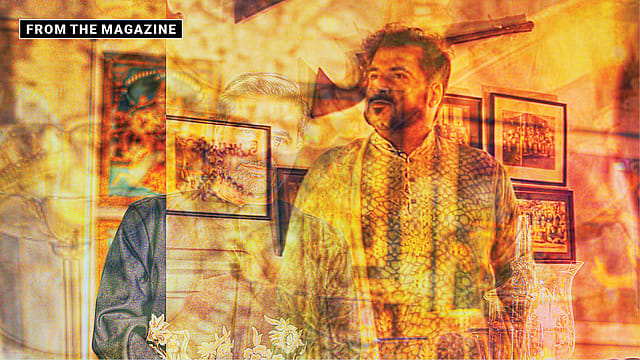
In October, I went to the Lahore Literature Festival for books and conversations. Instead, the journey led me to Allama Iqbal’s haveli, where his son and grandson opened their home and hearts to me. I arrived in a Heena Kochhar churidar kurta, pyjama and dupatta: shadow work, delicate hand embroidery, sheer muslin veiling a pale printed lining. For a few minutes, I stood alone in the library, wrapped in its majesty and magic. Then all eyes were on the boy from India. Everywhere, they called me Bade Bhaiya, elder brother, and celebrated me as nothing less. We stayed until the small hours, singing Iqbal, Faiz and others. There was no border, only voices meeting in music and the astonishment of belonging.
Deepavali asks us again to welcome light. A diya does not argue with darkness; it burns. The story of Ram’s return, and lamps lit to welcome him, carries a hope larger than ritual: that goodness can find its way back, and a home can open its doors. In Lahore, I felt that same light as songs from our shared inheritance made strangers kin.
Iqbal begins: Zameer-e-Maghrib hai tijarana, zameer-e-Mashriq hai rahibana
Wahan digargoon hai lahza-lahza, yahan badalta nahin zamana
The West’s conscience is mercantile; the East’s, ascetic. There, all changes moment by moment; here, time itself seems not to change.
Khizr speaks: Kinar-e-darya Khizr ne mujh se kahaba-andaaz-e-muhremana
Sikandari ho, qalandari ho, ye sab tareeqe hain sahirana
By the river, Khizr spoke in confidence: whether Alexander’s kingship or the dervish’s renunciation, both can be forms of enchantment.
Power dazzles in a crown; renunciation in a robe. Iqbal’s river runs through our time, where certainty is sold as wisdom and performance passes for principle.
He turns to the keepers: Hareef apna samajh rahe hain mujhe khudayan-e-khanqahi
Unhein ye dar hai ke mere nalon se shaq na ho sang-e-astana
The lords of the monasteries think me their rival. They fear my cries might split the stone at their threshold.
A true song disturbs the sealed room. It slips beneath the door, unsettles the comfortable and gives the silenced a sound of their own. Those who guard thresholds fear the voice that refuses to whisper.
For the enslaved: Ghulam qaumon ke ilm-o irfan ki hai yehi ramz-e-ashkara
Zameen agar tang hai to kya hai, faza-e-gar doon hai bekarana
Here is the secret of knowledge and wis dom for enslaved nations: so what if the earth is narrow? The sky has no bounds.
Though confined, the mind can still rise. What a gorgeous refusal to let circumstance become the whole story.
Then the question: Khabar nahin kya hai naam us ka, Khuda-farebi ke khud-farebi
Amal se farigh hua Musalman bana ke taq deer ka bahana
Is it deception of God, or of oneself? The Muslim has set action aside, making destiny an excuse.
We can hide behind a name, doctrine or destiny, leaving compassion outside. Muslim, Hindu, or any identity can become a cage when used to diminish the person inside it.
A rose branch sees him captive: Meri aseeripe shakh-e-gul ne ye keh ke Sayyad ko rulaya
Ke aise purssoz naghma-khwan ka giraan na tha mujh pe aashiyana
Seeing me captive, a rose branch made the hunter weep: “The nest of a songbird with such a burning song was no burden to me.”
In Lahore, that song found a home in every voice. Deepavali’s little flame and Iqbal’s burning song ask something alike: make room for one another, and let the light travel. We have shared music, memory and tenderness enough to keep us going as one people. We must keep singing.
We must, we must, we must.