Open Health & Wellness Summit: From longevity to lifestyle
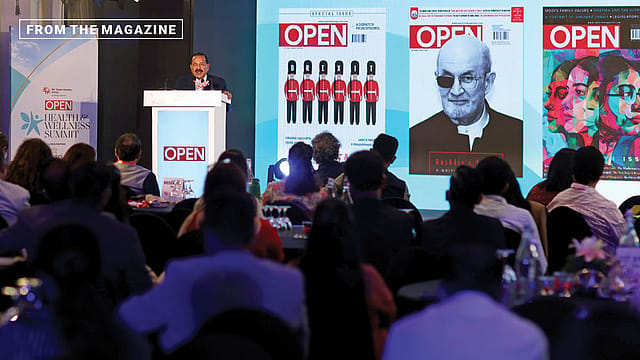
In the beginning there were the numbers. Dr Jitendra Singh, Union Minister of Science and Technology and Earth Sciences, set the terms for the Health & Wellness Summit, hosted by Open and the RPSG Group at The Park, Connaught Place, on September 25, 2026. “In 1947, the average life span was around 50 to 55 years. Today, it is nearing 70 years and beyond,” he said. India is a young country, over 70 per cent of the population is under 42, he pointed out, and “at the same time we are ageing rapidly because life expectancy has increased.” Both things are true at once, which is exactly the problem: the country now carries “a dual burden of disease, communicable diseases on one side and non-communicable diseases on the other.” Tuberculosis and malaria never actually left, they resurfaced in new forms, even as lifestyle conditions like diabetes and heart disease keep climbing on top of them. A tuberculosis diagnosis at Independence “was like a death warrant,” he said, a threat that gave way after the 1980s to what doctors used to call “civilised diseases”—heart attacks, diabetes, hypertension, the sort that arrive with prosperity.
Jitendra Singh’s fix wasn’t a new drug or scheme so much as a change in sequence: catch things early instead of only reacting. “The next phase of healthcare must place greater emphasis on prevention, early detection, and maintaining well-being,” he said, pointing to Ayushman Bharat’s hospital cover and Jan Aushadhi Kendras’ cut-price medicines as proof that the shift has already begun, and to India’s genomics push and its indigenous vaccine effort as evidence the country is “no longer catching up” but “setting the pace in preventive and precision healthcare.” He also pointed to where medicine itself is headed next. “We are moving towards personalised medicine where two patients with the same disease may receive different treatments based on genetic and environmental factors,” he said. “The future of medicine will be driven by genomics, lifestyle, and precision healthcare.” And he was careful to draw a line most people blur without thinking: “Wellness is not merely the absence of disease; it is a broader concept that includes physical and mental well-being.” Preventive healthcare, he said, closing his address, “is not just a medical issue, it is a national priority.”

Dr K Srinath Reddy, renowned for his pioneering work in preventive cardiology, took the argument to its foundation, arguing that India’s attention swings too easily between communicable and non-communicable disease without ever settling the basics underneath both.
India, he said, keeps stacking specialist care on top of a primary health system that was never actually finished. “We need to focus a lot on primary healthcare and the fundamental basis of our healthcare system. In fact, the population coverage should be attributed to the primary healthcare system, which should map out which is the area that should be covered by the primary healthcare system. And then, of course, coming to secondary and tertiary care as well. And we need an integrated healthcare system in many ways. We have too many disconnects in our healthcare system.”
Dr Ambrish Mithal, Group Chairman of Endocrinology and Diabetes at Max Healthcare, picked up almost exactly where Reddy left off and started naming the disconnects out loud. “If you don’t have walking spaces in your cities, how will you deal with a sedentary lifestyle?” he asked, pointing out that even Delhi’s well-regarded parks can be genuinely hard to reach on foot. The failure runs well past the health ministry, he argued, straight into food policy, city planning, and what actually gets served on a plate, in a school or a hospital cafeteria alike. Unhealthy food sells he said, and institutions keep choosing what sells. Even India’s staple diet hasn’t escaped, he pointed out: “The rice has changed, the roti is not the same, the atta is polished, devoid of all bran, any fibre.” He was no gentler on the public health system itself, asking why something as routine as a knee replacement so rarely happens there. “We don’t have a concept of economic viability in the government system,” he said. Regulation, in his view, is aimed at the wrong thing entirely. “Of course there should be regulation. Hospitals should not be allowed to cheat, no question about that. But more important regulation is about quality. What are your results of this procedure?” he asked, arguing that cost gets scrutinised far more than outcomes ever do. His one hope for relief going forward is AI, which he expects will get good at “screening patients better” long before most people ever need a doctor’s actual time, part of a broader shift, he said, away from chasing single numbers like blood glucose and towards “more holistic care” overall.
Dr Balbir Singh, Group Chairman of Cardiac Sciences at Pan Max, while agreeing with Mithal chose to dwell on the harder numbers. “Nowadays, getting a 29 or 35-year-old in the emergency room with a heart attack is not uncommon,” he said, recalling a time when a heart attack under 45 used to raise eyebrows across the ward. Some of that traces back to food, “this food is bad food, we know that”, and some to stress, smoking and drinking that a gym membership doesn’t cancel out. Hypertension, he warned, is “the biggest killer because it is a silent disease and nobody gets it checked,” and India tends to hit these conditions a decade earlier than the West does. “Nobody else will come to save you,” he told younger patients directly. “India is a land of paradoxes,” he said, world-class procedures alongside primary care that still falls short. Reach someone within four hours of a heart attack, though, and “there is no question that he should go home as a normal person.”
The panel on women’s health tackled a subject most families still avoid: menopause. Dr Surveen Ghumman Sindhu, Senior Director and HOD of IVF at Max Healthcare, said it doesn’t begin the day periods stop; it starts roughly a decade earlier, quietly, around the point bone density peaks: “Your menopause starts 10 years before actually the stoppage of your periods.”
Ashu Jain, a hybrid athlete and grandmother who took up strength training at 50, lived through that decade with almost no information. “There was a complete silence. And I was expected to accept it,” she said. Nutritionist Divya Gandhi, and founder of Vyomini Social Enterprise Prachi Kaushik, pushed the point further, into diet and, for rural India specifically, basic menstrual and menopause education that still doesn’t reach far enough.
Stress had its own panel. Dr Deepak Raheja, director of HopeCare India and president of the Mental Health Rehabilitation Society, wasn’t arguing for a stress-free life, just the ability to notice it building before it compounds. “We cannot do away with stress. Life is becoming challenging. We are multitasking more than we ever did,” he said. Dr Rachna Khanna Singh, founder of the Mind and Wellness Studio, saw something she genuinely finds encouraging in the generation coming up behind her. “The normalisation of understanding your mental health is important. The trend I see in the younger generations is the fact that they want to take care of their mental health,” she said.
It was left to Open Editor S Prasannarajan, who had opened the day on a thoughtful note, to frame what all this amounted to. “We are at a time when immortality is no longer a poetic idea, but a determination to defy biology,” he said, arguing that the conversation around health has moved past simply living long: “It is no longer enough to live well or live long, the conversation is about making death optional.” Knowledge, he added, is still the one thing that decides how well any of this actually works, “knowledge, at the end of the day, is the ultimate health,” and that knowledge no longer belongs to modern science alone. The Ayurveda voices in the room took that up in earnest, placing prevention in daily habit.
Dr Partap Chauhan, founder and director of Jiva Ayurveda, wasn’t interested in Ayurveda as a last resort when modern medicine fails. “Inner beauty is most important. Inner peace and wellbeing are integral to Ayurveda,” he said. Dr Nitin Agrawal, founder and managing director of Bliss Ayurveda, pushed the point into the body’s own wiring: “We need to take care of our health through Ayurveda, so it helps to strengthen our physiology from inside.”
Vasudha Rai, author and founder of the skincare label Amahvas, made the case from her own body. A long-running case of psoriasis, she said, simply disappeared once she started meditating. “The more I meditated, all the irritation, the psoriasis, just cleared up,” she said, adding that traditional medicine in India still isn’t getting the investment or research it probably deserves. Dr Geetika Mittal Gupta, founder and medical director of ISAAC Luxe, said patient expectations have shifted well past social media trends: “Now when we’re talking about prevention, people are more educated. They want to age well,” she said. “Your skin is the largest organ of your body... it’s also going to tell about your mental wellbeing.”
From skin, the conversation moved to shelves. Dr Kajal Singh, founder of MedKozy, thinks most people are far too casual about where their health advice comes from. “I would either go to an Ayurvedic doctor to understand about it or I would do research, read research papers to understand how many clinical trials there has been,” she said. Sarika Panchhi, founder and CEO of JiViSa Wellness, argued consumers have gotten harder to fool, not easier: “The consumer will be able to see through it if it isn’t authentic.” Alka Goel, founding partner of Alkemi Growth Capital, brought the money into the room directly: “A great innovation does not automatically make a great business. You need the good product, you need pricing, positioning, packaging, and you need business acumen.”
Longevity and disease do not usually share a stage with fitness dares involving press-ups, but by the end of the day at The Park they had, and the summit closed on a considerably lighter note. Model and actor-turned-fitness icon Milind Soman made a different kind of argument altogether, a case for movement. “To me, fitness is your ability to enjoy life, everything that life has to offer,” he said. “Life is a gift. The level of fitness determines how much of it you can experience.” He wasn’t talking about gyms so much as basic motion. “Movement is everything. I wouldn’t even call it exercise, just movement. Walking, running, yoga, dancing, anything that moves you away from a sedentary lifestyle,” he said, adding that the first real payoff is something as ordinary as circulation, “every cell in your body needs blood for oxygen and nutrition.” He had a similarly blunt line on food: “Healthy food is something your body can digest comfortably, not your tongue.” Fitness, in his telling, was never about how a person looks but about what their body could still actually do, and he wasn’t interested in excuses either way. “If you are weaker, you are more at risk of lifestyle disease or early death. So the question is, why wouldn’t you do it?” he asked, adding that longevity itself demands effort no shortcut can replace: “You cannot lie on the sofa and expect results.” Age, he argued, is not the obstacle people assume it to be. “You cannot say you won’t age, but you don’t have to become old.” His entire case for exercise came down to one line: “The right time to start is now. It is never too late.”
Nobody at the summit quite agreed on where health actually begins: a lab, a kitchen, or a gym. What the day did settle, however, is the direction of travel: away from late-stage cure and towards early, everyday prevention, built as much on individual habit as on public systems. Soman didn’t try to resolve the debate either. “The key to health and happiness is self-awareness,” he said. “Nobody can tell you exactly what works; you have to discover it yourself.”
The Price of a photograph
Milind Soman had a standing offer for anyone at the event hoping for a photograph with him: 20 press-ups first, 10 if you were a woman. It was also his argument for the evening. “You should ask yourself, can you climb stairs, can you lift something, do you get tired easily? Those are your real indicators,” he said, dismissing the idea that fitness has anything to do with appearance. Motivation, in his view, only works when it is personal. “You cannot convince someone to exercise.”