Letting Go
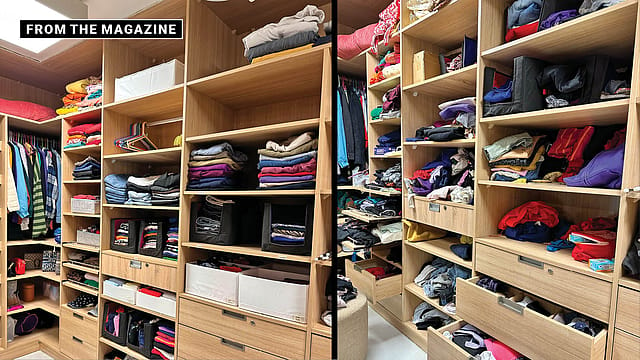
In a high rise in Powai, an upscale Mumbai suburb, a flat is being readied. The last of the civil work is ongoing. The bedroom is the only room that is entirely done. Knickknacks lie strewn on the ground and on tabletops. Cosmetics, accessories, all kinds of accoutrements gathered over years. Inside a wardrobe, however, clothes are neatly lined on hangers, organised by colour. Just below it is a drawer holding a flat organiser with niches. Raachna Kacker, founder of Messmerize India, is telling one of her team members how to place watches in them. Others meticulously go over the items in the room sorting them out. The house belongs to a young couple with a daughter who are about to move here. They got in touch with Kacker a few months ago. Her plan involved getting them to first decide which things they could discard. That part was decluttering; the second, which is ongoing now, is organising.

The family had lived abroad, so were used to letting things go. But it is not always like that. One major reason why Indians refuse to let go of things is because they are associated with memory and relationships. Often Kacker’s work involves understanding people’s emotions to make them eventually appreciate the necessity of discarding. An NRI once approached her to work on the family’s ancestral home where the mother lived alone with a considerable amount of clutter. Kacker spent seven days with her. “It made me realise that if you are working with elderly people, you really need to understand their emotions—why they are attached to their items and then get down to speaking in terms of the emotional connect that you are building with them. I felt more than a professional organiser or a decluttering expert, like a psychologist or coach helping and guiding the client,” she says.
Kacker is part of a growing service sector around decluttering and organising homes. India presents an unusually fertile ground for them simply because many factors come together here to make houses unwieldy in what they contain. There is size, for one. In cities, flats are small and aren’t usually designed with storage in mind. On top of it, Indians often stay together in families that are more than just a nuclear unit. Gifts are exchanged for festivals and stored. Parents die, leaving things behind that children are reluctant to discard. Also, Indians, possibly because of the country’s history of poverty, tend to hoard everything to be reused in a future that rarely arrives, like plastic bags. Enter then the decluttering specialist.
Kacker had seen her mother, who lives in Lucknow, struggle with clutter. For instance, she kept her children’s old things from decades ago. Despite her having a double-storeyed house, space was still a problem. Once in Lucknow in 2018, Kacker and her brother asked their mother to let go of unwanted things. “She broke down and said that you all just come for a vacation and give me a lecture—do this, do that. ‘Why don’t you stay and help me?’ Because I don’t know where and how to start,” says Kacker. She realised there would be many like her mother who want to let go, have a nice organised space but don’t know how. Initially, she did it as a hobby, being a consultant on weekends. She later took it up full-time, leaving her job as director of corporate relations at a B-school. “If you are not able to find out anything in sixty seconds, that means you need our services,” she says.
That such a business was possible came into Indian consciousness through Marie Kondo, a Japanese organising consultant, who wrote bestsellers on tidying up using a concept in which you discard what does not bring you joy. A 2019 Netflix show on her became enormously popular, making decluttering a buzzword. The next year Covid hit and people realised that they had to live 24 hours in their homes and saw just what had happened to them. Houses were redone and upgraded.
“There were a lot of moves to new homes. That’s when what we do got taken seriously. Initially just explaining what being a professional organiser is was challenging,” says Rohini Rajagopalan, founder of Organise with Ease, adding that now people call her using the correct terminology—asking if she is a professional organiser. Rajagopalan got into the field after stumbling on a book by Kondo. From six to seven projects a month, she now says it has become four to five a day.
She largely works with busy professionals, people with active lives who would pay for such a service than spend 10 to 20 days getting their houses in order. They would rather spend that time doing something else. A subgroup that is now increasingly becoming a mainstay for declutterers is families shifting to new homes who don’t want unwanted things in their old home to be carried forward. “A large part of what we do is also moving people’s homes. We set up new homes in three days’ time,” she says. Doing it by themselves, according to her, would take them 10 to 15 days, sometimes opening over 300 cartons.
This is true for Kacker’s clientele too. “If somebody is spending a lot on interiors, they generally want to create a system where right from the start everything has a place,” she says.
One of the highlights of this year for Zuweina Kapasi, cofounder of BlessTheMess with Raina Jain, was when they were hired to do the kids’ room and the kitchen of a family of four relocating from Seattle in the US to Ahmedabad. Kapasi and her team, based in Mumbai, had to go there. What they found was around 120 huge boxes. They were able to finish organising in less than three days. The client then wanted them to work on another container, which had more than 200 boxes and had filled a farmhouse. A second round to Ahmedabad followed. “It was just boxes and boxes till wherever you could see, piles stacked upon each other. Every box that we opened was a different category than the previous one. So categories on categories. Because their current house couldn’t accommodate [all] that, they had bought a storage space in their office where they were sending half of their stuff till their new house would get ready. It took us almost six days. And by the end of it, they had an organised home to live in, an organised set of boxes to send to storage, a set of boxes to donate to one family, a set of boxes to donate to another family. Obviously, there was also a lot of discard. So that was another set of boxes,” she says.
BlessTheMess was started in 2021 during Covid. So far, they have decluttered more than 300 houses. “We thought that storage is not a problem, the system is a problem,” she says. They came out with a system of their own, tried it out with relatives and friends, and then started getting clients. Kapasi begins with an extensive consultation to understand the clients, things they use frequently and what they reach for on a daily basis. She looks at storage spaces, like wardrobes and kitchen cabinets, that are currently being used to understand the mismatch between lifestyle and how things are kept. “What kind of clothes do you wear to work? How many times do you go out in a month? Is it twice, thrice? Why are your going-out clothes kept right at the first shelf if you’re not going out every now and then? Those are the questions that keep coming as we look at the wardrobe,” she says. Their organising system works by zones. The golden zone is for what is needed on a regular basis, where a person can immediately access it. Things not used as frequently go a little away where a mild effort is needed. Those rarely needed are kept away in areas like lofts or under-the-bed storage.
Everything is first categorised into groups and subgroups for which zones are created, the principle being that access must flow smoothly. She takes the example of a kitchen where cutting, chopping and then cooking must be in tandem with utensils and ingredients being handy. Separate zones are made for snacks, serving, etc. “We need to ensure that cooking spoons, masalas, chopping material are kept in close vicinity to the person who’s cooking and where he’s going to stand. If the utensils are kept away from the main cooking range, it doesn’t make sense,” she says.
Each decluttering specialist will have a different system. Kacker takes inspiration from Kondo’s KonMari method, tailoring it into what she calls her Zen Sort method. “We start the process of decluttering by making you go through each and every item. Your mind opens up to what you want. As consultants our role is to facilitate, not to take a decision on behalf of the client,” Kacker says. The concept is categorise and then compartmentalise. “Every item, especially small items, need to be given a compartment. And then, of course, organising. We follow a principle of vertical storage. It’s easy to take out, use and keep it back. The more the visibility, the more I will end up using the item,” she adds.
People who are older are more reluctant to discard things because of emotional attachments. Kacker also sees gender as a factor. “If you compare a woman’s wardrobe to a man’s, most of the time you’ll find men are minimalists, women have a lot of stuff. That affects whether they want to keep things or let go, or how much you are letting go. And of course the lifestyle of the client. If somebody is in a profession where they need to dress up and show what they have, then they need to have more clothes. Probably they will not want to let go of too much,” she says.
Indian homes not only hold a lot that is not needed but the problem might be getting worse with economic growth. Take online shopping or quick deliveries. These come in packets and bags which families keep accumulating. Rajagopalan says that earlier, Indian homes had limited occasions when new things would enter. “When we were growing up, we got new clothes for our birthday, for Deepavali, and I’m a South Indian, so Pongal. And when an aunt came from the US or Singapore or wherever,” she says. “The incoming bit has gone up substantially because you’re sitting bored in a meeting, you’re happy to click your fingers and order something. Our consumption and the speed at which we’re consuming are far higher than what it used to be generations before. I’ve had clients who have gone with two suitcases and come back with eight suitcases after a summer in London.”
Decluttering specialists can be hired for small jobs, from organising one cupboard to a kitchen or an entire house. Charges vary depending on the scale of the job and who is doing it. If it involves teams of two to four, an entire day can be billed up to Rs 50,000 by an established specialist catering to luxury homes. Others might do the same for Rs 25,000. Some charge lump sums of around Rs 50,000 for a 2 BHK and around Rs 10,000 for a wardrobe. And if it is a house shifting which is spread over many days, costs will be much more.
For someone grappling with clutter, what it buys can be more than just order. Recently, Kacker had as a client a man who had not been able to let go of any of the stuff of his parents who had passed away years ago. Eventually, after keeping a few items, which had memories tied to them, he could allow himself to discard the rest. “After the entire process, he shared that he felt lighter. That feeling of the parents still being around was there in spite of letting go of things,” she says.