Between The Tiles: The game of Mahjong is evolving into a lifestyle pursuit
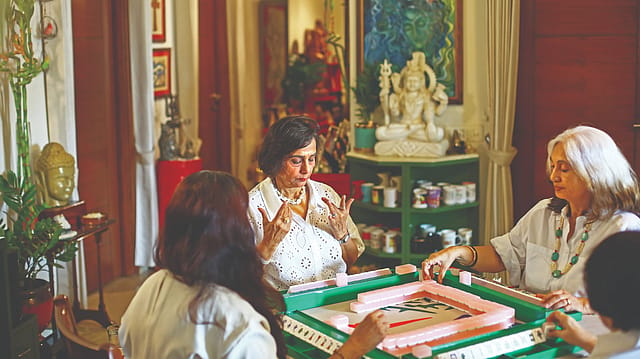
Vineeta Sahni found her passion for Mahjong amid war. A Delhi NCR-based life coach and founder of the training academy Varied Solutions, Sahni has been testing her mettle on mahjong tiles for three decades—playing, teaching and building communities. It began with memories of her mother playing the game with friends and a Mahjong set she’d received as a gift. “I used to play a little bit but didn’t know it too well,” she recalls. “During the Kargil War, my husband was away on duty and my daughters and I were stuck at home in Jodhpur. I asked Mrs Sarvate, the wife of a senior Army official, if she would teach me and she agreed. We would spend the day playing and that’s how I and my daughters learned—it was a beautiful thing.” In the years that followed, she continued playing as she moved with her husband across different Army bases. “Nobody else knew the game. So, I would invite the other ladies—senior and junior—to join me and play the game. Over time, I built my own repertoire and community.”
This pursuit has culminated in the Indian Mahjong Association (IMA), a platform Sahni founded in 2025 for Mahjong players and enthusiasts from around the country to hone their skills and build a network. Members gather at IMA events, receive coaching and certifications and find their place at tables with each other. A roster of experienced trainers works with Sahni and the association has travelled to cities like Hyderabad, Lucknow, Kanpur and Bengaluru for events. “Our aim is to create happy communities that can play forever,” Sahni tells Open. “Mahjong is a beautiful family game and a great way to bond. I recommend teaching it to children and students for greater focus and also for couples to learn and play together.”
There may not be a better time to find new converts to the game than the present when Mahjong’s popularity is exploding across India. A traditional Chinese tile game, estimated to have been codified around the 19th century, Mahjong is usually played by four players who combine strategy and memory along with a serving of luck. Each player begins with a fixed number of tiles and takes turns drawing and discarding tiles from the wall to improve their hand till a player completes a valid hand and declares “Mahjong”, or the supply runs out. The number of tiles and rules change according to the many variations of the game that have emerged around the world in the 20th century. The Chinese, Japanese and American variations are among the most well-known though there are other regional iterations of the game as well. Long before it became a trend, Mahjong arrived in India as a byproduct of historical trade, colonialism and military networks. Sahni notes that Army wives have been playing the game since the years after India’s Independence and have over the years developed their own adaptation of the game.
Until recently, Mahjong was however the niche pursuit of a few. Sangeeta Kewalramani, a Mumbai-based senior player and instructor, recalls a time when the city’s Mahjong circles were dominated by expats and a few local enthusiasts. Having played the game for 17 years and taught for over five, she describes her tryst with it as a “lifelong love affair” which began one evening when a close friend invited her to join a Mahjong circle. “At the time, I was playing Bridge so she thought I might enjoy learning this game too. And she was absolutely right,” she remembers. “The group I joined consisted of three expat women, one from Turkey, one from England, and one from Germany. Even though we were from all over the world, Mahjong brought us together. That first game felt like being let in on a secret society. I didn’t know the rules, but I was instantly hooked by the camaraderie around the table.” As she learnt the game, she began inviting others and teaching them; she has taught over 1,500 students since.
Today, Mahjong is anything but niche in the country.

A variety of circles, clubs and platforms have emerged across India, from metropolitan cities to smaller towns, drawing the curiosity of both serious players and casual learners. In Mumbai this year, 1Bam started as the city’s first dedicated Mahjong parlour—founded by Radhika Mukherji, Samipa Jolly Shaw, Shalini Bachani, and Kanchan Idnani—and is drawing steady crowds. Tabletop Tavern in Delhi hosts guided sessions and social events centred on the game. The Mahjong Network is a WhatsApp-led community connecting players across chapters in Mumbai, Delhi, Bengaluru, Alibaug, and Dubai. The game also has fans in non-metros. Take Poona Club, for instance, which houses a Mahjong room. In Visakhapatnam, the Vizag Mahjong Club founded by Anita Nuthakki boasts a growing number of members while in Ahmedabad, the pan-Asian restaurant TimTim launched a dedicated space named Mahjong Socials for players. Jaipur also got its first Mahjong club this year, cofounded by Anugya Maharwal and Anita Khandelwal. And small networks and events continue to popularise the games in cities such as Patna, Guwahati, Dehradun, and more.
Mahjong is a challenging mind sport, driven by strategy, pattern-recognition and complexities that amplify with every level. Beginners can learn the rules quickly but mastering it takes time and dedication. Even for those who may not have played the game, Mahjong may ring a bell from pop culture references—particularly the hit movie Crazy Rich Asians (2018) whose climax between Michelle Yeoh and Constance Wu takes place over a Mahjong table. It certainly came to Kolkata-based Nikita Agarwal’s mind when she got an opportunity to attend a workshop in the city last year. It was an instant connection. “When I started playing, I picked up the rules immediately and won the practice games. I was immediately fascinated,” says Agarwal who grew up in a joint family playing a lot of board games and card games. “The game involves a fair bit of calculation, I felt my love for numbers and board games come together.”
Over the past year, Agarwal, a former banking professional and mother to two children, has made Mahjong her full-time profession. “I think of Mahjong as my ikigai. I feel the utmost joy and pleasure in it, and it’s immensely satisfying when my students understand and play the game beautifully. Teaching Mahjong has become my passion.” Apart from hosting classes for batches of four to eight people, which keeps her busy through the month, she also hosts events ranging from birthday parties and soirées to store openings and curated events. At a recent birthday party, she took the guests through a guided session; on another occasion, she hosted an event for a silver store in Kolkata to mark the launch of their gifting section (including Mahjong sets). Next: she’s planning a Deepavali tournament.
There is in fact more than one Mahjong soirée and tournament on the calendar this festive season, and beyond it. As the game finds an increasing number of fans, Mahjong is now appearing in cafés, sundowners, kitty parties and a variety of get-togethers. “Mahjong is inherently social. People come for the game but stay for the energy around the table, the conversations, the laughter, the snack breaks, the competitiveness, and the silence in between,” observes Kewalramani. “In many ways, it feels like reclaiming how we used to spend time together before everything went digital. More and more, I see Mahjong tables at brunches, birthdays and tea parties. Even in my own classes, I’ve seen complete strangers turn into friends. They start playing together outside of class, meet weekly and host Mahjong nights—it becomes a ritual.”
Sahni prefers close-knit spaces and encourages players who intend to pursue the game for a long term. “Our game has evolved to a level of high challenge. It requires concentration and focus—and playing casually for an hour or two in cafés does not offer that,” she says, also emphasising the need for certified trainers who can teach players about rules and variations without diluting the gameplay.
Yet, Mahjong is steadily making its way into social events and casual spaces where the game is often simplified. Agarwal often curates events for occasions where most people are beginners. “I try to teach the basics. It’s essentially to catch their attention and show them that the game is not as difficult as one might imagine,” she says. “Once they start playing, and winning, they get interested. Post events, a lot of people approach me to learn the game in detail.” A casual approach helps its popularity but as Agarwal adds, “people who are playing seriously will continue to do so”.
Whether it is competitive or casual, the game allows people to gather and spend time together. Geet Nagi, a Delhi-based entrepreneur and founder of The Sorbet Soiree and the AWG art gallery, began playing Mahjong as a fun bonding exercise with friends. “There are lots of variations to the game and a lot one can keep learning, which keeps us hooked. Also, the game requires concentration and I find that we never look at our phones when we are playing—it’s a refreshing change,” she says. With the game’s growing popularity, she has seen new, interesting formats—like a recent pyjama party and potluck where she was invited to play Mahjong with more than 30 other women.
A whole economy is now developing around the game, much of it driven by enthusiasts who are teaching as well as selling Mahjong kits, mats and other tools. There are spaces available to hire for games and bookings for private events. The Mahjong set itself has become a collectible item. Internationally, Hermès, Prada and Louis Vuitton are among the numerous luxury brands offering Mahjong sets. The idea is also catching on in India, from Zen Diamond’s gem-studded set to couturier Gaurav Gupta’s design in collaboration with HSBC crafted in wood with mother-of-pearl tiles.
Earlier this year, Indian fashion and lifestyle label Shivan & Narresh launched Mahjong kits as part of its Homes vertical. “I think it’s the love of slowing down, gathering around a table and creating moments with friends and loved ones, and Mahjong feels like a good canvas for that. The idea is to reinterpret the game through our visual language, using vibrant tropical spirit of Palmera to create a set that feels playful, bold and mysterious and very much at home in the world of holidays,” says Shivan Bhatiya, the brand’s cofounder and head designer. He and his cofounder Narresh Kukreja (creative director of the label) were introduced to Mahjong by a friend about a year ago. “What fascinates us is the balance between strategy, instinct and chance; you can have a plan, but the game is constantly asking you to adapt,” Kukreja adds. “We also love its tactile quality and the beauty of the tiles themselves, which made it especially interesting for us as designers.”
In times of growing digital fatigue and diminishing attention, Mahjong offers people an absorbing, tactile alternative to doomscrolling that has the potential to outlast its current boom. “Mahjong is definitely here to stay, also because it goes beyond a game. It’s about knowing when to hold on, and when to let go, and most importantly, how to stay graceful in both victory and defeat,” says Kewalramani. “You might start a game thinking one hand will work, but the tiles have other plans. So you adapt and pivot to make the best of whatever hand [or tile] you’re dealt. In many ways, it’s a mirror to life.”