Youth Issue 2026: Rewinding to Real
FOR ISHITA ASWANI, 27, the scrapbook aesthetic of the 2000s used to hold an irresistible pull. She created an enviable scrapbook collection back when she was in school—it was made entirely out of Cadbury wrappers. The communications professional was once a devoted admirer of Shahid Kapoor—especially after his 2000s hit Jab We Met; Aswani would clip his photos from film magazines, paste them onto chart paper, and pin them up on her walls.
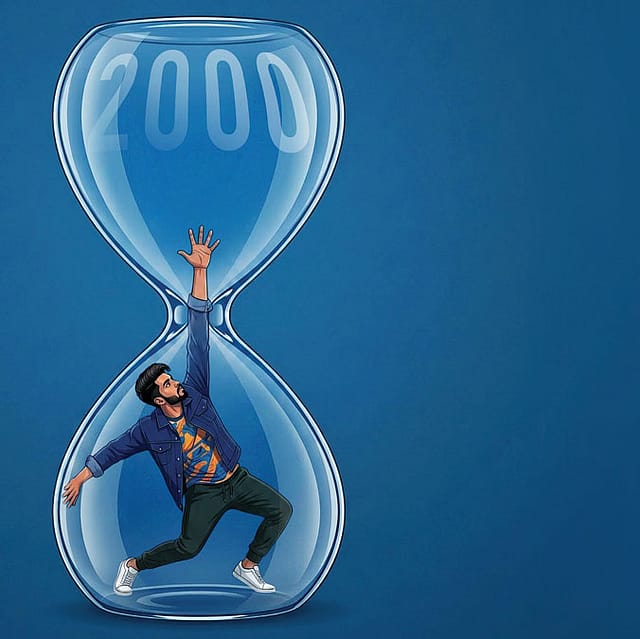
Is this the kind of tactile fandom younger Gen Z or Gen Alpha still engages in today? “No way,” quips Aswani. “Scrapbooks are all but gone. It was replaced by Canva, which millennials took months to master, and now, of course, there’s AI-generated fan art taking over the digital space.” It seems that Gen Z, even the ones who lived through the 2000s as kids, are nostalgic about an era that was rooted in a simpler kind of creativity. It is a past that feels more real than the present.
This grief over losing a simpler, relatively calmer time— when the constant urgency to respond to every text and check notifications wasn’t the norm—runs deep in this generation. This constant need to fill the 2000s-shaped hole in hearts with nostalgia is now reflected in pop culture. The resurgence of sequels—where popular 2000s Bollywood films are revived as sequels, at times because they merit one, at other times only to ride the nostalgia wave—is a norm. It wouldn’t be an exaggeration to say that the 2020s borrow so heavily from the 2000s that there might not be a distinguishable aesthetic to associate with this decade.
But why is Gen Z seeking refuge in nostalgia? An obvious answer is that the times we live in are so horrific, that escapism is less a luxury, more a necessity. With the rise in global conflicts, inflation, house of living crisis, and a general sense of doom, Gen Z is hyper-fixated with the past. It is almost as if they are rebelling against the oppressive times we live in by recreating the aesthetic of the yesteryears. On Instagram lately, there has been a rise in the number of Reels where Gen Z are seen stocking up CDs and DVDs on shelves—this, when streaming apps are only a click away. Physical media becomes a final bastion of sorts, against having your world taken away from you.
We live in an era of techno-feudalism where everything is stored on the cloud. To put it simply: we now subscribe to things we used to buy. Ownership is all but a myth and renting, sometimes over and above paying the subscription fees, is the norm. Gen Z, it seems, is fed up with this illusion of access.
According to Harnidh Kaur, the author of The Girls are Not Fine, Gen Z wants a physicality to their memory. Their memories aren’t necessarily tangible, unlike millennials (like the 31-year-old Kaur) who had physical photographs, cassettes, scrapbooks, and CDs. “No Gen Z remembers not being obscenely and immediately accessible,” Kaur says. “Gen Z is desperately missing this. They seek consistency of existence.” This loss of consistency Kaur alludes to is linked to the death of monoculture—everyone now exists in an algorithmic bubble where the generation no longer shares a common interest.
Bollywood, of course, is no different. While the 2000s films had their own aesthetic—chiffon saris in slow-motion songs, candy-coloured college campuses, low-rise jeans and crop tops, the films today don’t have that shared aesthetic. It is another conversation worth having as to why films now do not have the kind of cycles where anticipation was built over weeks as the film slowly seeped into pop culture. Everything is compressed into a weekend. No matter how big a release, films barely manage to stay in popular discourse beyond a year.
Kaur explains the reason behind this phenomenon. “We had epochs because it takes time for a culture to percolate. It took time for the transmutation of a cultural artefact. Due to the sheer surface area of distribution, we have micro-epochs. The visual that defines an era is no longer 5-7 years long. It is 5-7 months long.” She argues that the 2000s was a time when only big-screens could create a mass culture. “There is a reason superstars like SRK and Salman (Khan) exist,” she says. The distribution is increasingly fragmented. “Every screen has its own movie playing. There is no authority of culture. There is no in-group anymore.” Gen Z, it seems, craved for a monoculture and the closest they have to it is the 2000s.

SOCIAL MEDIA FEEDS into this obsession. Working on this feature, I began to wonder: what if platforms like Instagram and Pinterest are algorithmically fuelling the resurgence of 2000s nostalgia by continually serving us content that reinforces it? “We give algorithms a lot of credit,” Kaur opines. “It is not the most intelligent piece of architecture. It serves us a lot more of what we search for. It is just that the 2000s is naturally attractive to Gen Z because it is not only closest to monoculture but also because it is hyper-documented unlike the 1990s or the 1980s when films were more expensive and memory wasn’t as cheap as it is today.”
Jeevika Bhat, a 22-year-old master ’ s student is one of the many Gen Z obsessed with 2000s music. She laments the loss of the beats and tunes that defined that era. “I clearly remember the opening of ‘Zara Zara Touch Me’ from the movie Race—it begins with a male voice rapping in reggae. Or take the high-energy beat of ‘Dus Bahane’—you just don’t hear that in songs anymore.” Bhat remembers being obsessed with Kareena Kapoor Khan’s song ‘It’s Rocking’ as it played throughout the day on MTV. And then, there’s 9xm nostalgia—the golden era of late 2000s/early 2010s Bollywood which most Gen Z remember fondly.
Tanishk Shukla, a 27-year-old from Jabalpur, also a contestant on the latest season of Indian Idol, connects deeply to the songs that value sur over production or social media trends. He feels singers from the 2000s focused more on connecting with the audience than creating a spectacle. Shukla feels that some of us might make the mistake of looking at the 2000s through rose-tinted glasses. The time was problematic for many reasons. “I’m aware that my version of the 2000s is more romanticised than reality. Every era has challenges. The inline content tends to show the beauty and emotion more than struggles”.
“The nostalgia-seeking is so prominent that there are accounts on Instagram solely dedicated to posting popular advertisements from the 2000s,” Bhat says. She feels there is a monopoly of the West on culture. It isn’t surprising therefore that if one were to Google 2000s music, they would most likely find hits from Britney Spears, Black Eyed Peas, Lady Gaga more often than Sunidhi Chauhan, Shreya Ghoshal or Shilpa Rao. As a devout cinephile who now logs films on Letterboxd, Bhat reminisces about an era where she would buy pirated movie CDs from a local shop, well before torrents went mainstream. Once, cinema was something you could hold—scratched, smuggled, and yours. Now, it flickers in borrowed pixels, never quite possessed.
Beyond the tangible memories, what Gen Z seems to miss rather terribly is the sheer joy of discovering a film or a song while randomly switching on the television or flipping channels on radio—it is now a thing of the past. Tushar Priyadarshi, a 28-year-old banker, feels there was unpredictability in stumbling upon a newer, lesser-known film of cable television which is missing from the Netflix era. “Radio allowed us to discover new songs. Today, you turn on Spotify and hear Arijit Singh songs back-to-back.”
WHILE SOME OF the Gen Z experienced the 2000s as kids (especially those born in the early Zoomer years which began in 1997), others—born between 2010- 2012—haven’t experienced them at all. They are nostalgic about an era they never lived through. Another Indian Idol contestant, Manraj Veer Singh says he listens to old songs and watches interviews from a time which he didn’t personally experience, but still feels like “I am a part of the vibe.” Manraj feels that 2000s aesthetics—handwritten notes and scrapbooks—required effort, as opposed to everything being instantly generated, often through AI, in the digital age. “There is a lack of depth in the age of social media which is why the 2000s feel extra special.”
Nostalgia sells and production houses and content distribution companies know this to be true. Rajat Agrawal, COO and Director of Ultra Media and Entertainment, argues that there is tangible growth attached to nostalgia. “In recent times, it has turned out to be a strong business driver for us,” he says. 2000s Bollywood films rank as the best-performing genre on Ultra Play, the OTT arm of the distribution company, beating ’90s classics and films from previous eras.
Somewhere between cable television and curated feeds, the texture of living has changed. What was once stumbled upon is now served, what was once owned now slips through fingers. The 2000s remain, not as they were, but as they are remembered. Close enough to feel, distant enough to chase.