Women Issue 2026: Sport: Grit and Glory
IN JULY 2025, AN ALL-INDIAN FINAL UNFOLDED at the FIDE Women’s World Cup. Divya Deshmukh defeated Koneru Humpy in the tiebreaks, claiming the title and the Grandmaster credential in one stroke. It was not just a win. It was an image: a teenager and a veteran, across a board, both Indian, both elite. For years, the country’s sporting imagination had been trained on a narrow corridor. Now the corridor has widened. Four months later, Harmanpreet Kaur lifted India’s first Women’s Cricket World Cup. Women’s cricket had already built its case, with ticket demands swelling, sponsors queuing and broadcast slots claimed. Now, the argument was over; there was silverware to hold, numbers to point to, and a standard that stood on its own. Elsewhere, Indian women kept taking the podium, from Mirabai Chanu to Nikhat Zareen and hurdler Jyothi Yarraji. In India, women athletes have always been celebrated as exceptions, as stories of grit against odds. This is what a sporting era looks like when it matures. Not a single icon, but a field of them.
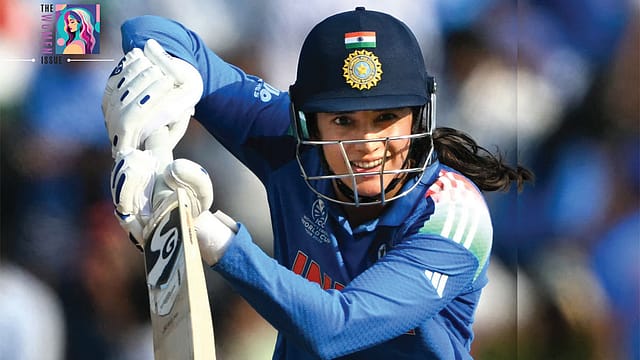
Champion’S Savvy: Smriti Mandhana, 29, Cricketer
On a June evening in Nottingham last year, Smriti Mandhana hit a major milestone: she became the first Indian woman to score an international hundred in all three formats. The T20I century— 112 off 62—was the final piece in a triptych that only the most elite batters manage to assemble. Mandhana has several records to her name, including being the fastest woman to 5,000 ODI runs and the first woman to breach the 1,000-run mark in a calendar year. She was also central to India’s maiden Women’s World Cup triumph in 2025, emerging as India’s leading scorer and anchoring the batting line-up. In a market that is increasingly expanding to include women’s sport, she is the safest blue-chip asset, technically sound and globally bankable. She does not merely open the batting. She opens the broadcast.
Captain Calling: Harmanpreet Kaur, 36, Cricketer

In February 2026, Harmanpreet Kaur became the most-capped cricketer in women’s international cricket, with 356 appearances, and a career that has outlived scepticism and administrative neglect alike. Earlier, she had captained India to its first Women’s World Cup title as the team’s tactical centre of gravity. Her batting remains muscular— she has made over 4,000 ODI runs, joining an elite group of Indian batters—but her greater achievement is stewardship. Her career spans eras, culminating in a world title that has recalibrated Indian women’s cricket, and her captaincy record in T20 Internationals ranks among the most successful globally, with India exceeding 76 wins, placing her ahead of Australia’s Meg Lanning for most victories in the format. Together, these milestones cement Kaur’s role not just as a captain but as a central architect of India’s sustained rise in global women’s cricket.
Playing to Win: Shafali Verma, 22, Cricketer
At 21, Shafali Verma has already delivered a starring performance in a World Cup final, a youth world title, and the promise of precocity. On November 2, 2025, in Navi Mumbai, Verma produced the defining performance of India’s Women’s Cricket World Cup triumph. In the final against South Africa, she scored 87 runs and claimed two wickets, earning the Player of the Match award as India won by 52 runs to secure their first world title. Her innings anchored India’s 298 for 7 and shaped the contest. Verma had entered the squad as a late replacement and converted that recall into the tournament’s most decisive display. The ICC then named her Women’s Player of the Month for November 2025.
Calm Precision: Divya Deshmukh, 20, Chess Player
In July 2025, in Batumi, Georgia, Divya Deshmukh won the FIDE Women’s World Cup and did so the hard way—through rapid tiebreaks against Koneru Humpy. The victory made her a Grandmaster and qualified her for the 2026 Women’s Candidates Tournament, compressing what is usually a decade-long ascent into one tournament run. Born in Nagpur in 2005, Deshmukh had already won the World Under-20 Junior Girls Championship and multiple Asian titles before this breakthrough. Her classical rating crossed the 2500 mark—the threshold of elite status— late last year and she became only the fourth Indian woman to earn the Grandmaster title. In a country that now produces chess prodigies with industrial regularity, Deshmukh stands out for her nerve—a world champion at 19 whose calm precision suggests that India’s future in women’s chess is no longer approaching. It has arrived.
Staying Grand: Koneru Humpy, 38, Chess Player
In a country drunk on chess prodigies, she is proof of longevity. A mainstay of Indian chess, Koneru Humpy made a dramatic comeback in December 2024, when she won the FIDE Women’s World Rapid Championship for the second time—years after motherhood, years after speculation about her decline. In 2025, she reached the Women’s World Cup final, forcing the new generation to go through her. Humpy’s game has survived eras—Soviet dominance, Chinese ascent, India’s own boom— and remains relevant. She remains one of only a handful of Indian women to have held the Grandmaster title for many years and continues to compete at the highest levels.
Lifting Medals, Mirabai Chanu, 31, Weightlifter
At the 2025 World Weightlifting Championships in Førde, Norway, Mirabai Chanu won silver in the women’s 48kg class, lifting a total of 199kg (84kg snatch and 115kg clean and jerk). This marked her first World Championship medal in three years and continued her string of podium finishes after Olympic and Commonwealth success. Mirabai Chanu’s career has, in fact, been an argument against fragility. An Olympic silver in Tokyo followed by years of injury and recalibration, then a narrow miss at the Paris 2024 Olympics, and finally a silver medal again, earned rep by rep. From a teenage lifter in Manipur who broke junior national records to a World Championships medallist, Mirabai Chanu has fashioned a career by sustained returns to the podium under escalating expectations.
Shooting Star: Manu Bhaker, 24, Shooter
In 2024 in Paris, she became India’s first multi-medallist at a single Olympic Games. That line will follow her for decades. But what sustains her relevance is the discipline that produced it: the unglamorous, daily negotiation with breath, trigger and doubt. A Youth Olympic champion in 2018, a regular presence at World Cups, a shooter who has endured equipment changes, technical resets, and the long scrutiny that follows teenage success, Manu Bhaker has built durability into her profile. At the 2026 Asian Shooting Championships, she won silver in the 25m pistol event, her first individual senior silver in that discipline, indicating growth beyond her staple 10m air pistol specialty. In a rapidly intensifying field, Bhaker continues to alter sponsorship conversations and to broaden the definition of what draws national attention.
Golden Punch: Nikhat Zareen, 29, Boxer
She boxes at 48–52kg but carries disproportionate symbolic weight. Indian women’s boxing is no longer a fringe discipline, and Nikhat Zareen stands at its centre. In the expanding ecosystem of Indian women’s sport, she is a crucial figure whose excellence is not episodic but sustained. A twotime world champion, she confirmed her standing again in November 2025 when she won gold at the World Boxing Cup Finals in Greater Noida, taking the 51kg title on home soil. She had first announced herself globally with gold at the IBA Women’s World Championships in 2022, then defended that title in 2023, a rare act of confirmation in an unforgiving 50–52kg division. Those wins moved her from prospect to standard-bearer. Now, she maintains her domestic supremacy while navigating shifting Olympic weight categories.
Fast and Steady: PV Sindhu, 30, badminton Player
PV Sindhu clocked 500 international match wins in January 2026, a remarkable milestone if you consider the attrition rate of elite badminton. Two Olympic medals, multiple world podiums, and a career lived in the glare of expectation have made her the reference point in Indian women’s racquet sport, the scale against which ambition measures itself. She has remained competitive through generational turnover in women’s singles, evolving her game as well as altering the country’s image of badminton as a sport. In a sporting era now crowded with new names, hers is a résumé that continues to define the outer limit of Indian ambition.
Speeding Through: Jyothi Yarraji, 26, Athlete
At the 2025 Asian Athletics Championships in Gumi, South Korea, she defended her 100m hurdles title, clocking a championship-record 12.96 seconds. She had already established herself as India’s national record holder in the event, the first Indian woman to break into truly competitive continental timings in a discipline long dominated by athletes from the US, the Caribbean and parts of Europe. At the 2023 Asian Games in Hangzhou, China, she was initially disqualified for a false start but was later reinstated, eventually winning silver in the 100 metres hurdles after officials’ review—an episode that tested her psychological composure in high-stakes competition. Since then, she has reverted to her eight-step rhythm between hurdles, a deliberate strategy to preserve speed and efficiency.