Women Issue 2026: Fashion: Style Statement
FASHION MAY BE FOR EVERYONE, BUT WOMEN occupy its heart—as consumers and creators. In India, where the fashion industry is but only a few decades old, women stakeholders have been instrumental in its growth from its earliest days— beginning with the pioneering interventions of designers such as Ritu Kumar or crafts revivalists such as Kamaladevi Chattopadhyay and Pupul Jayakar. Over the years, a nascent idea has burgeoned into a sprawling industry which is now beginning to command attention on global runways and red carpets. If designers are distinguishing themselves with a crafts-first aesthetics that is singularly Indian, models from the country are finding their place in a global fashion ecosystem that seeks inclusivity and authentic stories. But homegrown fashion’s biggest playground still lies here: the sprawling market that is India, where luxury goods are as coveted as contemporary India Modern style design sensibilities. Fashion is increasingly accessible, aided by technology and social media, the growing league of ambitious designers and brands and an abundance of products that leaves consumers spoilt for choice. In this ecosystem, women are thriving not only as designers, but stylists, models, business leaders, sustainability advocates and industry stakeholders, influencing the present and future of how we imagine Indian fashion, at home and in the world.
Breakout Designer: Masaba Gupta, 36, Designer and Actor
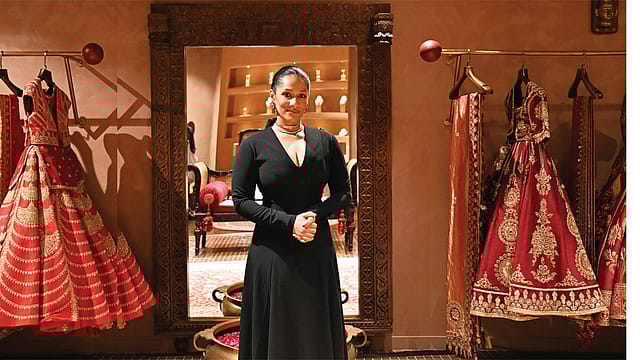
Masaba Gupta has been privy to fame long before she became one of India’s most sought-after fashion figures. Daughter of Viv Richards and Neena Gupta, who raised her as a single mother, Masaba grew up facing intense scrutiny and often, sexism and racism. The challenges didn’t hinder Masaba’s rise. In 2009, she debuted at Lakmé Fashion Week, capturing attention for her bright colours and kitschy motifs. The irreverent aesthetic continues till date when House of Masaba spans fashion, jewellery, beauty and lifestyle and the designer is striding into new categories. “It’s a brave move, both for myself and for the brand,” Masaba had told Open at the launch of her bridalwear store in Delhi last year. “The only way to do something like this is to go ahead and do it.” It is a brand as loud and proud as Masaba herself, who has lived every win and failure in the public eye.
Global Chic: Leena Nair, 56, Fashion Executive

The biggest news-making appointments at luxury fashion houses are usually creative directors; corporate roles are often behind the scenes. But when French luxury house Chanel appointed Leena Nair as its new CEO in 2021, it made a pop—she was after all the first Indian, the first person of colour and only the second woman in the role. Growing up in Kolhapur, Maharashtra, Nair wanted to be the prime minister of India. The first woman in her family to pursue higher education, she began her career at Hindustan Unilever as an intern and went on to become the chief human resources officer at Unilever— the first woman and first Asian, as well as the youngest in the role. At Chanel, Nair has driven the brand towards sustainability, gender equality and brand exclusivity. And, her accolades continue to mount: last year, she received the Commander of the Order of the British Empire.
Stars’ Choice: Anaita Shroff Adajania, 54, Celebrity Stylist
Stylist to the stars, and no less than a celebrity herself, Anaita Shroff Adajania’s clients and collaborators include India’s most famous faces, international luxury houses and an array of home-grown brands. Having started as a stylist in the Nineties, Adajania worked at major fashion magazines such as Elle India and Vogue India; her editorial flair paving the way for brand campaigns, costume styling for movies and the red carpet. Adajania is Isha Ambani Piramal’s go-to stylist, styling her for the MET Gala, Anant Ambani’s multi-ceremony event and several other events. She has also dressed Natasha Poonawalla, Hrithik Roshan, Gauravi Kumari, Kiara Advani and Jr NTR, among others. Adajania also collaborates with brands, from curating fashion showcases for Chivas to collaborating on collections with brands like Anaar. Earlier this year, fashion start-up ZILO announced a strategic partnership with Adajania, appointing her the style director. Meanwhile, magazine covers and film styling continues, including the much-anticipated Cocktail 2, directed by Adajania’s spouse, Homi Adajania.
Bohemian at Home: Anamika Khanna, 54, Designer
At their recent Udaipur wedding, Rashmika Mandanna and Vijay Deverakonda’s sumptuous ensembles sparked many a social media appreciation post. Behind the outfits was Anamika Khanna, a designer who has distinguished herself in the sprawling landscape of Indianwear with a design ingenuity that belies her lack of formal training. The Kolkata-based designer has mastered fashion on the job, honing an aesthetic that is recognisably hers—artful draping, tailoring with a hint of Bohemianism, and singular experiments with embellishment and textures. Mandanna and Deverakonda are just two stars she has outfitted lately—there’s also Jennifer Lopez, Shakira, Colman Domingo, Kareena Kapoor Khan, Ananya Panday, Ishaan Khatter and more. The usually reserved Khanna has enjoyed the spotlight in recent years, with an H&M collaboration in 2024, her prêt label AK|OK’s London Fashion Week debut in 2025 and a growing retail footprint in international markets.
Walking the Look: Lakshmi Menon, 44, Supermodel
Modelling may be a glamorous job, but it has its own challenges. Physical demands and competition aside, it is rarely a lifelong profession. How do some models endure in this fleeting pursuit? Lakshmi Menon may have an answer. Years before names like Avanti Nagrath or Bhavitha Mandava, Menon carved a niche in international fashion, booking campaigns with Hermès and Givenchy, appearing in the Pirelli calendar, and walking the runway for Jean Paul Gaultier and Tom Ford.
Now in her 40s and mother to a girl, Menon still lights up runways and editorials. “Ever since I started work as a model on international runways, I’ve always carried the conviction that while fashion is ever-evolving, it has to have a social conscience, and must respect community and culture,” she says. “To that end, both in my life as a model and as a woman, I have tried to epitomise and be conscious of both these elements. We have to build a world that is more equitable, more just, and prepared for the future.”
Storyteller: Aneeth Arora, Designer
In recent seasons, Aneeth Arora has let her brand péro do the talking, leading its creative expression behind the scenes. The lack of visibility does not diminish Arora’s impact on contemporary Indian fashion. The National Institute of Design graduate founded péro in 2009, building it into a label that situates textiles traditions in the current zeitgeist. Arora’s imagination, and the dexterity of her exceptional artisanal team, expands the possibilities of handlooms and crafts techniques. Think exquisitely crafted, whimsical collections dedicated to Hello Kitty and Alice in Wonderland, or inspired by French countryside and Scottish tartans. Arora’s design forte is coupled with her storytelling skills, her ability to create an immersive world for every collection she creates. Little wonder that today, péro finds space at fashion stores around the globe and its Handloom Modern designs are spotted on a staggering array of people, from Hollywood star Blake Lively to award-winning author Arundhati Roy.
Shaping Talents: Rhea Kapoor, 38, Stylist and Producer
When Rhea Kapoor styles someone, it becomes an exercise in taste-making, collaboration and spotlighting talent. Imagine bringing together designers Abu Jani-Sandeep Khosla with artist Jayasri Burman to dress Radhika Merchant-Ambani in a hand-painted lehenga or decking up Janhvi Kapoor in archival Prada and custom Miu Miu for international red carpet events. And then, there is a compendium worth of standout looks she has curated for her sister, actor Sonam Kapoor Ahuja, since the early days of her acting career. The sisters’ attempt at fashion entrepreneurship with the now-shuttered label Rheson may have fumbled, but they are hitmakers on the red carpet. Rhea Kapoor’s fashion sensibilities extend to the films she produces, from Aisha (2010) to Thank You for Coming (2023) or the 2024 hit, Crew, all stories in which impeccably dressed women steer the plot.
Crafting an Identity: Karishma Swali, Designer and Entrepreneur
Fashion is Karishma Swali’s family legacy. As managing director of Chanakya International, a firm founded by her father, Swali oversees an embroidery atelier working for the world’s biggest luxury brands, including Dior which—under the aegis of former womenswear artistic director Maria Grazia Chiuri—spotlighted Chanakya as collaborator for several shows. Combining her passion for crafts with women’s empowerment, Swali extended the atelier’s expertise to Chanakya School of Craft which trains underprivileged women in hand embroidery; the school has collaborated with artists like Madhvi Parekh, and is currently showcasing its first solo exhibition at Experimenter Kolkata. Swali also helms Chorus, with her daughter Avantika, a multi-disciplinary retail concept merging fashion with design, wellness and food—the label launched its first store in Mumbai last year.
Brand Brio: Tina Tahiliani Parikh, Entrepreneur
Tina Tahiliani Parikh’s journey runs almost parallel to the growth of the industry. A Stanford University alumna, she returned to India in the early Nineties and joined Ensemble—the multi-designer boutique started by her brother, couturier Tarun Tahiliani and his wife Sal.
Today, Ensemble has expanded from a single boutique to a multi-city institution showcasing both established and emerging designers. A seasoned scout for trends and talents, the incredibly stylish Tahiliani emphasises on strong curation and customer service in an increasingly competitive and changing landscape. “The industry shift that has excited me the most has been the rise of contemporary Indian fashion, using Indian crafts to make interesting, chic, wearable clothes,” she says. “For me to be relevant and contemporary, I want to support and keep alive our craft traditions and weavers.” As Ensemble enters its 40th year, Tahiliani hopes to keep doing what she loves, “to learn, to be curious and to constantly explore.”
Eco Cool: Darshana Gajare, 40, Fashion Executive
As Head of Sustainability at Lakmé Fashion Week (LFW), Darshana Gajare shapes the environmental agenda of one of India’s biggest fashion platforms. Yet Gajare had wanted to be a doctor. “When that didn’t work out, I found myself at NIFT and London College of Fashion, following what I believed was the traditional path of a career in fashion. Sustainability was never part of the curriculum. The focus was on design, production, targets, growth and yes, the glamour.” In 2015, watching the documentary The True Cost left her questioning the impact of fashion. She went on to work with Fashion Revolution India and built her own ethical fashion platform, Fairtrunk.
At LFW, Gajare and her team present sustainability as a core value and not just a curated segment. Highlights include the annual Circular Design Challenge and last year’s launch of a sustainable fashion dictionary. “For me, sustainability is not a moral obligation or an afterthought. It is a design challenge, a leadership responsibility, and ultimately, a cultural shift,” Gajare says. “And I’m hopelessly optimistic.”