Women Issue 2026: Art: Equalising the Palette
ART, ONCE CONSIDERED NICHE AND ESOTERIC, is today one of India’s most vibrant and exciting cultural sectors. Over the last couple of decades, public engagement programmes, fairs and exhibitions, galleries and initiatives have emerged in the country showcasing the works of artists from the region. On one hand, the works of the Modern Masters command record-breaking sales at auctions. Major cities like Delhi, Mumbai, Bengaluru, Kolkata, and Chennai are hubs for galleries, biennales, art fairs and museums while events like India Art Fair (IAF) or the Kochi-Muziris Biennale have helped position India as a significant participant in the global art ecosystem. On the other hand, contemporary and emerging artists at various stages of their careers are finding place in private collections and showcasing opportunities at national and international events. Artists are experimenting with materials, themes and medium which reflect social realities, political narratives, identity and belonging. In this booming ecosystem, women have played a major role—as cutting-edge artists certainly, but also as gallerists and curators, as collectors and industry stakeholders dedicated to democratising the industry and expanding its appeal among the public.
Doyenne In the Frame: Kiran Nadar, Patron
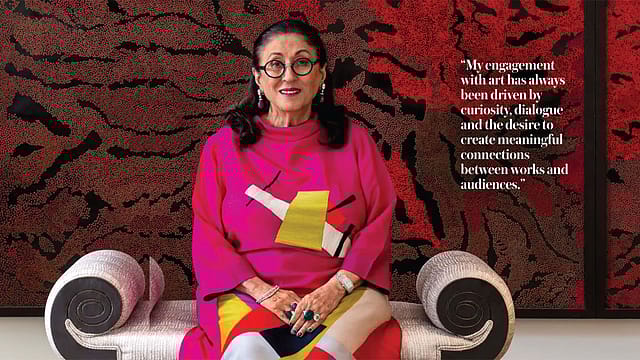
My engagement with art has always been driven by curiosity, dialogue and the desire to create meaningful connections between works and audiences,” says Kiran Nadar, philanthrophist, bridge player and, arguably, India’s most influential art collector. Nadar began to collect art as a serious pursuit in the 1990s, starting with Indian Modernists and gradually expanding to contemporary, folk and tribal art as well as interdisciplinary practices. What makes Nadar significant is not her vast collection but her initiatives to share it with the public. In 2010, she created the Kiran Nadar Museum of Art (KNMA) as India’s first private art museum, which has over the years assembling more than 15,000 works of art. The institution hosts a variety of public programmes, ranging from art exhibitions and symposiums to performance art demonstrations and engages with institutions and artists from across the globe. Coming up: KNMA’s new outpost in Delhi, slated to be one of South Asia’s largest cultural centres.
Beyond the Bindi: Bharti Kher, 57, Artist

Any mention of Bharti Kher immediately brings bindis to mind—a staple from the shringar rituals of Indian women that has become a leitmotif in her works. The bindi, which first appeared in her art in 1995, is but only one striking element in Kher’s oeuvre. Born in London, she studied painting in the UK and moved in the Nineties to India, establishing her home and studio here. Kher resists easy categorisation, moving effortlessly between painting and hybrid sculptures or installations, and experimenting with a multitude of materials from saris and broken mirrors to wheels and mannequins. A bona fide art superstar, Kher’s works have been showcased in solo exhibitions across the world, New Delhi to New York, Seoul and Shanghai to Somerset. The appeal goes beyond white cube spaces and galleries—Kher is among of the few South Asian artists to have created a Lady Dior bag reiterating the expansive possibilities of her practice.
Fair and Flair: Jaya Asokan, Impresario
Over 17 editions, India Art Fair has grown into a phenomenon that brings together artists, galleries and institutions, collectors and critics, and most importantly, the public. Director Jaya Asokan keeps calm through the intensity of realising the fair, which keeps growing bigger with every edition. A Parsons School of Design graduate, she worked with DAG and Saffronart before joining IAF in 2021, a time when Covid cast a long shadow on large-scale events. Cut to recent editions, and IAF is more than restored. Asokan has expanded the fair’s contours—introducing a design pavilion, engaging in cross-industry collaborations, spotlighting new artistic practices and strengthening regional networks with events such as AF EDI+IONS. Asokan believes in the firm’s ability to foster a culture of appreciation. “We definitely have a commercial aspect but I see us as more than that. It is also our role to educate,” she says. “Unless we do that, we cannot create the next generation of artists and collectors.”
The Mythmaker: Jayasri Burman, 65, Artist
On Jayasri Burman’s canvas, myth and memories meet. In the sprawling landscape of Indian art, her works stand out for their lush surfaces, dense and delicate line work, feminine figures painted as celestial visions, folkloric allusions and an abundance of motifs drawn from nature. Growing up in Bengal, she trained at the Kala Bhavan in Shantiniketan and at the Government College of Art and Craft, honing a distinct artistic practice and vocabulary. Over the years, she has showcased at numerous shows, both group and solos, and released publications of her works, received a number of awards and accolades and has had her work featured on a series of commemorative stamps released by the Government of India. Burman is perhaps best known for her paintings, but she has steadily expanded her use of materials and medium and explored new directions in her rpactice. Case in point: Impermanence, a solo project showcased at India Art Fair 2026 blending text with imagery and installation, dedicated to her later mother (the artist’s longstanding muse) and extending from her poetry collection, Tumi, Maa (You, Mother).
Eclectic Elan, Minal Vazirani, Collector and Auctioneer
Along with her husband, Dinesh, Minal Vazirani opened a new frontier when they launched Saffronart at the turn of the new millennium. A collector herself, Vazirani was a management consultant working across the US and Asia before she conceived of the auction house rooted in India, showcasing art from the region and strengthening its market linkages. Over the years, Saffronart has established a formidable presence with numerous auctions and highly values sales by works of master Indian artists. Vazirani has also played a key role in expanding the auction house’s repertoire to textiles, jewellery and collectibles and its footprint in international markets. More recently, she has been instrumental in setting up Art Mumbai which marked its third edition last year.
Expanding the Canvas: Renu Modi, 69, Gallerist
It was an artist who inspired Renu Modi to turn gallerist. In 1989, Modi founded Gallery Espace in Delhi on the suggestion of MF Husain, lending his creative inputs to the logo—a galloping horse. Since then, Espace has become integral to the city’s arts scene, showcasing generations of artists from Indian modernists to contemporary, genrebending names of today. Modi’s interests, be it abstraction and minimalism or sculptures and interdisciplinary practices, reflect in the gallery’s diverse programming and exhibitions. After more than 35 years in business, Modi still delights in the ability of art to surprise and amaze her. “Today, we are working with some wonderful young artists, and what really impresses me is the way they think about their mediums. They may be working with video or mixed media on paper, but what draws me in is the mind behind the work—how they look at their art, and how they look at life,” she says. “I’m interested in artists who go beyond the expected subjects and bring in other layers, including how they use craft within a contemporary expression. What excites me most is when an artist is creating their own language.”
Behind the Mask: Natasha Preenja, Artist
When Princess Pea arrived in the Indian art scene in the Noughties, a large anime-inspired headgear with big eyes and green buns covering her face, she was an instant hit. People wondered who this delightful artist was, as Pea presented innovative performances and art, collaborated with brands such as pero and Jaipur Rugs, and developed her own brand identity (cool merch included). Last year, Pea took off her mask, revealing artist Natasha Preenja in time for her first solo exhibition under her true name, at Tarq in Mumbai. Born in 1980, Preenja studied fine arts from the College of Arts, New Delhi, and conceptualised Pea as an alter-ego, who challenged notions of femininity and womanhood. Her practice, both as herself and as Pea, revolves around women— exploring domestic lives, aesthetics of care, systemic pressures and self-image, and gender discrimination. This year, Preenja became the recipient of the inaugural Swali Prize, with her work The Lotus Headed showcased at India Art Fair 2026.
Purposeful Aesthetics: Shireen Gandhy, 61, Gallerist
I see myself as mediator, to open doors, to provoke thought between the viewer and a very unique provocateur—the artist,” says Shireen Gandhy. The Mumbai-based gallerist and owner of the famed Chemould Prescott Road has spent a lifetime in the art sector, watching it grow and shapeshift from a niche to an industry. Her parents, Kekoo and Khorshed founded Chemould in 1963, and Gandhy herself joined the gallery in 1988. Under her guidance, the gallery has expanded its operations, undergone rebranding (in 2007) into the Chemould Prescott Road we know today, and represented artists such as Anju and Atul Dodiya, Jitish Kallat, Mithu Sen, Shilpa Gupta and more. The gallery takes pride in representing a large number of women artists, and Gandhy has also plays an important role in developing a culture of viewing art in her home city, collaborating with galleries and industry stakeholders to develop popular events such as Art Mumbai and Mumbai Gallery Weekend.
Big Picture: Saloni Doshi, 46, Collector
Over two decades, Saloni Doshi has built her collection of art with a keen eye and a desire to support living Indian artists. Her Space118 Art Foundation, launched in 2009, enables grants and mentorship opportunities for artists. Recently, the foundation has announced its Curatorial Research Grant for 2026, developed in partnership with Sharjah Art Foundation, while one of its grantees, artist Skarma Sonam Tashi will present his work at the Indian pavilion in Venice Biennale. The Saloni Doshi Collection is also periodically presented, through curated exhibitions, offering a glimpse of Doshi’s collecting journey. Beginning as a first-generation, young collector two decades ago, Doshi’s love for art underpins all her initiatives. She recalls times when she would be asked if she had ever made a mistake with an art acquisition. “If you love everything you buy, then what is a mistake?” she asks. “When you buy art with the purpose of passion, indulgence, and wanting a beautiful piece for yourself, there can be no mistake because its beauty will always remain.”
Spreading the Thread: Lekha Poddar, Patron
Lekha Poddar have been collecting art for decades, amassing a collection of thousands of works. Her taste and wide-ranging interests have established her as one of the country’s most important patrons. In 2005, she and her son Anupam, co-founded the Devi Art Foundation to facilitate the viewership and appreciation of contemporary art from the region. Poddar’s collection, though diverse, is particularly well-regarded for its emphasis on folk and tribal art as well as textile art— Devi Art Foundation has facilitated multiple exhibitions on textiles in recent years, spotlighting India’s diverse handlooms and crafts practices. Highly regarded in the arts sector, Poddar has been part of prestigious juries and awards programmes, and previously chaired the South Asian Acquisition Committee at Tate Modern; she continues to serve as an ember of the Tate International Council.