Women chefs are redefining the professional kitchen with the ingredients of emotion
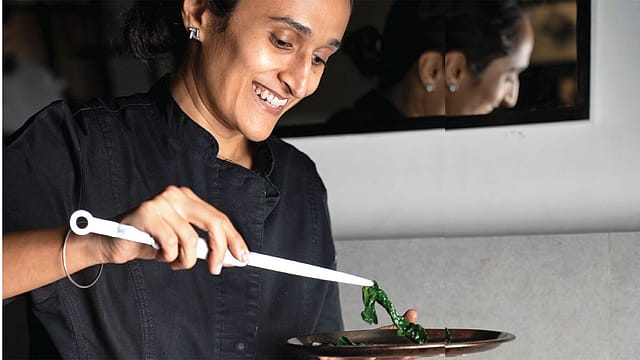
WHEN A FEMALE matriarch in the 2025 Booker-shortlisted novel by Kiran Desai The Loneliness of Sonia and Sunny is asked to share the prized recipe of her Galawati kebabs by a neighbour, her first thought is, “Why should we hand over the secrets of our kitchen for no reason?” Just like this matriarch, who painstakingly supervises the step-by-step procedure of cooking the melt-in-your-mouth variety of North Indian meatballs, down to counting each exquisitely hand-rolled kebab, lest one go unaccounted for, there are countless others working tirelessly to create culinary masterpieces in millions of Indian kitchens spread across the country’s vast length and breadth.
Women have always displayed exemplary culinary skills—as anyone wistful about their “maa ke haath ka khaana” will attest— but till recently, only a meagre number of these gifted and talented cooks reached the ranks of the top chefs and food entrepreneurs in the country. This is evident from a 2019 report by the National Restaurant Association of India which showed that women comprise only 10 per cent of the leadership positions in the food service industry. After all, a patriarchal society finds it tough to accept them as leaders in a job that is provided as free labour in homes. Even those that do break the glass ceiling encounter problems like gender-based pay gaps, achieving a healthy work-life balance between professional commitments and raising a family, fighting gender stereotypes of being the ‘gentler’ sex, and more.
Fortunately, in the years since that survey, things have changed. Women chefs now navigate professional kitchens with ease and are increasingly coming into the spotlight with their own restaurants and ventures. Chefs like Anahita Dhondy, Doma Wang, Niyati Rao and Garima Arora, India’s first female chef to earn the coveted Michelin star for her Bangkok-based restaurant Gaa, have become worthy role models for others to emulate, as they move from working in professional kitchens to helming their own.
Chef and co-founder of popular Delhi eateries Plats, Chard, Genre, and Savage/Painkiller (a dual concept that transitions from a daytime sandwich spot to an evening bar), Hanisha Singh’s culinary journey began in her grandmother’s kitchen. “That’s where the need to cook and to feed people first took root,” she recalls. She built her early career in hotel kitchens like that of the Oberoi group, and later by heading Impresario’s Smoke House Deli where she learnt the discipline and rigour demanded by professional cooking.
The desire to strike out on her own led to her establishing “My Little Food Company” or MLFC in 2012, where she conducted cooking classes and catered for intimate gatherings, before expanding to restaurant and menu consulting. She also worked as a chef consultant for KitchenAid across the Asia-Pacific region during this time.
“Conceptualising menus, training teams, and opening over 20 restaurants across the country taught me as much about running a business as it did about cooking,” she shares. The turning point came in 2019, when she opened Plats with her partner in career and life, Jamsheed Bhote.“I’ve been a chef, consultant, cooking instructor, business owner, and creative director all at once,” she smiles. This variety of roles may have proved a deterrent to many, but Singh believes women are naturally inclined to think across disciplines. “When I’m creating a new restaurant concept, I’m simultaneously thinking about the food, the story behind it, building that brand identity, the space, the service, and the guest experience as a whole. That holistic thinking is something I consider an advantage, and I think it comes quite naturally to many women in this field.”

For chef, educator and founder of Goa’s famed Edible Archives, Anumitra Ghosh Dastidar, being a woman in the culinary space is definitely an advantage. It is the women of the household, after all, who are exposed to the secrets of the kitchen from a very young age. “Knowledge acquired in one’s childhood absorbs better,” she explains. This coupled with women’s inherent detail-oriented nature generally make them better chefs, in her mind.
GHOSH DASTIDAR’S INTEREST in food goes beyond it being a mere means of sustenance. She is drawn to its origin and provenance. Edible Archives, which she began with partner, Shalini Krishan, is simultaneously a restaurant and research project, first presented at the Kochi-Muziris Biennale in 2018. The initial mandate was to catalogue and profile 40 varieties of indigenous rice grains from Kerala. Later, it evolved to a restaurant located in a Portuguese-style house in Anjuna, where the food is ingredient-driven and made from an anthropological lens.
Damini Ralleigh, co-founder of indica in Delhi, also doesn’t ascribe to the traditional definition of a chef. Her experiential dining space, which she opened with Sandeep Garg, focuses on rethinking how cuisine is presented, contextualised and experienced. Ralleigh initially worked as a journalist and food critic in Delhi. Pursuing a Master’s degree from the University of Gastronomic Sciences in Italy led her to a stint with the Slow Food Movement, and eventually to founding indica. Her multitude of experiences has given her an interesting perspective.
“I feel the old hospitality model is giving way to something a little more thoughtful, a little more culturally aware,” muses Ralleigh.“indica was never conceptualised as a conventional fine-dining space and it certainly wasn’t built for speed. We were never bothered with scale but guests have consistently shown up for these experiences and encouraged us to continue on our mission. That tells me the change isn’t happening in isolation.” Ralleigh asserts that the female founders of newer culinary ventures are evolving because diners are evolving. “There is something about the female lens that allows for this expansion.”
Chef Sneha Singhi Upadhaya from Kolkata had a more conventional journey in the field, beginning by helming nine outlets of her Paris Café across the city. The pandemic shut them down, but opened other doors instead. She embarked on a journey to creating culinary content on Instagram, amassing over a million subscribers, becoming a sought-after food and beverage consultant, and launching her own set of kitchen tools under the brandVelora, designedtocaterspecificallytomodernIndianhomes.
Upadhaya credits her adaptive nature and willingness to explore newer concepts and accept change as a woman, as the reason for her success. “Women are more creative, hardworking, passionate and involved in their business as compared to men, but we also have self-doubts and question everything. It feels like we need to take the extra step to prove ourselves and succeed. Personally, I don’t micromanage and give my team the creative freedom to express themselves, which has only made my business grow,” she shares.
These talented culinary entrepreneurs have faced their fair share of misogyny while building their multifaceted practices from scratch. Ralleigh recalls, “I’ve been in rooms where people assume that I’m the marketing person before they assume I’m the co-founder. You have your authority questioned in ways that your male counterpart just doesn’t.” Upadhaya remembers needing to assuage the apprehensions of her father before pursuing the culinary arts. “Now, he is one of my biggest supporters,” she shares. Singh blames the culture that has historically pervaded professional kitchens built around hierarchy, physical endurance, and a certain kind of machismo.
FOR GHOSH DASTIDAR, the solution to this problem was seeking mentorship from talented women, instead of turning to men. Being acutely aware of the asymmetry in power, and actively working to address it is Ralleigh’s way of dealing with it. “I built my brand with the intention of taking my entire team forward. I’m less interested in standing on top of one and more interested in how I can empower the people who work with me. I feel that women have the profound ability to hold vision and empathy in the same hand.They can be commercially sharp and emotionally intelligent at the same time. Being a woman has made me more expansive in how I define power.”
Another innovative contribution of women in professional kitchens has been to focus on local instead of global, humble instead of splashy, and instinct-led instead of trend-led. What Ralleigh describes as the ‘Frenchification’ of our food, which has long been measured against Western benchmarks is finally being challenged. Young and visionary chefs are recognising the importance of our temple cuisines, community feasts, indigenous fermentation practices and agricultural wisdom.
Singh points to another interesting trend. “There’s a growing movement of cuisine-agnostic restaurants—and I include Plats in this— where the menu isn’t bound by geography or tradition. We take inspiration from everywhere, cook whatever excites us, and let flavour lead. It’s robust, it’s honest, and it has no interest in fitting into a box.” That freedom, according to her, is producing some of the most interesting food being made right now, anywhere in the world.
It is evident that today women are taking over kitchens, major culinary entrepreneurial ventures, peripheral paths adjacent to the culinary arts, and winning accolades along the way. But Singh believes this was always the case. The biggest change is an acknowledgement by the industry that women have always been there, doing the work. “That visibility matters because it makes the path easier for the next generation,” she declares.