Winter Is Coming, So Is Bad Air
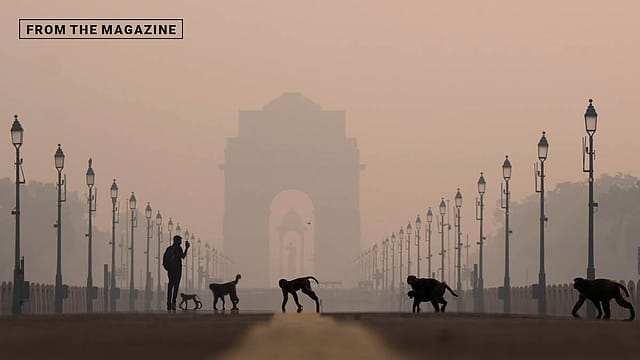
As the monsoon retreats across northern India, slowing winds and falling night temperatures have already set the stage for an early onset of its infamous winter pollution season. The Delhi government’s announcement of its newest pollution mitigation plan for the expected peak season on September 28—fine-tuned from a bold new series of measures first announced in April—is better than any previous winter action plan and should have given at least the capital city some hope. But despite being more proactive, science-based, and enforcement-oriented compared to the usual hurriedly cobbled-together reactive measures of early years, this winter’s plan is also unlikely to bring any real relief to Delhi and its neighbouring areas.
This is because the plan has no control over two pivotal factors that contribute to more than two-thirds of Delhi’s winter pollution spikes: smoke drifting downwind from the neighbouring states of Punjab, Haryana, Uttar Pradesh (UP), and Rajasthan from farmers illegally burning crop stubble, and unrestrained Deepavali firecrackers. Worse, these anthropogenic factors are likely to overlap this year, with both their peak levels coinciding in a “perfect storm” in early November, around Deepavali.
As far as crackers are concerned, Chief Minister Rekha Gupta could easily have enforced a complete ban at least in Delhi. Last year, she was the one who had petitioned the Supreme Court to allow people to burst “green” crackers, leading to the first spike of the season. And this year, even without being petitioned, a two-judge Supreme Court panel has already rejected a total ban on firecrackers around the upcoming Deepavali festival saying that could “hurt the sentiments of people.” However, between the fires and firecrackers, it is much more than people’s sentiments that will be hurt. Lungs, heart and other organs of nearly half-a-billion people of northern India will suffer additional damage from inhaling this toxic cocktail of chemicals, an annual episodic spike that drives increasing droves of patients to doctors and hospitals every winter.
As for regional crop residue fires, which have already started in some areas according to satellite imagery, they are projected to intensify around Deepavali in early November, coinciding with the chemical-laden smoke from nearly half-a-billion people in the Indo-Gangetic plain bursting conventional crackers.
Any serious attempt to prevent this man-made crisis will require all northern state governments to synchronously focus on lowering local emissions—pollution has no geographic boundaries. The most critical first steps, if they are serious at least about reducing winter pollution peaks, should include strict enforcement of a complete ban on all firecrackers and an aggressive crackdown on agricultural burning this winter, neither of which looks likely at present.
Only one of those state governments—Delhi—has announced a robust winter pollution action plan targeting critical multi-sectoral sources of pollution as yet. The fact that the Delhi government first announced it in April, well ahead of winter spikes, and based it on atmospheric science is an important marker of its seriousness about combating pollution. This, combined with subsequent interim announcements indicating a stronger focus on electric mobility, public transport, and better solid waste management, and followed by a final, fine-tuned winter plan reiterated last week, demonstrates Delhi’s commitment and resolve. None of the other northern neighbouring states of Haryana, Rajasthan, UP, and Punjab, some with cities with equally toxic pollution levels, has bothered to create a similar, coordinated, proactive scientific pollution mitigation plan, although newspapers are reporting scattered enforcement of some of those measures in two immediately adjoining states that form part of the National Capital Region (NCR) to lower emissions and focus on stricter compliance.

This doesn’t augur well for Delhi, whose own assessment “has shown that 30% of the city’s pollution is generated within Delhi and its immediate neighbourhood, while approximately 60-65% comes from or is influenced by surrounding areas,” according to last week’s press release quoting its Environment Minister Manjinder Singh Sirsa.
A government technical report by the Indian Institute of Tropical Meteorology indicates that the first winter high-pollution episode happens around stubble fires peaking—and on the worst days, nearly 50 per cent of Delhi’s pollution can come from these fires. “This underscores the significant role that stubble burning plays as a source of both primary and secondary pollutants, affecting not just the local regions of Punjab and Haryana but also distant locations such as Delhi.” (‘Assessment of GRAP implementation on Air Quality in Delhi’, from the Indian Institute of Tropical Meteorology.)
The reason why fires and firecrackers have an outsized impact on pollution at this time of year is because smoke from all that anthropogenic burning gets trapped at ground level due to the phenomenon of winter “thermal inversion”, in which warm air acts as a lid that traps cold, polluted air close to the ground. At the same time, the mighty Himalayan range in the north acts as a barrier, effectively sealing in this toxic smog over the Indo-Gangetic plain, smog that is inhaled by nearly half-a-billion Indians.
With experts further highlighting that the Super El Niño effect could reduce rain-causing western disturbances, North India’s geographical and brewing meteorological misfortune—layered with anthropic smoke—won’t even get the temporary benefit of pollutants getting washed away.
Unfortunately, all these factors mean that despite Delhi’s latest science-based plan that includes curbs on construction, tighter checks on industries and vehicles, better enforcement of open waste burning, higher parking charges, staggered office timings and work-from-home mandates—all of which should bring down at least some of the capital’s base pollution load—its residents are still unlikely to get respite from the hazardous winter pollution peaks, since the first pollution spike will come from the farm fires intensifying around the same time as Deepavali firecrackers are burst.
Punjab Inaction in Election Year
Farmers have already started setting fire to paddy stubble standing in the fields after this year’s harvest. This is something they do each year as the quickest way to turn around their fields in the narrow window between harvest and the new sowing season. Satellite data compiled by the Indian Agricultural Research Institute tracked early incidents across multiple states in September 2026. Punjab recorded 25 fires, followed by UP with 19 and Haryana, Rajasthan, and Madhya Pradesh one each. These will soon rise, despite the carrot-and-stick approach of the state governments—subsidies to farmers to use machines for crop residue management (CRM) and penalties, a combination of financial fines, police reports, and adverse “red” entries in their land revenue records—for lighting up post-harvest crop residue.
Punjab has historically had the highest crop stubble fires. When the Aam Aadmi Party (AAP) was governing Delhi, it would routinely blame Punjab farmers for Delhi’s pollution. Congress then governed Punjab. Once Congress lost Punjab to AAP in February 2022, AAP went silent on Punjab fires’contribution to Delhi’s pollution. For the three winters it was in power in both Punjab and Delhi (winter 2022, 2023, 2024), AAP dashed the hopes of its pollution-activist supporters by not only failing to control Punjab farm fires but also avoiding strong, decisive action despite having a popular mandate in both states and all necessary wherewithal. And when AAP lost Delhi to the Bharatiya Janata Party (BJP) in February 2025, it found itself at the receiving end of the same blame it had meted out to Congress.
With Punjab due for its Assembly elections in February 2027, its AAP government is unlikely to be very strict in penalising farmers who provide the bulk of voters in the primarily agrarian state.
Haryana Manages Stubble Better
Field researchers and experts note that Haryana has historically managed its crop stubble better than Punjab. There are two reasons for this: Haryana grows a larger percentage of basmati as compared to Punjab, and basmati stubble, being more nutritious and digestible, makes better cattle fodder; thus it doesn’t need to be burnt. However, the Punjab rice varieties have more silica, which makes them less welcome as fodder (and also tougher for the machines to cut and grind down). Second, Haryana seems to be doing a better job of distributing its CRM subsidies and providing additional direct cash subsidies, which helps it manage crop residue better. Furthermore, Haryana farmers have also tended to be more compliant with existing restrictions, perhaps because penalties are also enforced, a senior researcher who has done fieldwork in both states said.
On the other hand, the Punjab government administers its subsidies differently, focusing more on machine subsidies than direct cash benefits. Additionally, with Punjab preparing for its Assembly elections in February 2027, the governing AAP is unlikely to penalise farmers strictly, since they are its base of support. As pre-poll canvassing will be in full swing, other political parties will also likely hold back from pressuring the government on stricter penalties.
While Punjab also offers subsidies to farmers to buy or lease machines to grind rather than burn crop residue, these have proven to be less effective than incentives offered by other states in the form of direct cash benefits.
“Haryana has done a much better job in administering its subsidies,” a Delhi-based think-tank researcher who conducts fieldwork in both states concluded. The Supreme Court has even asked Punjab to take a cue from Haryana’s example of managing its paddy stubble and subsidy management.
In effect, Punjab’s upcoming 2027 election could leave the state’s 2026 farm fires out of control, costing North Indian residents poorer health outcomes from downwind smoke, especially if it overlaps with the chemical-laden smoke of Deepavali firecrackers.
Meanwhile, Punjab farmers have already learned to evade satellite detection by burning late in the evening.
Drones to Detect Fires
Fire counts across northern states are becoming unreliable as farmers have learnt to circumvent the twice daily (13:30PM and 01:30AM) geospatial satellite circumnavigation. Most fires in Punjab are now lit after 5PM, say field researchers. There have been conflicting reports on how much reduction in crop stubble burning the government has actually achieved over the years. The Union government-appointed Commission on Air Quality Management (CAQM) itself has pointed out that farmers are burning crop residue late in the evening in order to evade satellite-based detection and this “requires close attention and calls for a strengthened surveillance and monitoring mechanism”.
Calling stubble-burning prevention an “urgent priority”, the commission has, for the first time, asked states to use drones to detect farm fires promptly, which is likely to provide more reliable data through ground-based monitoring and stronger inter-agency coordination.
“Reducing these episodic pollution spikes depends on precise, timely detection of burning events, robust surveillance and coordinated enforcement,” the CAQM said on its website.
The commission has also asked the Indian Space Research Organisation (ISRO) to improve accuracy in analysing burnt areas with regard to stubble burning, and differentiate between “high”, ”medium” and “low” intensity fires by making changes to its methodology and models. The satellites and models used presently cannot differentiate between the nature of fire, whether it is a large fire or a small localised fire.
These directives, if followed through meticulously, could help detect winter fires more precisely, especially if coordinated with satellite data. This would help better enforcement and fairer penalties and help prevent future events.
Focus on Proactive, Scientific Measures
Both the April and September press releases highlight the Delhi government’s sharp focus on limiting vehicular emissions by promoting year-round electric mobility, curbing the entry of older, more polluting combustion-engine vehicles during seasonal peaks, and enforcing laws against open waste burning.
This year’s annual suite of winter air pollution mitigation measures, mirroring protocols from previous years include partial or complete bans on construction and demolition, a doubling of vehicle parking fees, staggered office timings, and a 50 per cent work-from-home mandate for both government and private offices starting November 1. These restrictions will remain active through the winter months until January. Additionally, the Delhi government intends to “further strengthen” enforcement mechanisms that restrict fuel access to vehicles lacking a valid Pollution Under Control (PUC) certificate. Crucially, however, standard PUC certification completely excludes the critical and highly toxic PM2.5 (microscopic particulate matter) as well as Nox (Nitrous Oxides) from its testing parameters.
The government press release said it will also intensify deep cleaning operations to reduce dust and crack down on open waste burning. The text repeatedly emphasised the administration’s core focus on “prevention, preparedness, and accountability”.
Yet, none of the announced measures was fundamentally new. The only novel disclosure is that Delhi will add 13 continuous ambient air quality monitoring stations, bringing the city’s total to 60. While an expanded network undeniably strengthens monitoring, data collection does not automatically translate into an actual reduction in emissions, which remains the only definitive way to lower pollution. The additional monitors will facilitate “more granular monitoring of pollution levels and faster identification of local hotspots”. However, given that the capital already has one of the densest air-quality monitoring networks among major global urban centres, it remains unclear how this expansion will significantly reduce smog. This scepticism is compounded by the fact that existing monitors often mysteriously stop working during peak pollution days. Furthermore, local media and citizens have documented heavy-duty, truck-mounted water sprinklers circling these stations to artificially lower readings. Still, the press release maintains that “the Government intends to use this expanded monitoring infrastructure not merely for data collection, but for targeted enforcement and faster field-level response.”
This is still better than previous attempts at controlling pollution when the focus was more on optics like smog towers and water spraying machines. And this time, the state governments have the support of the Centre. Even the CAQM has been more proactive than usual. In addition to directing states to use drones for more effective surveillance and detection of fires, it said on October 6 that it has proposed to the Delhi government to ban vehicles in downtown Connaught Place and redesign it to make it more pedestrian-and-cycle-friendly. This could be a starting point for “clean air” or low-emission zones. On October 5, the CAQM said it has deployed flying squads to monitor stubble burning in Punjab and Haryana. It has revamped, strengthened, and made more proactive the Graded Response Action Plan (GRAP) which bans local pollution-generating activities.
Unfortunately, since GRAP only affects local pollution sources, it won’t be effective in reducing the first pollution peak which will come mainly from drifting smoke. However, it will come in very useful for the second spike, which usually happens in December when temperatures dips to seasonal lows and biomass burning for heating intensifies.
However, the fact that the CAQM itself issued an advisory to the governments of Delhi, Haryana, Rajasthan, and UP, asking them to ensure no physical sport activities or sport competitions take place at schools during November and December, makes it clear that it doesn’t expect pollution controls to be very effective. The focus needs to shift from merely announcing stringent controls to strict enforcement of existing policies.
While the Delhi government has undeniably been proactive in its mobility policies—particularly regarding EV adoption—enforcement remains conspicuously weak for other critical emission-reduction strategies. This includes the failure to effectively tackle open burning, including both agricultural stubble and municipal biomass, or to stringently enforce the ban on firecrackers, which generate a massive share of the toxic load during the four peak days of Deepavali and are structurally far easier to restrict and contain. Other northern states are even worse.
Unless the most stringent of pollution controls are strictly enforced, all over northern India, the needle won’t move enough to significantly reduce the levels of disease, disability and death air pollution triggers.
(Jyoti Pande Lavakare is a journalist and the author of Breathing Here Is Injurious to Your Health: The Human Cost of Air Pollution. She also co-founded clean-air nonprofit Care for Air)